On this page
It is also one of the few invitations that the children send. Often they are the ones organising it, sometimes from abroad, for parents who would never throw a party for themselves. This page explains what the day involves, who should be named, what goes on the invitation, and gives wording in English, Hindi, and the styles Telugu, Tamil and Kannada families use.
What Shashtipurti is
Shashtipurti, also written Shashtiabdapurti, Sashtiabdapoorthi or Shashti Poorthi, means the completion of sixty years. Sixty is one full turn of the Hindu calendar's cycle of sixty years, so the person has lived through every year of the cycle once. In Tamil families the celebration is also called Manivizha.
It is a religious ceremony with a muhurat, usually in the morning, followed by a meal, not an evening party. Most often it is held for the husband's sixtieth, with his wife beside him through the rituals, and many families make it a renewal of the marriage: new clothes for the couple, a new mangalsutra tied by the husband, and the children and grandchildren in the places the wedding guests once sat.
What usually happens on the day
- Ganapati puja, to begin without obstacles.
- Homams for long life and health, often the Ayushya and the Mrityunjaya homam, and the Navagraha homam for the nine planets.
- Kalasha abhishekam, when water sanctified in the kalashas during the homam is poured over the couple.
- The mangalya dharanam, the husband tying a new mangalsutra, and an exchange of garlands, in families that renew the marriage.
- Blessings from the elders and the priests, then the meal.
Temples hold these ceremonies too. The Abirami temple at Thirukadaiyur in Tamil Nadu is known for sixtieth and eightieth ceremonies, and temples abroad perform them as well: the Sri Siva Vishnu Temple in Maryland, for one, lists the service and asks families to bring a new dhoti, sari and mangalsutra as their tradition requires.
When it is held
Not always on the birthday in the passport. Many families hold it once the sixty-first year has begun, on the day of the person's birth star, the janma nakshatra, in the month of their birth by the Hindu calendar. That day can fall days or weeks away from the calendar birthday. Others choose a convenient auspicious date close to it.
The family priest fixes the date and the muhurat. Do not print either until the priest has, and if relatives are travelling, ask for the date months ahead so they can book.
Who hosts, and how to say it
The children host. The invitation goes out in their names, or in the whole family's, inviting guests to bless their parents. If the couple's own brothers and sisters are hosting, which happens when the children are young or abroad, use their names the same way.
| Who is inviting | How it opens |
|---|---|
| The children | We, [children's names], invite you to the Shashtipurti of our father [Name], with our mother [Name] |
| The whole family | The [Surname] family invites you to the Shashtipurti of [Name] and [Name] |
| Children and grandchildren | With love from [children's names] and [grandchildren's names] |
| The couple themselves | Rare, but some prefer it: [Name] and [Name] invite you on the occasion of... |
Grandchildren's names are a lovely addition at the end. If one of the couple's own parents is alive, put their blessing line at the top, as you would on a wedding card.
The key lines in Telugu, Tamil and Kannada
South Indian invitations, whatever the occasion, lean on the same few courtesies: the occasion and when it takes place, a request to come with the whole family, and a request for blessings. The samples below use these lines, written in Roman letters.
| Language | The line | What it means |
|---|---|---|
| Telugu | Shashtipurti mahotsavam ... jarugunu | The Shashtipurti celebration will take place |
| Telugu | Meeru sakutumba saparivaara sametamga vichchesi | Please come with your whole family |
| Telugu | aaseervadinchavalasindiga koruchunnamu | We request you to bless them |
| Tamil | Sashtiapthapoorthi (Manivizha) ... nadaiperugiradhu | The sixtieth celebration takes place |
| Tamil | Thaangal kudumbaththudan vandhirundhu | Come with your family |
| Tamil | vizhavai sirappikkumaaru anbudan azhaikkirom | We lovingly invite you to grace the occasion |
| Kannada | Shashtyabdapurti samarambha ... nadeyalide | The Shashtyabdapurti will take place |
| Kannada | Taavu sakutumba sametaraagi aagamisi | Please come with your whole family |
| Kannada | aashirvadisabekendu vinanti | We request your blessings |
What goes on the invitation
- The occasion, in your family's word for it. Shashtipurti, Sashtiabdapoorthi or Manivizha. Elders look for the word they know.
- Both names. The person turning sixty, and the spouse who sits with them.
- The muhurat, written plainly. If it is 7:30 in the morning, say so twice. Morning ceremonies are the ones guests arrive late for.
- The rituals, in order, with a time for each if the priest has given them: the homam, the abhishekam, the mangalya dharanam.
- The meal, with its time.
- The venue, with a map. A temple, a kalyana mandapam or a hall, with a line on parking.
- Dress, if you would like traditional clothes. Many families ask for them.
- Gifts. If your parents would rather have none, say 'Your blessings are the only gift we ask for'. Guests are often unsure what to bring to a sixtieth.
- The children's numbers, for relatives coming from out of town.
When the children live abroad
Children who live abroad organise many of these, often with the ceremony in India and themselves flying in for a week. The invitation has to work for relatives in India who will come, for friends abroad who will not, and for parents who should not have to deal with any of it.
- A message the parents can forward. Send them a short line with the link that they can paste to their own friends, from their own phone. Elders trust a message from someone they know.
- A video for relatives who will not tap a link. The 4K video of your invite (₹1,100) turns the invitation into a short film with your music, in 4K and as a light 720p for WhatsApp.
- India's time on the invitation, theirs in the message. Write the muhurat in Indian time. When you send it to friends abroad, add their time in your message; the guide for guests abroad has a time zone table.
- Paying from abroad. Invifest's prices are in rupees, and a card from outside India pays through Razorpay; the checkout adds the gateway's 3% and the GST on that fee before you pay.
If your parents live with you abroad, the invitation may travel the other way: to relatives in India who will follow the day on WhatsApp. Put the city and the local time first, and India's time beside it.
70th, 80th and the other milestones
The same families often mark the later milestones the same way. Bhimaratha Shanti is held at seventy years and seven months in many traditions, and Sadabhishekam when a person has seen a thousand full moons, at around eighty years and eight months. Their invitations follow the same pattern: a muhurat, the rituals, then a meal.
The birthday guide lists these milestones, and the anniversary guide covers the silver and golden jubilees that children also organise for their parents.
A digital invitation for the sixtieth
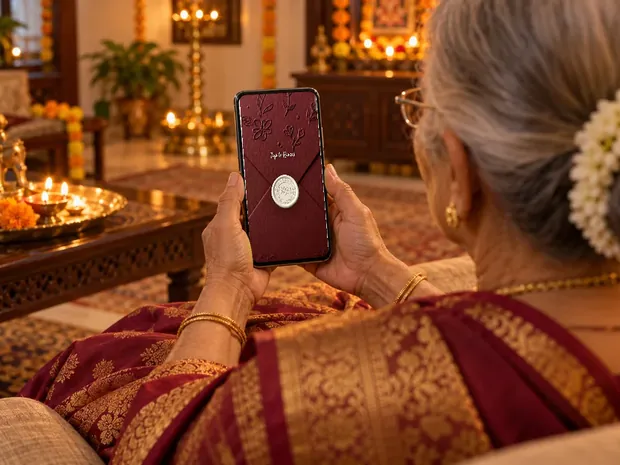
Our Yaadein design is built as a photo wall, which suits a sixtieth: the couple's wedding photograph beside a recent one, the muhurat and the venue with a map, and an RSVP so you know how many to cook for. It is made by hand from your details, with two rounds of changes, from ₹2,499. The wording can be in English or Hindi; for another language, ask us on WhatsApp before you order.
Wording you can copy
English first, then Hindi, then lines in the style Telugu, Tamil and Kannada families use, written in Roman letters the way most families type them on WhatsApp. If yours is printed in Telugu, Tamil or Kannada script, ask an elder to check the spellings. Change everything in [brackets].
Shree Ganeshaya Namah
With the blessings of the Almighty,
we invite you to the
Shashtipurti
of our father
[Father's name]
with our mother [Mother's name]
[Day, Date]
Muhurat: [Time] in the morning
[Venue]
Lunch will follow.
[Children's names]
Sixty years, and still the first to wake up in the house.
We are celebrating our father [Name]'s Shashtipurti with our mother [Name], and we would love you there to bless them.
[Day, Date] · Muhurat [Time]
[Venue]
Lunch from [Time]
With love,
[Children's names]
Sashtiabdapoorthi of
Sri [Name] and Smt. [Name]
[Day, Date]
[Venue]
Ganapati puja: [Time]
Homam: [Time]
Kalasha abhishekam: [Time]
Mangalya dharanam: [Time]
Lunch: [Time]
Your blessings are the only gift we ask for.
Namaskaram [Name],
We are celebrating Appa's Shashtipurti on [Day, Date], with the muhurat at [Time] at [Venue].
Please come and bless Amma and Appa. Everything is on this link: [link]
[Your name]
Namaskaram [Name],
Thank you for your time on the phone. As we said, Appa's Shashtipurti is on [Day, Date] at [Venue], with the muhurat at [Time].
Your blessings mean the most to them. The invitation, with the map, is here: [link]
॥ श्री गणेशाय नमः ॥
हमारे पूज्य पिताजी श्री [नाम] एवं माताजी श्रीमती [नाम]
की षष्टिपूर्ति के शुभ अवसर पर
[दिन, तिथि] · प्रातः [समय]
हवन एवं पूजन: [समय]
भोजन: [समय] से
स्थान: [स्थान]
आप सपरिवार पधारकर आशीर्वाद प्रदान करें।
निवेदक: [बच्चों के नाम]
Shree Ganeshaya Namah
Hamare pujya pitaji Shri [Naam] evam mataji Shrimati [Naam]
ki Shashtipurti ke shubh avsar par
[Din, Tithi] · Pratah [Samay]
Havan evam Pujan: [Samay]
Bhojan: [Samay] se
Sthaan: [Sthaan]
Aap sapariwar padharkar aashirwad pradan karein.
Nivedak: [Bachchon ke naam]
Sri [deity's name] anugrahamuto
Maa nannagaru Sri [Name] garu, ammagaru Srimathi [Name] garla
Shashtipurti mahotsavam
[Day, Date] na [Venue] lo jarugunu.
Meeru sakutumba saparivaara sametamga vichchesi, maa thallidandrulanu aaseervadinchavalasindiga koruchunnamu.
[Children's names]
Engal anbu thanthaiyar Thiru [Name] avargalukkum
thaayar Thirumathi [Name] avargalukkum
Sashtiapthapoorthi (Manivizha)
[Day, Date] andru [Venue]-il nadaiperugiradhu.
Thaangal kudumbaththudan vandhirundhu vizhavai sirappikkumaaru anbudan azhaikkirom.
[Children's names]
Namma tande Sri [Name] mattu taayi Srimati [Name] avara
Shashtyabdapurti samarambha
[Day, Date] randu [Venue]-alli nadeyalide.
Taavu sakutumba sametaraagi aagamisi, aashirvadisabekendu vinanti.
[Children's names]
Our grandparents are celebrating sixty years of Thatha.
Please come for the Shashtipurti on [Day, Date], muhurat at [Time], at [Venue], and stay for lunch.
From [grandchildren's names], who are in charge of the photographs.
Amma and Appa have asked for nothing but your presence and your blessings.
Please, no gifts.
[Day, Date] · Muhurat [Time]
[Venue]
Want these words on a real invitation? See the designs.
Birthday invitation designs
1 design you can personalise, from ₹2,499. Open any one to see it full size, with a live demo.


Questions people ask
What is Shashtipurti?
The ceremony that marks the completion of sixty years, one full turn of the Hindu calendar's sixty-year cycle. In many South Indian families it includes homams for long life and a renewal of the couple's marriage, with a new mangalsutra, followed by a meal.
Who sends the Shashtipurti invitation?
Usually the children, in their names or the whole family's, inviting guests to bless their parents. Grandchildren are often named at the end.
Is Shashtipurti held on the exact 60th birthday?
Not always. Many families hold it after the sixtieth birthday, once the sixty-first year has begun, on the day of the birth star in the birth month by the Hindu calendar, which can differ from the calendar birthday. The family priest fixes the date and the muhurat.
What should a 60th birthday invitation include?
The occasion by the name your family uses, both names, the muhurat, the rituals in order, the meal, the venue with a map, any dress or gift guidance, and the hosts' names and numbers.
Can we send a digital invitation for Shashtipurti?
Yes. Invifest's Yaadein design suits a sixtieth: a photo wall with the muhurat, the venue and a map, and an RSVP. It is made by hand with two rounds of changes, from ₹2,499.
What is Manivizha?
The Tamil name for the sixtieth celebration, the same occasion as Shashtipurti or Sashtiabdapoorthi.