On this page
There is a simple way through, and couples we work with use it every month. This page sets it out: two versions or one, invocations side by side, languages, explaining rituals to the other side, a design that belongs to both families, and wording you can copy.
Putting two invocations side by side
Most Indian invitations open with a prayer. When the families pray differently, each version can open with its own, or a shared invitation can carry both, each in its own script and at the same size.
| Faith | A usual opening |
|---|---|
| Hindu | Shree Ganeshaya Namah, or Om |
| Sikh | Ik Onkar (ੴ), or Waheguru Ji Ka Khalsa, Waheguru Ji Ki Fateh |
| Jain | Namo Arihantanam |
| Muslim | Bismillah ir Rahman ir Raheem |
| Christian | A verse from the Bible, often 1 Corinthians 13 |
| For both | With the blessings of God and our elders |
A real case from October 2026: a Hindu groom and a Sikh bride. His version opened with Om and 'Om Shri Ganeshaya Namah'; hers opened with Ik Onkar and carried Punjabi wording. Each family's elders saw their own first line, and the two invitations still looked like one wedding.
On a shared invitation, agree the order before anything is designed. One Punjabi and Maharashtrian couple's card opened with the Khanda and then Ganesha, with a line of Gurbani in Gurmukhi, the same line in Devanagari, and its meaning in English beneath.
Languages: who reads what
Language follows the elders. Grandparents read the invocation, their own names and the family list most carefully, so those go in the script they read: Devanagari, Gurmukhi, Tamil, Bengali. English carries the practical parts, the dates, times, venues and maps, because both families can read it.
- Hindi and Punjabi. Devanagari on one version, Gurmukhi on the other, English on both.
- Tamil or Telugu with Hindi. The muhurtham and the family names in the South Indian family's script on their version, Devanagari on the North Indian family's, English on both.
- English as the bridge. For a shared invitation, English for the body, with each family's invocation and names in its own script.
Whatever the mix, a guest reading one language should not meet the other in the middle of a sentence. Keep each view, or each version, in one language from top to bottom.
Explaining the rituals to the other family
Half your guests will be seeing the other family's rituals for the first time. One plain line under each function, saying what happens and how long it takes, makes them feel included rather than lost.
- Haldi. Turmeric paste is put on the bride or groom by the family. Wear something you do not mind getting yellow.
- Mehndi. Henna for the bride and the women of both families, with music. An afternoon or an evening.
- Jaggo. The night before, the family carries a pot of lit lamps through the neighbourhood, singing. Late and loud.
- Milni. The two families meet at the entrance, relative by relative, with garlands and hugs.
- Anand Karaj. The Sikh wedding in the gurdwara. The couple walk around the Guru Granth Sahib four times, the four Laavan. Please cover your head.
- Pheras. The Hindu wedding. The couple walk around the sacred fire, four or seven times depending on the family, at the muhurat.
- Kashi Yatra. In Tamil and Telugu weddings the groom pretends to leave for a life of study in Kashi, and the bride's father persuades him to stay and marry.
- Nikah. The Muslim marriage contract: an offer and an acceptance before witnesses, the Nikah Nama signed, then a prayer for the couple.
One family went further and gave each ceremony a small card of its own after the photographs, explaining the haldi, the mehndi and the pheras in English and in Spanish for guests from abroad. Guests remember being made welcome.
The community guides explain each family's functions in full: Punjabi, Anand Karaj, Tamil, Christian and Nikah.
A design that belongs to both families
The design can say 'two families' before anyone reads a word. A South Indian and North Indian couple asked us in October 2026 for a 'two states' theme, with something of each home in the art. Another couple's monogram joined Odisha, Maharashtra and Germany in one mark.
- Two scripts in one monogram, the initials in Devanagari and Gurmukhi, or in Tamil and English.
- Each family's motif in the border, so both homes are in the frame.
- The same layout in each family's colours for the two versions, so they read as a pair.
- Signed by both families: 'With love, the [Surname] and [Surname] families'.
If no ready design carries both of your traditions, a custom design can start from your two homes.
Words that work for both families
- A neutral blessing line. 'With the blessings of God and our elders' sits well in every faith.
- Both families named in the same style. If one side is Shri and Smt., the other is not Mr and Mrs. A Sikh family may prefer Sardar and Sardarni, so ask.
- Each ceremony by its own name. Anand Karaj for a Sikh wedding, never 'pheras'. Nikah for a Muslim one. A church wedding by the church's name.
- The food, stated. Say what is served, especially when one family is vegetarian or Jain.
- What guests should know. Covering heads in the gurdwara, shoes off in the temple, how long a church service lasts.
Wording you can copy
Shared invitations first, then each family's own version, then the lines that explain the rituals. Change the names, dates and places in [brackets].
With the blessings of God and our elders,
the [Surname] and [Surname] families
invite you to the wedding of
[Name] and [Name]
[Day, Date] · [Time]
[Venue]
Two families, one celebration.
ੴ · ॐ
With the blessings of Waheguru and Shri Ganesh,
Sardar [Name] and Sardarni [Name]
and
Shri [Name] and Smt. [Name]
invite you to celebrate the wedding of
[Bride's name] and [Groom's name]
Wedding: [Day, Date] · [Time] · [Gurdwara or venue]
Reception: [Day, Date] · [Time] · [Venue]
॥ ॐ श्री गणेशाय नमः ॥
Shri [Name] and Smt. [Name]
request the pleasure of your company
at the wedding of their son
[Groom's name]
with
[Bride's name]
daughter of Sardar [Name] and Sardarni [Name]
[Day, Date] · [Time]
[Venue]
ੴ ਸਤਿਗੁਰ ਪ੍ਰਸਾਦਿ
Waheguru Ji Ka Khalsa, Waheguru Ji Ki Fateh
Sardar [Name] and Sardarni [Name]
invite you to the wedding of their daughter
[Bride's name]
with
[Groom's name]
son of Shri [Name] and Smt. [Name]
[Day, Date] · [Time]
[Gurdwara or venue]
If the ceremony is in the gurdwara, please bring something to cover your head.
"Love is patient, love is kind."
1 Corinthians 13:4
Shree Ganeshaya Namah
Together with their families,
[Name] and [Name]
invite you to their wedding
Church service: [Day, Date] · [Time] · [Church]
Hindu ceremony: [Day, Date] · Muhurat [Time] · [Venue]
Dinner: [Time] · [Venue]
Two states. Two families. One wedding.
[Name] from [City] and [Name] from [City]
Muhurtham: [Day, Date] · [Time] in the morning · [Venue]
Pheras and sangeet: [Day, Date] · [Time] · [Venue]
Reception: [Day, Date] · [Time] · [Venue]
Come for both. We promise you will want to.
॥ श्री गणेशाय नमः ॥
हमारे सुपुत्र चि. [नाम]
का शुभ विवाह
सौ. कां. [वधू का नाम]
सुपुत्री सरदार [नाम] एवं सरदारनी [नाम]
के साथ होना निश्चित हुआ है।
[दिन, तिथि] · [समय]
[स्थान]
आप सपरिवार पधारकर आशीर्वाद प्रदान करें।
विनीत: श्रीमती [नाम] एवं श्री [नाम]
Ungal varugaiyai anbudan edhirpaarkkirom.
(We lovingly await your arrival.)
[Name] and [Name]
[Day, Date] · Muhurtham [Time]
[Venue]
Haldi: turmeric for the bride and groom. Wear something you do not mind getting yellow.
Milni: the two families meet at the entrance, relative by relative.
Anand Karaj: the Sikh wedding. Please cover your head.
Pheras: the Hindu wedding, around the sacred fire, at the muhurat.
Dear [Name],
Our wedding brings two traditions together, and we would love you to be part of both.
Every function is on this link, each with a line on what happens and what to wear: [link]
With love,
[Name] and [Name]
With love and blessings from
the [Surname] family and the [Surname] family
We cannot wait to celebrate with you.
Want these words on a real invitation? See the designs.
Invitation designs
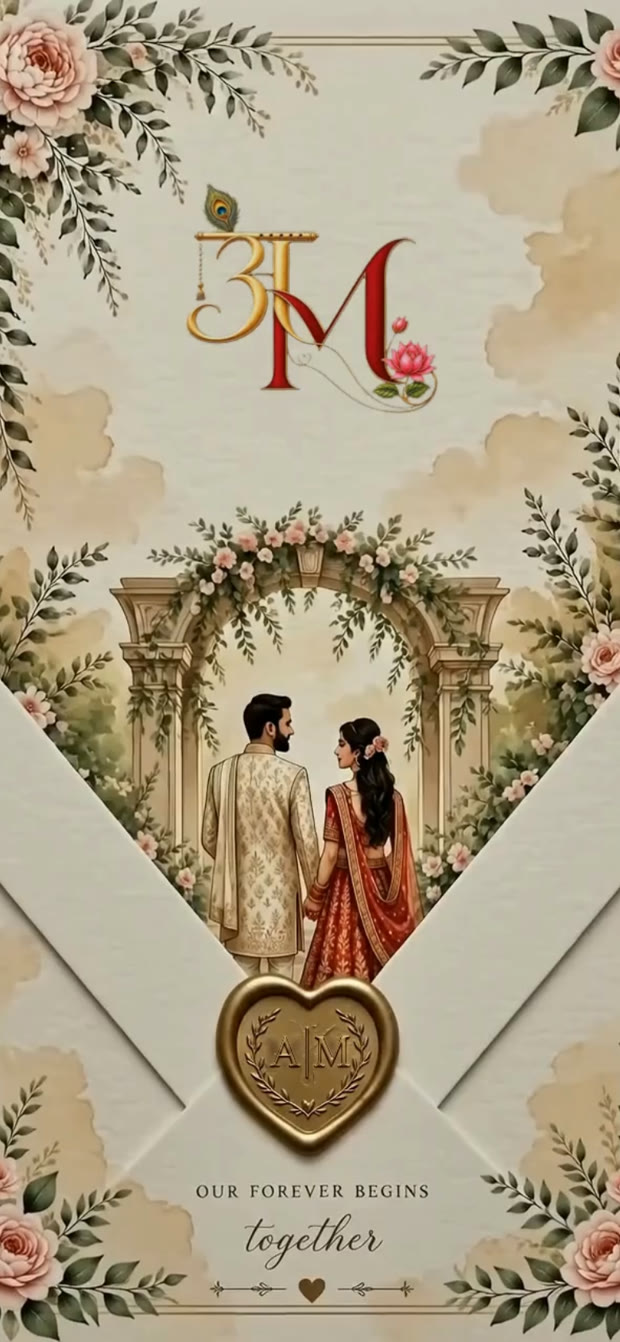
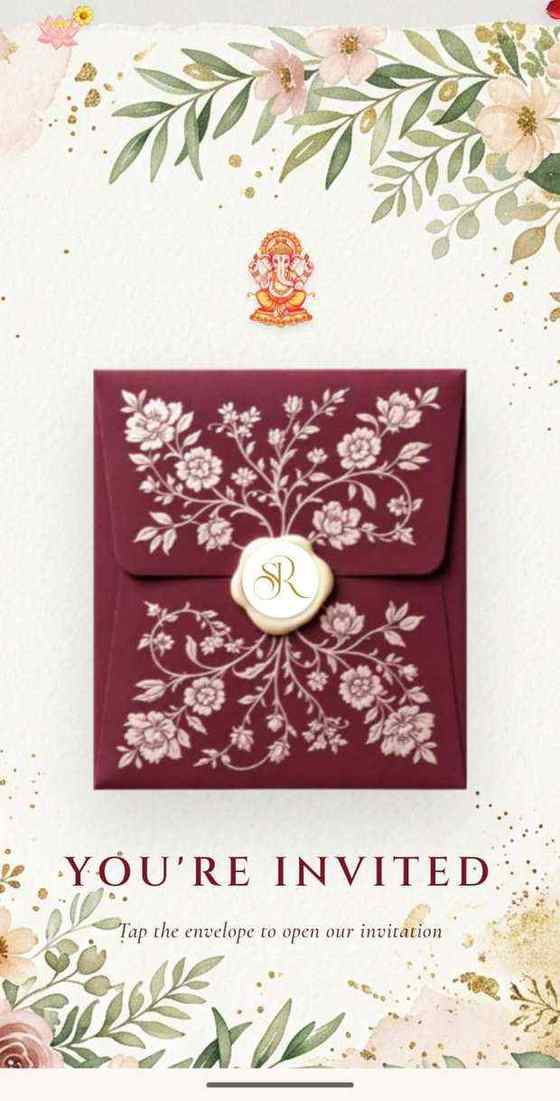
6 designs you can personalise, from ₹2,499. Open any one to see it full size, with a live demo.

Questions people ask
How do you word an invitation for an interfaith wedding?
Use a request line that suits both families, put both invocations at the top or give each family its own version, and name both sets of parents in the same style. Call each ceremony by its own name, and explain each ritual in one line.
Should we make two separate invitations?
Often that is best. Each family sends its own version, in the same design and with the same date, but with its own invocation, language and family first. Elders on both sides then read an invitation that looks familiar.
Can one invitation have two religious symbols?
Yes, side by side and at the same size, in an order both families agree on. Many Punjabi families already print both Ik Onkar and Shree Ganeshaya Namah, and nobody finds it odd.
How do we explain rituals to guests from the other family?
Put one plain line under each function: what happens, how long it takes and anything guests should do, such as covering their head in the gurdwara.
Can the invite be in two languages?
Yes. Either give each family's version its own language, or keep a shared invitation in English with each family's invocation and names in its own script. Keep each view in one language from top to bottom.
Can a Hindu-Sikh couple have an Anand Karaj?
Ask the gurdwara. Under the Sikh Rehat Maryada the Anand Karaj is for couples who are both Sikh, and gurdwaras differ in how they apply it. Settle the ceremony first, then word the invitation to match.