On this page
- What changes between the two versions, and what stays
- How the host line flips
- Which functions each side hosts
- When the two sides start on different days
- When the families come from different traditions
- Keeping the replies of two families in order
- What a second version costs
- Wording you can copy
- Designs
- Questions
So most weddings end up with two invitations, whether anyone planned it or not. This page sets out what should change between the two and what must stay identical, wording for both sides in English and Hindi, and how to keep the replies of two families in order.
What changes between the two versions, and what stays
| Bride's side | Groom's side | |
|---|---|---|
| Whose name comes first | The bride's | The groom's |
| Host line | Her parents invite you to the wedding of their daughter | His parents invite you to the wedding of their son |
| Family list | Her family: darshanabhilashi, swagatotsuk, nanihal paksh | His family, in the same places |
| Functions | Hers: mehndi, haldi, mayra or chooda, the baraat's welcome, the pheras | His: tilak, haldi, sehra, ghudchadi, the baraat, the reception |
| The baraat line | Baraat Aagman, when it arrives | Baraat Prasthan, when and where it leaves |
| Contact numbers | Her family's | His family's |
| Design, wedding date, wedding venue | The same on both | The same on both |
In October 2026 families asked us for exactly this again and again: the same design with the names swapped, each side's own functions, with the baraat only on the groom's side and the Mayra only on the bride's, and their own family listed first.
The song usually stays the same, but it does not have to. One family wanted a different song on the groom's version, which is a nice touch when the two families' music is different.
In Hindi, the bride's side is the vadhu paksh (वधू पक्ष) and the groom's side the var paksh (वर पक्ष), the formal words for ladki wale and ladke wale. You will see them on cards that list both families.
How the host line flips
The two versions are the same sentence seen from the other side. Write one, then turn it round.
| Bride's side | Groom's side | |
|---|---|---|
| English | Mr and Mrs [Her surname] request the pleasure of your company at the wedding of their daughter [Bride] with [Groom], son of Mr and Mrs [His surname] | Mr and Mrs [His surname] request the pleasure of your company at the wedding of their son [Groom] with [Bride], daughter of Mr and Mrs [Her surname] |
| Hindi | हमारी सुपुत्री सौ. कां. [नाम] का शुभ विवाह चि. [नाम] के साथ | हमारे सुपुत्र चि. [नाम] का शुभ विवाह सौ. कां. [नाम] के साथ |
| The baraat | बारात आगमन: [समय] | बारात प्रस्थान: [समय], [स्थान] से |
| Signed | विनीत: [her parents' names] | विनीत: [his parents' names] |
Agree on how much of the other family each version prints. Usually each side names the other's parents in the 'son of' or 'daughter of' line. On one Marwari wedding in October 2026, each version listed only the other family's parents and its own family in full. Either way is fine, as long as both families know before the cards go out.
Which functions each side hosts
The pattern differs by community, and each family has its own habits on top of it. Use this as a starting point and confirm with both sets of parents.
| Community | Usually on the bride's side | Usually on the groom's side | Both families |
|---|---|---|---|
| North Indian Hindu | Mehndi, haldi, the pheras, vidaai | Tilak, haldi, sehra and baraat, reception | Often the sangeet |
| Punjabi | Chooda, the Anand Karaj or pheras, doli | Sehra bandi and the ghodi | Jaggo at each home, the Milni at the venue |
| Marwari | The pheras and vidaai | Baraat and toran, Mooh Dikhai | Pithi Dastoor and Mahira Dastoor at each home |
| Gujarati | Mameru, the wedding, kanyadaan | The jaan, the groom's procession | Pithi, Griha Shanti and garba |
| Bengali | The wedding itself, usually late at night | Bou Bhaat, the day after | Aiburobhaat and Gaye Holud at each home |
| Tamil and Telugu | The muhurtham, which her family usually arranges | The groom's family's own functions, which vary | The reception, often the evening before, hosted by either family |
The community guides have the full order: Punjabi, Marwari, Gujarati, Bengali, Tamil and Telugu.
When the two sides start on different days
The two sides do not always start together. On one wedding this season, the bride's functions began two days before the groom's. That is normal, and it is the best argument for two versions: her guests see her mehndi and haldi on her dates, his guests see his on his, and both lists meet at the wedding.
Keep the shared events word for word the same on both versions: the wedding's date, the muhurat, the venue and its map pin. If one of them changes, change both versions on the same day, or one side's guests will turn up at the old time.
When the families come from different traditions
Two versions also solve the harder case: a Hindu groom and a Sikh bride, or a Tamil family and a Punjabi one. Each version can open with its own invocation and speak its own language. One couple in October 2026 had Om and 'Om Shri Ganeshaya Namah' on his version, and Ik Onkar with Punjabi wording on hers.
Invitations for an interfaith or inter-state wedding covers invocations side by side, languages and explaining rituals to the other family. The Punjabi guide explains how Hindu and Sikh Punjabi invitations differ.
Keeping the replies of two families in order
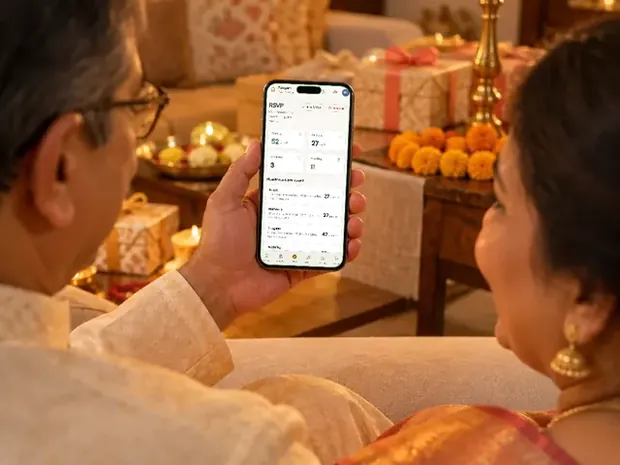
Each version has its own guest list, so each needs its own replies. Every Invifest invitation comes with a private RSVP console, free, and each side's link reports its own replies, which you can download as an Excel sheet.
If one person is running both, Aangan (₹3,000) can hold both versions under one login. One family ran both their links, the groom first on one and the bride first on the other, from a single Aangan login, switching between the two. Every guest gets a personal link from your own WhatsApp, and you can see who has opened it and who is coming.
- Agree who calls whom. Each side calls its own elders. Nobody should hear about the wedding first from the other family's version.
- Never forward your version to the other side's relatives. They will receive their own, with their family's names in the right place.
- Add up the shared functions together. The caterer needs one number for the wedding dinner, from both lists, a week before. RSVP for an Indian wedding shows how to turn replies into those numbers.
What a second version costs
With printed cards, the second side's version is a second print run. With an invitation link it is the same design with different names and functions, so it costs much less than the first.
At Invifest the 'Invite for the other side' is ₹999 on Sindoori and Gulmohar and ₹1,500 on every other design, whatever the design itself costs. It is the same design with the other family's names first and only their functions, on the same date. It has two rounds of changes of its own, and it reaches you within 2 days of the first family's final invite. See both sides of a sample.
If you are choosing a design partly for this, Sindoori and Gulmohar carry the lower price on the second side.
Wording for both sides
Each pair is the same invitation from the two families. Change the names, dates and places in [brackets], and keep the shared details identical on both.
Shree Ganeshaya Namah
Mr and Mrs [Her surname]
request the pleasure of your company
at the wedding of their daughter
[Bride's name]
with
[Groom's name]
son of Mr and Mrs [His surname]
[Day, Date] · Muhurat [Time]
[Venue]
Shree Ganeshaya Namah
Mr and Mrs [His surname]
request the pleasure of your company
at the wedding of their son
[Groom's name]
with
[Bride's name]
daughter of Mr and Mrs [Her surname]
[Day, Date] · Muhurat [Time]
[Venue]
॥ श्री गणेशाय नमः ॥
हमारी सुपुत्री
सौ. कां. [वधू का नाम]
का शुभ विवाह
चि. [वर का नाम]
सुपुत्र श्रीमती [नाम] एवं श्री [नाम]
के साथ होना निश्चित हुआ है।
बारात आगमन: [दिन, तिथि], [समय]
पाणिग्रहण: [समय] · [स्थान]
आप सपरिवार पधारें।
विनीत: श्रीमती [नाम] एवं श्री [नाम]
॥ श्री गणेशाय नमः ॥
हमारे सुपुत्र
चि. [वर का नाम]
का शुभ विवाह
सौ. कां. [वधू का नाम]
सुपुत्री श्रीमती [नाम] एवं श्री [नाम]
के साथ होना निश्चित हुआ है।
बारात प्रस्थान: [दिन, तिथि], [समय], [स्थान] से
आशीर्वाद समारोह: [दिन, तिथि], [समय]
आप सपरिवार पधारें।
विनीत: श्रीमती [नाम] एवं श्री [नाम]
Shree Ganeshaya Namah
Hamari suputri
Sau. Kaa. [Vadhu ka naam]
ka shubh vivah
Chi. [Var ka naam]
suputra Shrimati [Naam] evam Shri [Naam]
ke saath hona nishchit hua hai.
Baraat Aagman: [Din, Tithi], [Samay]
Panigrahan: [Samay] · [Sthaan]
Aap sapariwar padharein.
Vineet: Shrimati [Naam] evam Shri [Naam]
Shree Ganeshaya Namah
Hamare suputra
Chi. [Var ka naam]
ka shubh vivah
Sau. Kaa. [Vadhu ka naam]
suputri Shrimati [Naam] evam Shri [Naam]
ke saath hona nishchit hua hai.
Baraat Prasthan: [Din, Tithi], [Samay], [Sthaan] se
Aashirwad Samaroh: [Din, Tithi], [Samay]
Aap sapariwar padharein.
Vineet: Shrimati [Naam] evam Shri [Naam]
दर्शनाभिलाषी:
[दादा-दादी, ताऊ-ताई, चाचा-चाची के नाम]
स्वागतोत्सुक:
[भाई-बहन और परिवार के नाम]
ननिहाल पक्ष:
[नाना-नानी, मामा-मामी के नाम]
विनीत:
श्रीमती [नाम] एवं श्री [नाम]
Darshanabhilashi:
[Dada-dadi, tau-tai, chacha-chachi ke naam]
Swagatotsuk:
[Bhai-behen aur parivar ke naam]
Nanihal Paksh:
[Nana-nani, mama-mami ke naam]
Vineet:
Shrimati [Naam] evam Shri [Naam]
Shree Ganeshaya Namah
Together with their families,
Smt. [Name] and Shri [Name]
and
Smt. [Name] and Shri [Name]
invite you to the wedding of their children
[Bride's name] and [Groom's name]
[Day, Date] · Muhurat [Time]
[Venue]
Namaste [Name] ji,
Our daughter [Name] is getting married on [Date]. The mehndi and haldi are at our home on [Dates], and the wedding is on [Date] at [Venue].
Everything, with the map, is here: [link]
Please come with the family.
[Your names]
Namaste [Name] ji,
Our son [Name] is getting married on [Date]. The baraat leaves from [Place] at [Time], and our reception is on [Date] at [Venue].
Everything, with the maps, is here: [link]
Please come with the family.
[Your names]
Namaste [Name] ji,
Here is our version of the invitation: [link]
It has the same design, date and venue as yours, with our functions. Could you please check the spellings of your family's names before we send it out on [day]?
Thank you,
[Your name]
Want these words on a real invitation? See the designs.
Hindu wedding invitation designs
8 designs you can personalise, from ₹2,499. Open any one to see it full size, with a live demo.

Questions people ask
Do the bride's and groom's families send separate wedding invitations?
Usually yes. Each family invites its own guests in its own names, so most Indian weddings have two versions of the invitation: the bride's side and the groom's side.
Whose name comes first on the bride's side invitation?
The bride's, with her parents as hosts and the groom named as 'son of' his parents. On the groom's side it is the other way round.
Can both sides use the same design?
Yes, and it helps. With the same design, date and venue on both versions, guests from either family see one wedding. Only the names, the host line, the family list and the functions change.
How much does a second side's invitation cost?
At Invifest the other side's link is ₹999 on Sindoori and Gulmohar and ₹1,500 on every other design, with two rounds of changes of its own. It arrives within 2 days of the first family's final invite.
Can each side see its own RSVPs?
Yes. Each link's replies go to its own private RSVP console, or both versions can sit under one Aangan login so one person can see both lists.
What do var paksh and vadhu paksh mean on a wedding card?
Var paksh (वर पक्ष) is the groom's side and vadhu paksh (वधू पक्ष) is the bride's side, the formal Hindi for ladke wale and ladki wale.