On this page
Families often send us the matter of their printed card to set as an invitation website, so these are the parts we work with. The meanings of the symbols come from the reference articles linked beside them. Customs differ from region to region, so where your family does it differently, the eldest relative is right.
The symbols on a traditional card, and what they mean
| Symbol | Where you see it | What it stands for |
|---|---|---|
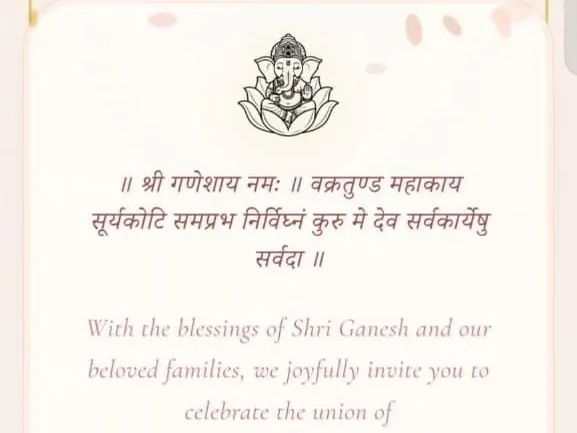
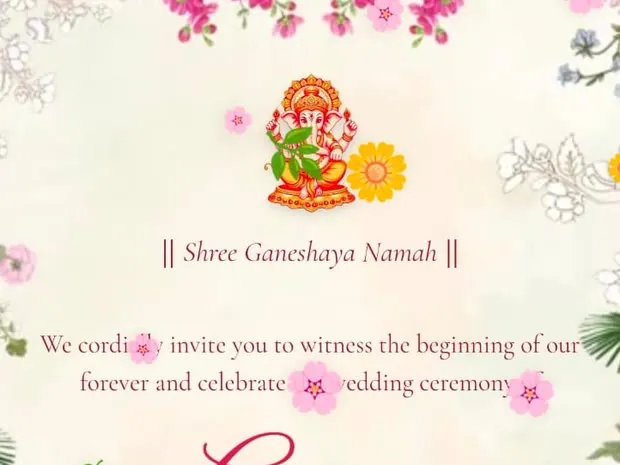
| Ganesh ji, with Shree Ganeshaya Namah | At the top of most Hindu cards | The remover of obstacles and bringer of good luck. As the god of beginnings he is honoured at the start of rites and ceremonies, which is why he comes first. |
| Om (ॐ) | Above or beside the invocation | The sacred syllable; its written form is called the most important symbol in Hinduism. |
| Swastik | Hindu, Jain and Marwari cards, often in red | From the Sanskrit svastika, "conducive to well-being": a sign of auspiciousness in Hinduism, Jainism and Buddhism. |
| Kalash | Beside Ganesh ji, or on the envelope | A pot of water topped with mango leaves and a coconut, the purna kalasha: a symbol of abundance, worshipped in Hindu festivities of marriage and childbirth. |
| Mango leaves and marigolds | Along the top edge and the borders | The toran tied across the main door: mango leaves and flowers, an auspicious welcome and a sign of good fortune. |
| Shehnai and nadaswaram | In the corners, or drawn with the baraat | The music of the wedding itself. The shehnai is played at weddings in the north; in the south the nadaswaram is considered very auspicious and is played at almost every Hindu wedding. |
| Ik Onkar (ੴ) | At the top of Sikh, Anand Karaj cards | "One supreme reality": the first words of the Mul Mantar and of the Guru Granth Sahib. |
| Bismillah, or 786 | At the top of Muslim, Nikah cards | "In the name of God, the Most Gracious, the Most Merciful". 786 is its numerical value, written in its place especially by South Asian Muslims. |
| The Navkar Mantra | At the top of Jain cards | Namo Arihantanam: the most significant mantra in Jainism, and the first prayer Jains recite in meditation. |
The meanings above are from the reference articles on Ganesha, Om, the swastika, the kalasha, the toran, the shehnai, the nadaswaram, Ik Onkar, the Basmala and the Navkar Mantra. Christian cards usually open with a cross or a verse of scripture, and the full opening lines for each faith are in our wedding invitation wording guide.
The parts of a traditional card, in order
- The symbol and the invocationShree Ganeshaya Namah, Ik Onkar, Bismillah or your family's own, at the very top.
- A shloka or coupletOptional. Many Hindu cards print a Ganesh shloka such as Vakratunda Mahakaya.
- The blessing of the eldersGrandparents by name, including those who have passed, written with Late, Swargiya or Sw. before the name.
- The invitation lineSadar nimantran in Hindi, or a line such as "solicit your gracious presence" in English.
- The couple and their parentsChi. before the groom's name; Aayushmati, or Sau. Kaa., before the bride's. Whose side comes first depends on who is hosting.
- The programmeEvery function with its day, date, time and place, often under a heading such as Mangal Karyakram.
- The venueWith a landmark for guests who do not know the town.
- The family's namesVineet for the hosts, then headings such as Darshanabhilashi and Swagatotsuk for the wider family, or "With best compliments from" on an English card.
- The children's lineBaal manuhar: a request in a child's voice, such as "Mere chachu ki shaadi mein zaroor aana".
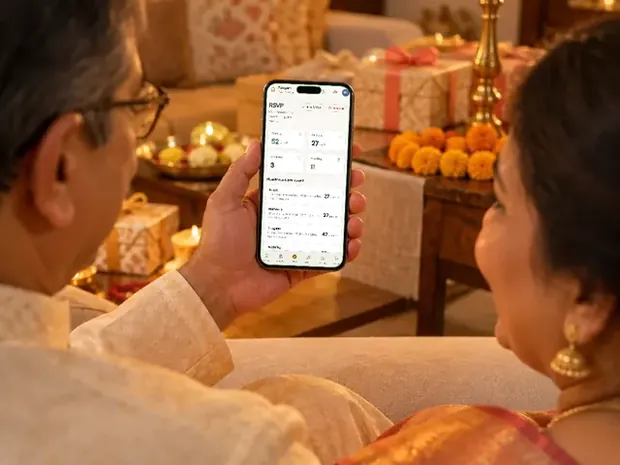
- The RSVP and the senderA name and number to call, and the sender's name and address on the back or the envelope.
Each Hindi term, from vineet to nanihal paksh, is explained with full card matter to copy in Hindi wedding card matter. Who goes first, how to write a late parent's name and the honorifics people get wrong are in wedding invitation wording.
Kankotri, lagna patrika and the other names for it
The same card goes by different names. Gujarati families send a kankotri, Marathi families a lagna patrika, and Hindi-speaking homes a shaadi card or a vivah nimantran patra. The names change, and so do the order of the rituals and the set phrases: the Marathi card puts Chi. Sau. Kaa. before the bride's name, and a Marwari card lists the mayra among its functions. Our guides to the Gujarati kankotri, the Marathi lagna patrika, Marwari, Bengali and Tamil cards have each community's wording.
Many families still print a few traditional cards even when most guests get a link: one for the mandir, a few for the elders, and the ones they hand over in person. One family this season asked us for a PDF of their invite to print for the card puja on Dussehra.
What "editable format" means: CDR, PSD, Word, Canva and PDF
Search for an editable wedding card and you will be offered five kinds of file. They are not the same thing, and the right one depends on who is going to change it.
| Format | What it is | Who can change it | Good for |
|---|---|---|---|
| CDR | The file of CorelDRAW, a design program made by Corel | A designer or printer who has CorelDRAW | A design that will be changed and printed in CorelDRAW |
| PSD | Photoshop's own file, which keeps text and pictures on separate layers | Someone with Photoshop; Adobe says you need it to edit the original | Changing the artwork and the words layer by layer |
| Word (.doc or .docx) | A document of the wording, the card's "matter" | Anyone, on a computer or a phone | Typing and checking the matter before it goes to the printer or designer |
| Canva template link | A link that opens a copy of a design in Canva; Canva's help centre says making one needs a paid plan, and anyone with the link can use the design | Anyone with a Canva account | Changing names and dates yourself |
| A fixed document that looks the same on any phone, computer or printer | Not meant for editing; changing one takes a PDF editor | Printing, and sending as one file on WhatsApp |
Template apps sell these to printers too: Crafty Art's paid plans, for example, include PSD exports (5 a month on its ₹499 Starter plan) and an "Editable PDF for Corel Draw Support" from its ₹999 Pro plan. A file is only as good as the matter typed into it, so check every name and date twice before it reaches the press.
What Invifest makes instead
Invifest does not sell CDR, PSD, Word or Canva files of its designs. Our designs stay ours (section A8 of our Terms). We make the invitation for you: you send the matter on WhatsApp, a designer sets it as an invitation website, and you get two rounds of changes, with a link that updates for everyone who already has it. If you need paper, a PDF of your invite (₹1,000) lays out its pages for printing a few copies; it is not a separately designed card, and if your invite changes later we make the PDF again once, free.
A traditional card as an invitation website
Every part of the printed card has a place on an invitation website, and the symbols come with it: Ganesh ji or Ik Onkar on the opening screen, the elders' blessing, the couple, a page for each function with its own map, and the family's names in the same order as the card. What a card never could do, the link adds: a reply form for each function, and a time that can still change after you send it.
On Invifest, traditional designs include Kesariya (₹3,499), with saffron and marigold for Rajasthani and Marwari families, and Vrindavan (₹4,100) for families whose wedding begins at the thakurji. Sindoori's Rooted theme (₹3,500) carries Ganesh ji, the shlokas and Hindi beside English. Whether to print, send a link or do both is weighed in printed or digital invitations.
Traditional card wording you can copy
Traditional English card wording, ready for your names, dates and places. For Hindi card matter in Devanagari and Roman script, see Hindi wedding card matter; for samples for every host, wedding invitation wording; and for the kankotri and the lagna patrika, the Gujarati and Marathi guides.
|| Shree Ganeshaya Namah ||
With the blessings of the Almighty and our elders,
Smt. [Mother's name] and Shri [Father's name]
solicit your gracious presence with family
on the auspicious occasion of the marriage of their daughter
[Bride's name]
with
Chi. [Groom's name]
son of Smt. [Name] and Shri [Name], [City]
on [Day], [Date]
Muhurat: [Time]
at [Venue], [City]
Kindly grace the occasion and bless the couple.
|| Shree Ganeshaya Namah ||
With the blessings of [Grandparents' names],
Smt. [Mother's name] and Shri [Father's name]
cordially invite you and your family
to the marriage of their son
Chi. [Groom's name]
with
[Bride's name]
daughter of Smt. [Name] and Shri [Name], [City]
Baraat departs: [Day, Date], [Time], from [Place]
Wedding: [Day, Date], Muhurat [Time], at [Venue]
Your presence will be our blessing.
Mangal Karyakram (Programme)
Ganesh Puja: [Day, Date], [Time]
Mehendi: [Day, Date], [Time], [Venue]
Haldi: [Day, Date], [Time], [Venue]
Sangeet: [Day, Date], [Time], [Venue]
Baraat Swagat: [Day, Date], [Time]
Jaimala and Pheras: [Day, Date], Muhurat [Time]
Reception: [Day, Date], from [Time], [Venue]
Aashirwad (blessings): [Grandparents' names]
Darshanabhilashi (longing to see you): [Uncles, aunts and their families]
Swagatotsuk (eager to welcome you): [Brothers, sisters and cousins]
With best compliments from: [Names] and family
Baal Manuhar: "Mere [chachu / mama / bua] ki shaadi mein zaroor aana!" - [Children's names]
RSVP: [Name], [Phone number]
To,
[Guest's name] and family
[Address]
From:
[Family name]
[Address], [City]
[Phone number]
Want these words on a real invitation? See the designs.
Invitation designs
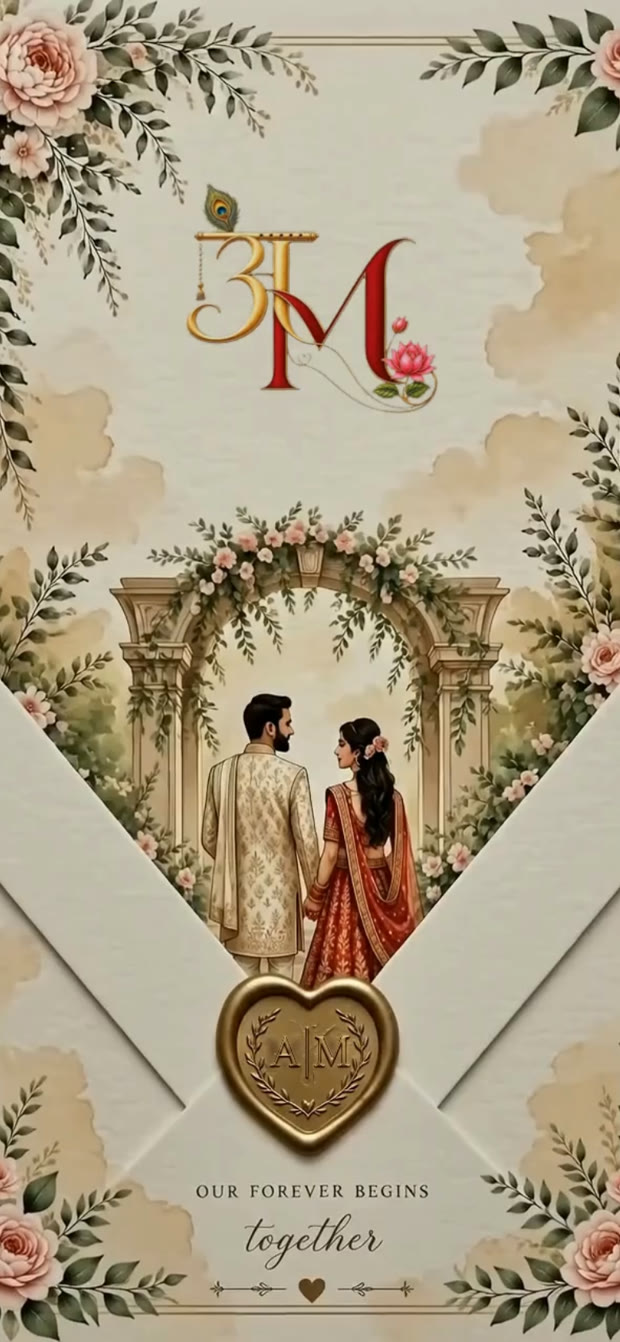
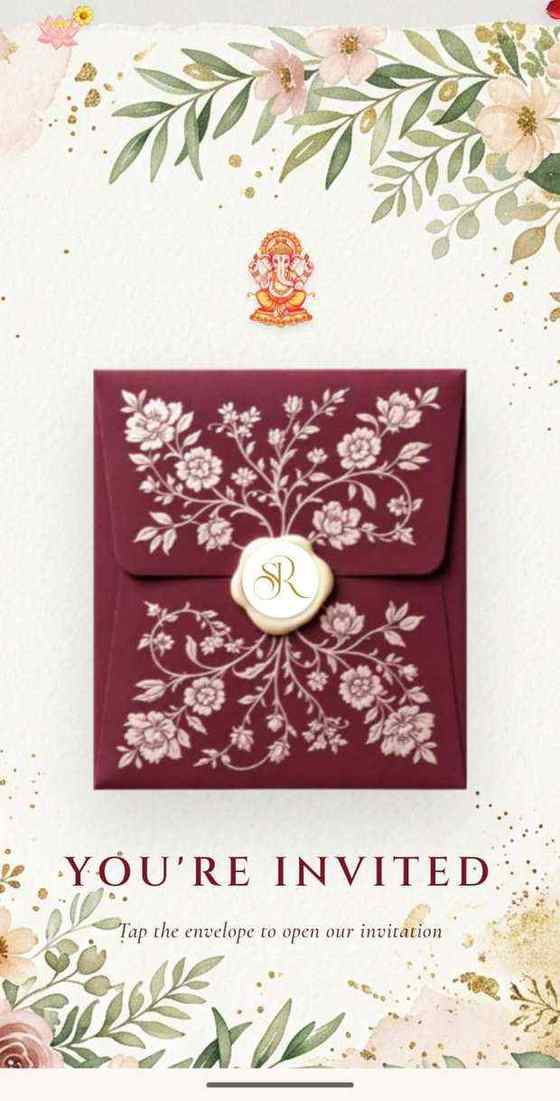
6 designs you can personalise, from ₹2,499. Open any one to see it full size, with a live demo.

Questions people ask
Why is Ganesh ji printed at the top of a wedding card?
Ganesh ji is the remover of obstacles and, as the god of beginnings, is honoured at the start of rites and ceremonies. Printing him first, with Shree Ganeshaya Namah, asks for a wedding without obstacles.
What does the swastik on a wedding card mean?
It comes from the Sanskrit svastika, "conducive to well-being", and is a sign of auspiciousness in Hinduism, Jainism and Buddhism. Hindu, Jain and Marwari cards often print it in red beside Ganesh ji or the kalash.
What does the kalash on a wedding invitation stand for?
The purna kalasha, a pot of water topped with mango leaves and a coconut, is a symbol of abundance and is worshipped in Hindu festivities of marriage and childbirth.
What is a CDR file for a wedding card?
A CDR file is the design file of CorelDRAW. A designer or printer with CorelDRAW can open it and change the names, dates and artwork before printing. To change only the wording, a Word file of the matter is enough.
Can I get my wedding card in an editable format?
Yes, from template sites that sell CDR, PSD, Word or Canva files, if you or your printer will edit it. A PDF is meant for printing and sharing, not editing. Invifest does not sell editable files; it makes the invitation for you, with two rounds of changes.
What is a kankotri?
Kankotri is what Gujarati families call the wedding card. It usually opens with Shree Ganeshaya Namah, or Shree Krishnah Sharanam Mama in Vaishnav homes, and names the elders first. Our Gujarati guide has the wording and the rituals in order.
What is written at the bottom of an Indian wedding card?
The family's names under set headings: vineet for the hosts, darshanabhilashi and swagatotsuk for the wider family, or "With best compliments from" on an English card, followed by a child's line and a number to call.
Can a traditional card be sent as a digital invitation?
Yes. Every part of the card, the symbol, the invocation, the couple, each function and the family's names, has a place on an invitation website, which also adds a map and a reply form for each function. Invifest's designs start at ₹2,499.