Digital or printed wedding invitations: an honest comparison, and what most families do
Digital or printed wedding invitations in India: what each does better, the real cost for 300 families, the print-plus-link plan most families use, and safety.
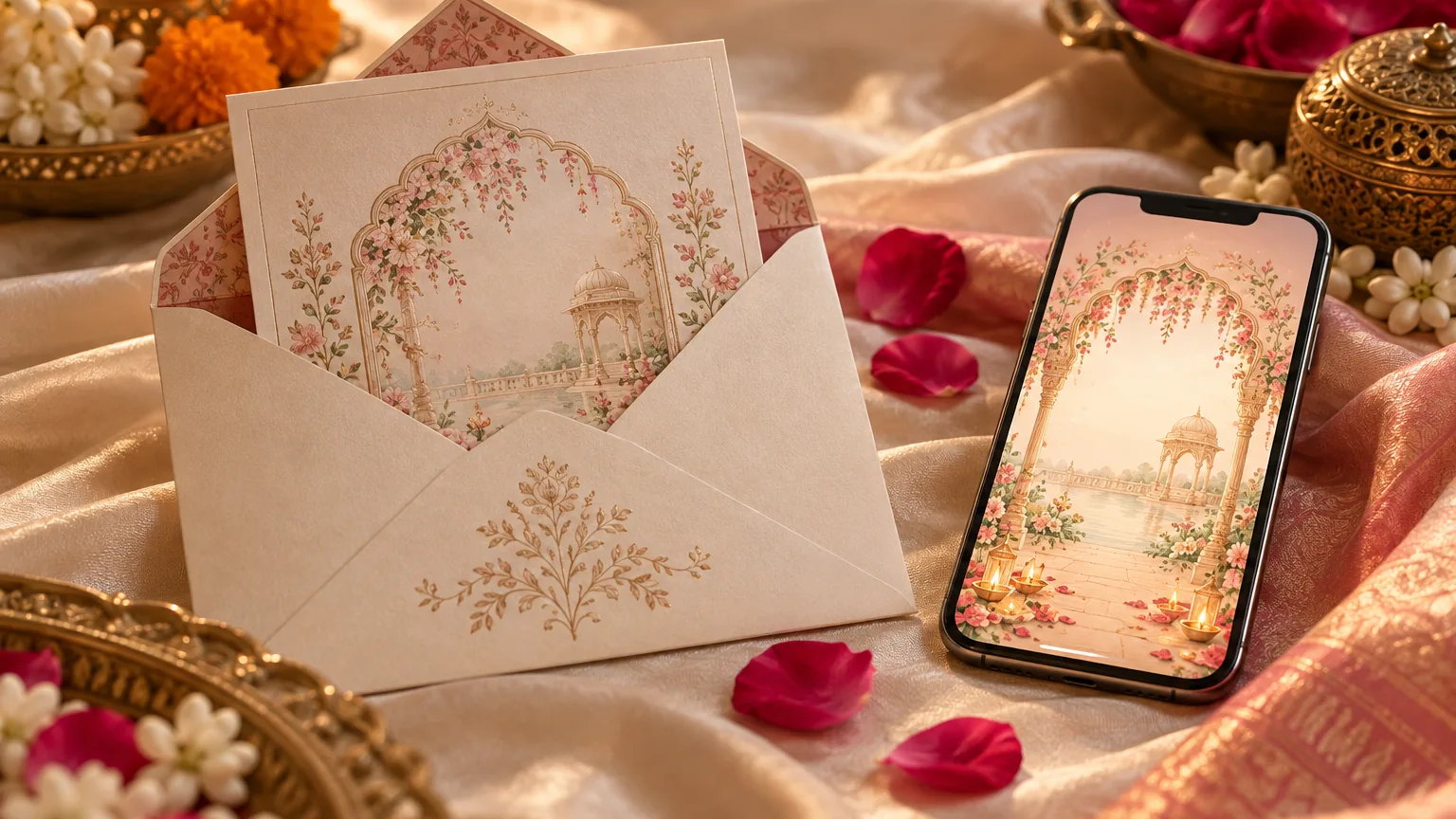
A printed card is still best for elders, the puja and the families you visit in person; a link is better for everything that changes, for maps and replies, and for guests far away. Most families do both: they print 30 to 60 cards and send the link to everyone else.
On this page
We sell digital invitations, so read this knowing that. We have still tried to write the version we would want if we were the ones deciding, because the honest answer for most Indian families is not one or the other.
It is a small print run for the people who need a card in their hands, and a link for everyone else. This page covers what each does better, the cost for 300 families, how to make the two work together, and the question elders now ask about any link: is it safe to open?
What a printed card genuinely does better
- It can be handed over. In a lot of families, giving the card in person is the invitation. The visit matters more than the card, and a link cannot carry that.
- It can be placed in the mandir, offered to the family deity, or given to the priest. This is a real use and it is not sentimental.
- Elders read it more comfortably. Not everyone wants to scroll, and some will never open the link no matter how many times you send it.
- It is a keepsake. Twenty years later somebody finds it in a book. A link, unless the service keeps it alive, does not do that.
- It signals expense. Uncomfortable to say, but in some circles the weight of the card is read as a statement, and that is a real social function.
One more thing about a printed card, which families rarely say out loud: it has to be disposed of. Some Hindu families do not like to throw away a card printed with Ganesh ji or another deity, and people living in flats ask on dharma forums what to do with them instead (one such question). Each family has its own respectful way of handling them. A link never has to be thrown away.
What a link does better
- It can be corrected. Times move, venues change, a function gets added. Everyone who already has the link sees the new version. This alone is worth it.
- It carries a live map. The single largest source of wedding day phone calls is people who cannot find the venue.
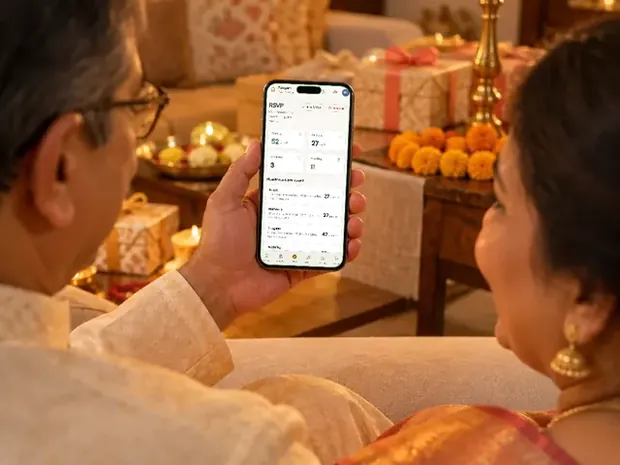
- It collects RSVPs into a list, instead of ninety replies across three group chats. Catering numbers are the most expensive guess at an Indian wedding.
- It holds everything. Every function, every venue, your story, photos, music. A card holds one side of one page.
- It reaches people abroad instantly, with no courier and no three week wait.
- It costs the same for fifty guests or five hundred.
- Different guests can see different functions. Close family gets every function and the office only the reception, so nobody opens a Mehndi they were not invited to (how families split it).
The cost maths, done properly
Rough figures for 300 families. Count households, not people: one card goes to each family. Published ranges put a printed card anywhere from ₹40 to ₹300 depending on the paper and the finish (InviteCrafter, February 2026), and boxed cards with sweets cost far more. The table uses ₹60 to ₹250, inside that range, for a typical card with its envelope.
| Print only | Print 50 + link | Link only | |
|---|---|---|---|
| Cards printed | 300 | 50 | 0 |
| Cards at ₹60 to ₹250 each | ₹18,000 to ₹75,000 | ₹3,000 to ₹12,500 | ₹0 |
| Courier and delivery | ₹3,000 to ₹9,000 | ₹500 to ₹1,500 | ₹0 |
| Invitation website | ₹0 | ₹2,499 | ₹2,499 |
| Rough total | ₹21,000 to ₹84,000 | ₹6,000 to ₹16,500 | ₹2,499 |
| Ready to send | After printing, which InviteCrafter puts at 7 to 15 days | The link the day it is final; the cards after printing | The day it is final |
The cost guide breaks down every kind of digital invitation by price, from free e-cards to designer-made websites, with a real order added up.
Where a video invite fits
A video invite is a third thing, and it is worth being clear about what it is.
It is a short clip, and in India it can cost very little or quite a lot. On 27 October 2026, Desievite listed wedding videos at Rs 149 to Rs 499, and WedMeGood said its video invites start at INR 749, with customised caricature and 3D videos at ₹6,999.
It looks good the first time. The problem is what happens next. It plays once, it sits in the chat, and two weeks later when somebody wants to check the Haldi timing they have to scroll back through four hundred messages and watch the whole thing again to find one line of text.
A video is a lovely announcement. It is a poor reference. If you want one, treat it as a teaser that points at a link, not as a replacement for one. Invifest makes its video from your finished invite, so the two always match: the 4K video of the invite is ₹1,100, with a light 720p copy for WhatsApp (see a sample). Our guide to a video or a website compares the two side by side.
Print and link together
The two work best when each points at the other.
- A QR code on the printed card that opens the invitation link, so the elders who prefer paper can still reach the map and the reply form.
- The essentials printed as well. Names, date, time and venue belong on the card itself. Some guests will never scan a code, and a card that only says 'scan for details' leaves them with nothing. Our ideas guide gives the same warning.
- Test the code before the print run, on two or three phones, an old Android among them, and check that it opens the final link, not a draft.
- Print from the invite itself. A PDF of the finished invite, laid out page by page in the same design, gives you the cards on paper without a second design (see a sample PDF; when a PDF beats a link). At Invifest it costs ₹1,000 and is remade once free if the invite changes. Printing is up to you and your printer.
- The card in the hand, the link in the message. For the families you visit, hand over the card and send the link the same evening, with a line like the ones below, so the details are always one tap away.
Is the link safe to open?
Elders now ask this, and they are right to. In April 2026 police in Rajasthan warned that fraudsters were sending fake wedding cards on WhatsApp as app files, and a senior officer was quoted by ThePrint: a file ending in .apk 'is not an invitation card but a virus'. A real invitation link opens a page in the phone's browser. It never asks you to install anything or to type an OTP.
Send yours from your own number with a personal line, and tell the elders on the phone that it is coming. Is this wedding invitation link safe? has the full checklist for guests.
How families usually split it
If you are doing both, these are the lines that make the split feel natural rather than like a downgrade for the people getting the link.
It was so good to see you.
Here is everything in one place, all the functions, timings and directions, in case the card is out of reach:
[link]
Do forward it to anyone I may have missed.
Aapse milkar bahut achha laga.
Card ke saath saari jaankari is link par bhi hai, sabhi karyakram, samay aur raasta:
[link]
Aap sapariwar zaroor padhariye.
We would have loved to bring you a card in person.
Here is our invitation instead, with every function and all the details:
[link]
We really hope you can come.
We are getting married, and we know a card would take three weeks to reach you.
Everything is here, including the timings in your time zone:
[link]
We would love to have you with us.
Scan for every function, the map
and to tell us you are coming.
[Short link]
Want these words on a real invitation? See the designs.
Invitation designs
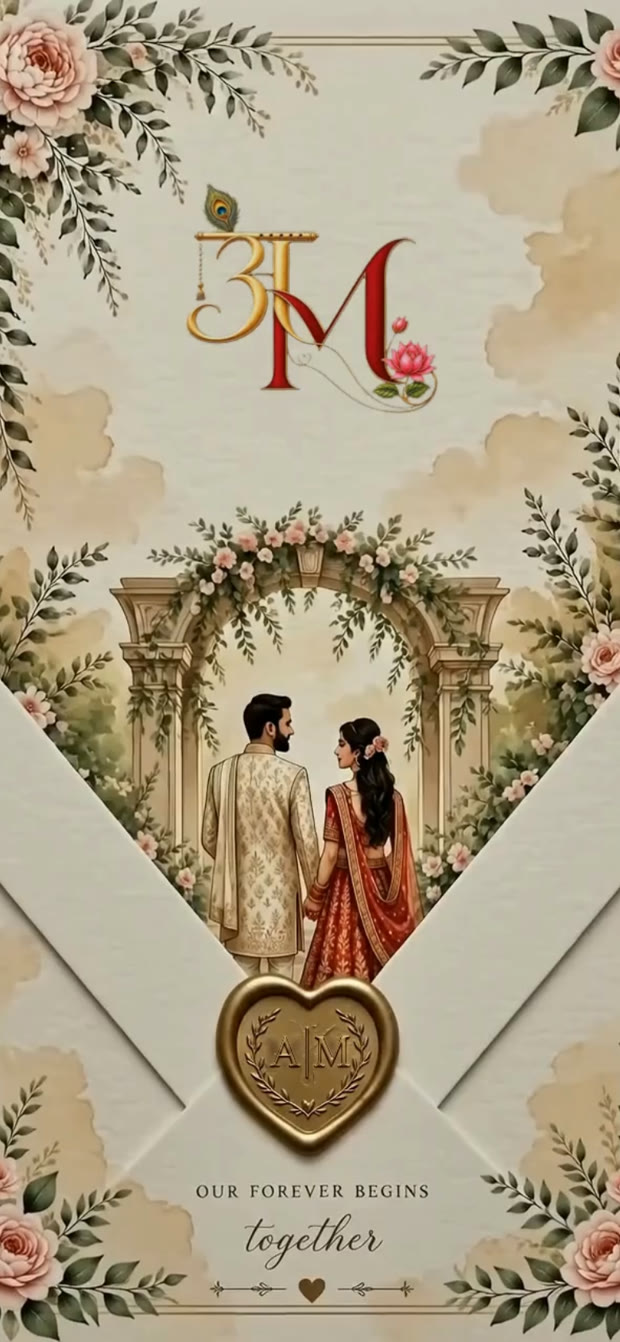
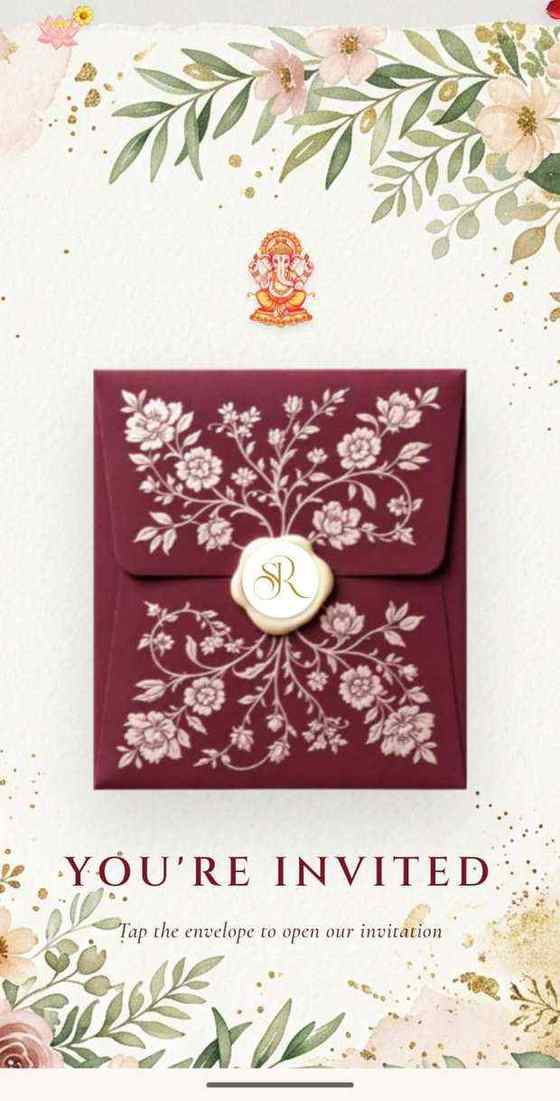
6 designs you can personalise. Open any one to see it full size, with a live demo.

Questions people ask
Is a digital wedding invitation acceptable in Indian families?
For most guests, yes, and it has become entirely normal. The exception is the small group where handing over a card in person is part of the invitation itself. Most families print thirty to fifty cards for those people and send the link to everyone else. Our guide on whether a WhatsApp invitation is rude has the plan most families follow.
How much do printed wedding cards cost in India?
Published ranges run from about ₹40 to ₹300 a card depending on the paper and the finish, and boxed cards with sweets cost much more, plus courier. For 300 families at ₹60 to ₹250 a card that is roughly ₹21,000 to ₹84,000 all in, which is why most families now print a fraction of the guest list.
Can we put a QR code on the printed card?
Yes. Point it at the invitation link, so guests holding the card can reach the map and the reply form, but print the names, date, time and venue as well, because some guests will never scan it. Test it on an old phone before the print run.
Is a video invite better than a website?
They do different jobs. A video is a good announcement but a poor reference, because guests cannot easily check a timing later. A link stays findable. If you want a video, use it as a teaser pointing at the link.
Can we change details after sending a digital invitation?
Yes, and this is its biggest single advantage. Everyone who already has the link sees the corrected version. A printed card cannot be recalled.
Do older relatives struggle with a link?
Some do, which is exactly why the print plus link split works. Print for the people who would rather hold a card, call before you send the link, and keep the invitation short and plain. Our guide to a digital invitation elders can open has the details.
Is a wedding invitation link safe to open?
A real one opens a page in the browser and never asks you to install an app or share an OTP. The 2026 police warnings were about .apk files sent as fake wedding cards. If something asks to be installed, delete it and call the person who sent it.