Hindi wedding card matter: every term explained, with samples you can copy
Hindi wedding card matter you can copy, with every term explained: vineet, darshanabhilashi, swagatotsuk, Chi., Sau. Kaa., sapariwar, and where each goes.
A Hindi wedding card follows a fixed order: the invocation (Shri Ganeshaya Namah), a blessing couplet, the invitation line, the couple with their parents (Chi. before the groom, Aayushmati or Sau. Kaa. before the bride), each function, then the families who invite you under headings like vineet, darshanabhilashi and swagatotsuk. Every term is below in Devanagari, Roman and English, with full samples.
On this page
A Hindi wedding invitation is not an English one translated. The structure is different, the honorifics carry real weight, and the family headings at the bottom, vineet, darshanabhilashi, swagatotsuk, decide who is named and in what order.
This page explains every part in Devanagari, Roman and plain English, then gives full card matter you can copy: a standard card, a Marwari style card with the mayra and the baraat, and a reception card. Families name these sections when they order from us (one family this month asked for Swagatotsuk, Darshanabhilashi and Nanihal paksh, each with its own list), so the explanations here are the ones we give them on WhatsApp.
The honorifics, and why they matter
Getting these wrong is the fastest way to have an uncle call your father. They are not decoration, they encode who is who.
| On the card | Who it is for, and what it means |
|---|---|
| Chi. (चि.) | The groom, or any younger man. Short for Chiranjeevi (चिरंजीवी): may you live long, said of someone younger than the family writing the card. |
| Aayushmati (आयुष्मती) | The bride, or a younger woman: the feminine form of the same blessing. Aayushman (आयुष्मान) is the masculine form. |
| Sau. Kaa. (सौ. कां.) | The bride, before the wedding. Short for Saubhagyakankshini (सौभाग्यकांक्षिणी): one who wishes for saubhagya, the good fortune of a married life. Marathi cards write Chi. Sau. Kaa. (चि. सौ. कां.) before the bride's name. |
| Sau. (सौ.) | A married woman. Short for Saubhagyavati (सौभाग्यवती), one who has that good fortune. The bride becomes Sau. once she is married, which is why a reception card can write Sau. before her name. |
| Suputra, Suputri (सुपुत्र, सुपुत्री) | Son of, daughter of. Literally good son, good daughter. Standard on invitations. |
| Supautra, Supautri (सुपौत्र, सुपौत्री) | Grandson, granddaughter. Used when the grandparents invite: 'hamari supautri', our granddaughter. |
| Shri, Shrimati (श्री, श्रीमती) | Parents and elders. The ordinary respectful prefix; Shrimati is often shortened to Smt. |
| Sw. (स्व.) | Someone who has passed. Short for Swargiya (स्वर्गीय), literally of heaven, placed before the name so they are still included. |
| Pujya (पूज्य) | Grandparents and revered elders. Worthy of reverence, and stronger than Shri. |
The family headings, decoded
The bottom of a Hindi card lists the family under a few set headings. They cause more discussion than anything else on the card, because every name left out is noticed and remembered.
There is no single rule across India, and printers in each town follow the local habit. This is what each heading means and who usually goes under it.
| Heading, and what it says | Who is usually listed under it |
|---|---|
| Vineet (विनीत): humbly yours | The hosts, usually the parents, sometimes with the grandparents or the head of a joint family. It closes the card the way a signature closes a letter. |
| Darshanabhilashi (दर्शनाभिलाषी): longing to see you | The wider family who look forward to your coming: uncles and aunts and their families. On some cards it carries the hosts too, in place of vineet. |
| Swagatotsuk (स्वागतोत्सुक): eager to welcome you | The people who will receive guests at the door: brothers, sisters and cousins, the younger generation. |
| Swagatakankshi (स्वागताकांक्षी): hoping to welcome you | The same place as swagatotsuk. Families pick one of the two. |
| Preshak, Nivedak (प्रेषक, निवेदक): the sender, the one who requests | The name the card is sent from, often printed on the back or on the envelope with the address. |
| Nanihal paksh (ननिहाल पक्ष): the mother's family's side | The maternal grandparents and the mama and mami, named as a family. It honours the mother's family by name. |
| Aashirwad (आशीर्वाद): blessings | Grandparents and senior elders whose blessings the card asks for, including those who have passed, written with Swargiya. |
| Baal manuhar (बाल मनुहार): a child's loving plea | The children of the family, with a line in their voice, such as 'Mere chachu ki shaadi mein zaroor aana'. |
Vineet usually carries the parents' names and sits where a letter's signature would, while the other headings list the wider family. Which heading comes first changes from family to family, so show the draft to the eldest person in the house before it goes out, and count the names twice.
The standard phrases, decoded
- Sadar nimantran (सादर निमंत्रण) = a respectful invitation. The most common opening line.
- Aap sapariwar padharein (आप सपरिवार पधारें) = please come with your family. Sapariwar is doing a lot of work here, and leaving it out reads as inviting one person.
- Aapke aashirwad ki abhilasha hai (आपके आशीर्वाद की अभिलाषा है) = we desire your blessings. Used when inviting elders, and it is the warmer alternative to a flat request for attendance.
- Shubh vivah (शुभ विवाह) = auspicious marriage. The standard term for the wedding itself.
- Panigrahan (पाणिग्रहण) = the taking of the hand, the wedding ceremony. Often printed as Panigrahan Sanskar.
- Vivah muhurat (विवाह मुहूर्त) = the ceremony's fixed time. Always print it.
- Baraat prasthan (बारात प्रस्थान) = the procession's departure time, printed when the groom's side is travelling. The bride's side prints baraat aagman (बारात आगमन), its arrival.
- Bhojan vyavastha (भोजन व्यवस्था) = meal arrangement. Usually followed by a time.
- Preetibhoj (प्रीतिभोज) = the wedding feast, literally a meal of affection.
- Swaruchi bhoj (स्वरुचि भोज) = a meal you serve yourself to your own taste, a buffet. Aashirwad Samaroh evam Swaruchi Bhoj heads many reception cards: a blessing ceremony, then dinner.
- Darshanabhilashi (दर्शनाभिलाषी) = one who desires your presence. It sits at the bottom of the card, above the family's names.
The order of a Hindi invitation
- The invocationShri Ganeshaya Namah (श्री गणेशाय नमः), or your family's own. Always at the very top.
- A couplet or blessingOptional. Many families print a Ganesh shloka such as Vakratunda Mahakaya, or a two line verse about marriage.
- The invitation lineSadar nimantran, or a fuller sentence inviting the family.
- The coupleGroom with his parents' names, bride with hers. Which comes first varies by community, so ask.
- The scheduleEach function with its date, time and place, often under a heading such as Mangal Karyakram (मंगल कार्यक्रम).
- VenueWith enough detail for someone unfamiliar with the town.
- The family headingsAashirwad, vineet, darshanabhilashi, swagatotsuk and baal manuhar, as your family uses them.
- The senderPreshak, with the name and address, often on the back or the envelope.
Aamantran or nimantran?
In everyday Hindi the two words mean the same thing, and either is correct on a card. The old difference comes from Sanskrit grammar. The Kashika commentary on Panini's rule 3.3.161 defines nimantran (निमंत्रण) as an invitation that binds, one you are expected to accept, and aamantran (आमंत्रण) as one you are free to accept or decline (read the Kashika lines).
By that rule a wedding card is a nimantran patra: the family is asking you to come, not offering you the choice. Inside it, 'aap sadar aamantrit hain' (आप सादर आमंत्रित हैं) is still the most common polite line, and nobody minds the mix.
How a Hindi card maps onto a digital invite
Every part of the printed card has a place on an invitation website. Nothing has to be dropped, and a few things work better.
| On the printed card | On the invitation website |
|---|---|
| Shri Ganeshaya Namah and the shloka | The opening screen, before the names |
| The couple with their parents | The first page after the opening |
| Each function | A page of its own, with the time, the venue, a map button and what to wear |
| Aashirwad, vineet, darshanabhilashi, swagatotsuk | A family page, in the same order as the card |
| Aap sapariwar padharein | The invitation line stays, and a reply form follows it, so guests can say how many are coming. A card never could. |
| Preshak with the home address | Usually left off. The link already comes from you, and the address does not need to travel with it. |
Families decide which parts stay in Hindi only. One family this month asked for the Ganesh shloka in Hindi with no English translation under it. Others want Hindi beside English, so friends from other states can follow the functions.
On Invifest, Sindoori can carry the wording in Hindi exactly as it would appear on a printed shaadi card, and its Rooted theme puts Ganesh ji, the shlokas and Hindi beside English. The wording guide covers the English side, and the Marwari and Marathi guides have each community's own card matter. For the WhatsApp message that goes with a Hindi invite, see wedding invitation messages in Hindi.
Full Hindi card matter you can copy
Each sample is given in Devanagari and again in Roman script, so it can be typed anywhere. Change the names, dates and places; the words in square brackets are yours to fill in.
॥ श्री गणेशाय नमः ॥
वक्रतुण्ड महाकाय सूर्यकोटि समप्रभ।
निर्विघ्नं कुरु मे देव सर्वकार्येषु सर्वदा॥
सादर निमंत्रण
परमपिता परमेश्वर की असीम कृपा एवं पूज्य बुज़ुर्गों के आशीर्वाद से
हमारे सुपुत्र
चि. [नाम]
का शुभ विवाह
आयुष्मती [नाम]
सुपुत्री श्रीमती [नाम] एवं श्री [नाम], [शहर]
के साथ होना निश्चित हुआ है।
इस मंगल अवसर पर आप सपरिवार सादर आमंत्रित हैं।
मंगल कार्यक्रम
हल्दी: [दिन, तिथि], [समय]
मेहंदी एवं संगीत: [दिन, तिथि], [समय]
बारात प्रस्थान: [दिन, तिथि], [समय]
पाणिग्रहण: [दिन, तिथि], मुहूर्त [समय]
प्रीतिभोज: [दिन, तिथि], [समय] से
स्थान: [स्थान का नाम एवं शहर]
आशीर्वाद: पूज्य [दादाजी का नाम] एवं [दादीजी का नाम]
विनीत: श्रीमती [नाम] एवं श्री [नाम]
दर्शनाभिलाषी: [चाचा, ताऊ एवं परिवारजन]
स्वागतोत्सुक: [भाई, बहन एवं भाई-बहनों के नाम]
बाल मनुहार: "मेरे चाचू की शादी में ज़रूर आना" - [बच्चों के नाम]
|| Shri Ganeshaya Namah ||
Vakratunda Mahakaya Suryakoti Samaprabha,
Nirvighnam Kuru Me Deva Sarvakaryeshu Sarvada.
Sadar Nimantran
Parampita Parmeshwar ki aseem kripa evam pujya buzurgon ke aashirwad se
hamare suputra
Chi. [Naam]
ka shubh vivah
Aayushmati [Naam]
suputri Shrimati [Naam] evam Shri [Naam], [Shehar]
ke saath hona nishchit hua hai.
Is mangal avsar par aap sapariwar sadar aamantrit hain.
Mangal Karyakram
Haldi: [Din, Tithi], [Samay]
Mehndi evam Sangeet: [Din, Tithi], [Samay]
Baraat Prasthan: [Din, Tithi], [Samay]
Panigrahan: [Din, Tithi], Muhurat [Samay]
Preetibhoj: [Din, Tithi], [Samay] se
Sthaan: [Sthaan ka naam evam shehar]
Aashirwad: Pujya [Dadaji ka naam] evam [Dadiji ka naam]
Vineet: Shrimati [Naam] evam Shri [Naam]
Darshanabhilashi: [Chacha, Tau evam parivarjan]
Swagatotsuk: [Bhai, behen evam cousins ke naam]
Baal Manuhar: "Mere chachu ki shaadi mein zaroor aana" - [Bachchon ke naam]
श्री गणेशाय नमः
आपके स्नेह एवं आशीर्वाद के साथ, हमारे परिवार के शुभ विवाह प्रसंग पर आप सपरिवार पधारें।
चि. [नाम]
सुपुत्र श्री [नाम] एवं श्रीमती [नाम]
का शुभ विवाह
आयुष्मती [नाम]
सुपुत्री श्री [नाम] एवं श्रीमती [नाम]
विवाह मुहूर्त: [समय], [दिन, तिथि]
स्थान: [स्थान]
दर्शनाभिलाषी: [परिवार का नाम]
Shree Ganeshaya Namah
Aapke sneh evam aashirwad ke saath, hamare parivar ke shubh vivah prasang par aap sapariwar padharein.
Chi. [Naam]
suputra Shri [Naam] evam Shrimati [Naam]
ka shubh vivah
Aayushmati [Naam]
suputri Shri [Naam] evam Shrimati [Naam]
Vivah Muhurat: [Samay], [Din, Tithi]
Sthaan: [Sthaan]
Darshanabhilashi: [Parivar ka naam]
Shree Ganeshaya Namah
[Naam] evam [Naam] ke shubh vivah par aap sapariwar sadar aamantrit hain.
Haldi: [Tithi] · [Samay]
Mehndi: [Tithi] · [Samay]
Sangeet: [Tithi] · [Samay]
Baraat Prasthan: [Tithi] · [Samay]
Vivah Muhurat: [Tithi] · [Samay]
Sthaan: [Sthaan]
Bhojan Vyavastha: [Samay] se
Aapke aashirwad ki abhilasha hai.
॥ श्री गणेशाय नमः ॥
मंगलम् भगवान विष्णुः मंगलम् गरुड़ध्वजः।
मंगलम् पुण्डरीकाक्षः मंगलाय तनो हरिः॥
सादर निमंत्रण
हमारी सुपौत्री एवं सुपुत्री
आयुष्मती [नाम]
का शुभ विवाह
चि. [नाम]
सुपुत्र श्रीमती [नाम] एवं श्री [नाम], [शहर]
के साथ होना तय हुआ है।
आप सपरिवार पधार कर वर-वधू को आशीर्वाद प्रदान करें।
मांगलिक कार्यक्रम
गणपति स्थापना: [तिथि], प्रातः [समय]
पीठी दस्तूर (हल्दी): [तिथि], [समय]
मायरा (माहेरा दस्तूर): [तिथि], [समय]
महिला संगीत: [तिथि], सायं [समय]
बारात आगमन: [तिथि], सायं [समय]
पाणिग्रहण संस्कार: [तिथि], शुभ मुहूर्त [समय]
प्रीतिभोज: [तिथि], [समय] से
स्थान: [स्थान का नाम एवं शहर]
निवेदक: [दादाजी का नाम] एवं समस्त [उपनाम] परिवार
ननिहाल पक्ष: श्री [नानाजी का नाम] एवं [मामाजी का नाम] परिवार, [शहर]
स्वागतोत्सुक: [चाचा-चाची, भाई-भाभी के नाम]
बाल मनुहार: "मेरी बुआ की शादी में ज़रूर आना" - [बच्चों के नाम]
|| Shri Ganeshaya Namah ||
Mangalam Bhagwan Vishnuh, Mangalam Garudadhwajah,
Mangalam Pundarikakshah, Mangalaya Tano Harih.
Sadar Nimantran
Hamari supautri evam suputri
Aayushmati [Naam]
ka shubh vivah
Chi. [Naam]
suputra Shrimati [Naam] evam Shri [Naam], [Shehar]
ke saath hona tay hua hai.
Aap sapariwar padhaar kar var-vadhu ko aashirwad pradaan karein.
Mangalik Karyakram
Ganapati Sthapana: [Tithi], pratah [Samay]
Pithi Dastoor (Haldi): [Tithi], [Samay]
Mayra (Mahira Dastoor): [Tithi], [Samay]
Mahila Sangeet: [Tithi], saayam [Samay]
Baraat Aagman: [Tithi], saayam [Samay]
Panigrahan Sanskar: [Tithi], shubh muhurat [Samay]
Preetibhoj: [Tithi], [Samay] se
Sthaan: [Sthaan ka naam evam shehar]
Nivedak: [Dadaji ka naam] evam samast [Upnaam] parivar
Nanihal Paksh: Shri [Nanaji ka naam] evam [Mamaji ka naam] parivar, [Shehar]
Swagatotsuk: [Chacha-chachi, bhai-bhabhi ke naam]
Baal Manuhar: "Meri bua ki shaadi mein zaroor aana" - [Bachchon ke naam]
॥ श्री गणेशाय नमः ॥
आशीर्वाद समारोह एवं स्वरुचि भोज
हमारे सुपुत्र
चि. [नाम]
एवं सौ. [नाम]
के शुभ विवाह के उपलक्ष्य में
आशीर्वाद समारोह एवं स्वरुचि भोज का आयोजन किया गया है।
आप सपरिवार पधार कर नवदंपति को आशीर्वाद प्रदान करें।
दिनांक: [दिन, तिथि]
समय: सायं [समय] से
स्थान: [स्थान का नाम एवं पता]
विनीत: श्रीमती [नाम] एवं श्री [नाम]
केवल आशीर्वाद की अभिलाषा है।
|| Shri Ganeshaya Namah ||
Aashirwad Samaroh evam Swaruchi Bhoj
Hamare suputra
Chi. [Naam]
evam Sau. [Naam]
ke shubh vivah ke upalakshya mein
aashirwad samaroh evam swaruchi bhoj ka aayojan kiya gaya hai.
Aap sapariwar padhaar kar navdampati ko aashirwad pradaan karein.
Dinank: [Din, Tithi]
Samay: saayam [Samay] se
Sthaan: [Sthaan ka naam evam pata]
Vineet: Shrimati [Naam] evam Shri [Naam]
Keval aashirwad ki abhilasha hai.
Shree Ganeshaya Namah
Pujya Swargiya Shri [Naam] ke aashirwad se,
[Naam] evam [Naam] ka shubh vivah
Vivah Muhurat: [Samay], [Din, Tithi]
Sthaan: [Sthaan]
Aap sapariwar padharein.
Shree Ganeshaya Namah
[Naam] aur [Naam] shaadi kar rahe hain.
[Din, Tithi] · Muhurat [Samay]
[Sthaan]
Aap sabka aana zaroori hai. Saare functions aur raaste is link par hain.
Want these words on a real invitation? See the designs.
Hindu wedding invitation designs
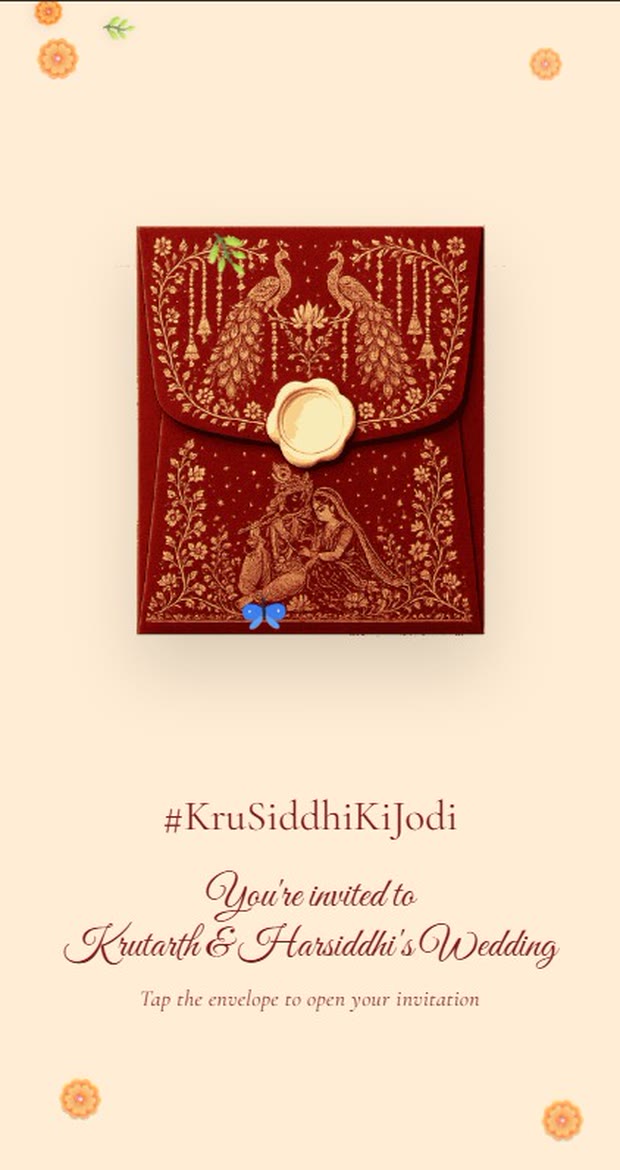
8 designs you can personalise. Open any one to see it full size, with a live demo.


Questions people ask
What does darshanabhilashi mean on a wedding card?
One who longs to see you: darshan, sight or presence, and abhilashi, one who desires. It sits at the bottom of a Hindi card above the family's names. Where the card also has vineet, vineet usually carries the parents and darshanabhilashi the wider family.
Who is listed under vineet on a wedding card?
The hosts who humbly invite you, usually the parents, and in a joint family sometimes the grandparents or the eldest brother as well. Vineet closes the card the way 'yours humbly' closes a letter, so it carries the people sending it.
What does Chi. Sau. Kaa. mean?
Chi. is Chiranjeevi, may you live long, written before the groom's name. Sau. Kaa. is Saubhagyakankshini, one who wishes for the good fortune of a married life, written before the bride's. Marathi cards put the two together before the bride's name as Chi. Sau. Kaa. After the wedding she is Sau., Saubhagyavati.
What is the difference between aamantran and nimantran?
In everyday Hindi there is none: both mean an invitation. In Sanskrit grammar, nimantran is an invitation you are expected to accept and aamantran one you may accept or decline, so a wedding card is properly a nimantran patra.
Can a digital invitation be fully in Hindi?
Yes. An invitation website can carry the whole card matter in Devanagari, or Hindi beside English. Our Sindoori design can carry the wording in Hindi exactly as it would be printed, and there is no separate charge for the language at checkout.
What does sapariwar mean and why is it important?
It means with your family. Without it, a Hindi invitation reads as inviting one person rather than a household, which is almost never what is intended.
How do we mention a grandparent who has passed away on a Hindi invitation?
Print the name with Swargiya, often shortened to Sw., or Pujya Swargiya before it, usually in a blessing line above the couple's names. Leaving them off entirely is read as an omission.
Should a Hindi invitation be in Devanagari or Roman script?
Devanagari for elders and for the formal sections, and many families print both. A digital invitation can carry both without doubling any cost, which is one of its practical advantages.