Wedding invitation wording: who to name, in what order, and samples for every host
Indian wedding invitation wording with samples for every host: parents, the couple, grandparents, one parent, a late parent, mothers' names first, and more.
Start with the host line, because it decides everything else: the parents, the couple, or grandparents and parents together. Then the request line, the names with honorifics, the date, time and venue of each function, and a closing with the family names. Samples for every kind of host, including a parent who has passed, are below, each with a Copy button.
On this page
Most of the arguments about a wedding invitation are not about design. They are about whose name goes where, in what order, and with which honorific.
This page sets out the conventions that actually exist, gives a full sample for every kind of host, and answers the questions families asked us most this season: mothers' names first, Smt. or Mrs., who gets ji, and how to name a parent or grandparent who has passed.
The host line decides everything else
Whoever is hosting is named first, and the rest of the wording follows from that. Pick the row that matches your situation. Every row has a full sample further down this page, with a Copy button, and wording in the parents' own voice is in the guides for a son's wedding and a daughter's wedding.
| Who is hosting | How it opens |
|---|---|
| The bride's parents | Mr and Mrs [Surname] request the honour of your presence at the marriage of their daughter… |
| The groom's parents | Smt. [Name] and Shri [Name] request the honour of your presence at the marriage of their son… |
| Both sets of parents | Together with their families, [Parents] and [Parents] invite you… |
| The couple themselves | Together with our families, we invite you to celebrate our marriage… |
| Grandparents included | With the blessings of [Grandparents], [Parents] invite you… |
| One parent | Smt. [Name] requests the honour of your presence at the marriage of her son… |
| One parent has passed | [Living parent], along with the family of the late [Name], invites you… |
| A mother and a brother | With the blessings of the late Shri [Name], Smt. [Name] and [Brother's name] invite you… |
| Parents are divorced | Name each parent on their own line, without and between them, in whichever order you both agree. |
Mothers' names first, and Smt. or Mr. and Mrs.
Two requests came up again and again on our calls this season. Several families asked for both mothers' names before the fathers', on the bride's side and on the groom's. Another wanted Mr. and Mrs. in place of Smt. before the parents' names. Both are correct, and neither breaks any rule.
Many Hindi cards already put the mother first: the classic 'Shrimati evam Shri [Naam]' (श्रीमती एवं श्री) names her before him, so a mother-first English card is closer to tradition than it looks.
| Style | How the parents' line reads |
|---|---|
| Mother first | Smt. [Mother's name] and Shri [Father's name] [Surname] |
| Father first | Shri [Father's name] and Smt. [Mother's name] [Surname] |
| Mr. and Mrs. | Mr. and Mrs. [Father's full name] |
| Both first names, English style | Mrs. [Mother's name] and Mr. [Father's name] [Surname] |
| Both mothers first, on a joint card | Smt. [Bride's mother] and Shri [Bride's father], with Smt. [Groom's mother] and Shri [Groom's father] |
Pick one style and use it for both families. A card that writes Smt. for one side and Mrs. for the other looks like a mistake even when it was a choice, and someone will ask about it.
When a parent has passed
This comes up constantly and families agonise over it, so here are the options that are actually used, none of which is wrong.
- Name them with late. Daughter of Mrs [Name] and the late Mr [Name]. Plain, common, and reads as respectful.
- A separate blessing line. With the blessings of the late Shri [Name], placed above the host line.
- Name the family rather than the person. [Living parent] and family invite you. Avoids the word entirely, which some families prefer.
- Use a memorial line at the end. We remember [Name], who is with us today.
Late or Swargiya, and where it sits
Late is the English word and Swargiya (स्वर्गीय) the Hindi one, often shortened to Sw. (स्व.). Use the one that matches the language of the line: 'the late Shri [Name]' in English, 'Swargiya Shri [Naam]' in Hindi. Write Late in full, because Lt. is an army rank.
Most families put a late grandparent in a blessing line at the very top, so the card begins with him, and a late parent either there or beside the living parent in the host line. One family this October asked for exactly that: Late Shri before the grandfather's name, in the blessing line above everything else.
When a father has passed, a brother often stands beside the mother as host. One bride this season put her card together with her brother after their father died, and the sample further down is written for that.
Honorifics people get wrong
- Who gets ji. Ji after a name is respect, and families care exactly where it goes. One family this season asked for ji after the bride's father and grandfather and after both of the groom's parents, and nowhere else. A safe rule: ji for elders and for the other family's parents, never for the couple, whose names carry Chi. and Aayushmati instead.
- Shri, Smt. and Kumari. Shri for men, Smt. for married women, Kumari or Sushri for unmarried women. On a Hindi card the groom is Chi., not Shri, on his own wedding card.
- Chi. and Chi. Sau. Kaa. On Marathi cards the groom is Chi. (Chiranjeev) and the bride Chi. Sau. Kaa. (Chiranjeevi Saubhagyakankshini). A family asked us for exactly this, and getting the two the wrong way round is noticed at once. The Marathi guide has the full Lagna Patrika.
The rest of the Hindi honorifics, with the Devanagari and what each one means, are in the Hindi card matter guide.
The contact and RSVP block
Indian cards end with two small blocks that families discuss more than the main text: 'With best compliments from', and the names and numbers to call.
- With best compliments from. The relatives who want their names on the card, often the younger generation: '[Names] and family'. One line per family. A list of fifteen names in small type is not read.
- Numbers stacked, one under the other. Put each name on its own line with its number beside it. Side by side, the numbers wrap badly on a phone screen, and guests call the wrong person.
- The order is noticed. One family this season asked us to move an uncle's number above another's. Agree the order before it goes out.
- Say what each number is for. 'For directions and stay: [Name], [number]' saves the bride's father fifty calls about parking.
- On a digital invitation, the reply form does the RSVP. Keep one or two numbers for the elders who would rather call, and let everyone else reply on the link. The RSVP guide has reply wording that elders do not find abrupt.
Honour of your presence, or pleasure of your company
This is the rule almost nobody knows, and once you know it you cannot unsee it on other people's cards.
Honour of your presence is used for a ceremony in a place of worship. A church, a temple, a gurdwara, a mosque.
Pleasure of your company is used for everything else. A banquet hall, a hotel, a farmhouse, a reception.
So a wedding at a temple with a reception at a hotel correctly uses honour for the first and pleasure for the second. Nobody will complain if you get it wrong, but getting it right costs nothing.
Things to leave off
- Your home address, if the function is elsewhere. A wedding invitation gets forwarded far beyond the people you sent it to. If the function is at home, give the colony or society and a map pin, not the flat number.
- Gift instructions, unless you are asking for none. No gifts please is gracious. Anything that reads as a demand is not.
- Registry details on the main invitation. Put them on a website or tell people who ask.
- Anything you are not certain of. A time that might move, a venue that is not confirmed. Say to be confirmed rather than printing a guess, because a digital invitation can be updated but a printed one cannot.
If you want no gifts, how to say it
A bride's father this season asked for two words at the bottom of the reception invitation, Blessings only, so guests would not arrive with boxed gifts and cash envelopes. It worked because it was short. Other lines families use, and more in our no gifts wording guide:
- Your blessings are the only gift we ask for.
- Blessings only, please.
- Aapka aashirwad hi hamara uphaar hai.
- Keval aashirwad ki abhilasha hai (केवल आशीर्वाद की अभिलाषा है).
Invocations by faith
| Tradition | Usual opening |
|---|---|
| Hindu, general | Shree Ganeshaya Namah |
| Vaishnav, Pushtimarg | Shree Krishnah Sharanam Mama |
| Jain | Namo Arihantanam, or the full Navkar Mantra. Some families open with Shri Gautam Swami Namah instead |
| Sikh | Ik Onkar, or Waheguru Ji Ka Khalsa, Waheguru Ji Ki Fateh |
| Muslim | Bismillah ir Rahman ir Raheem, often with Surah Ar Rum 30:21 |
| Christian | A scripture verse, most often 1 Corinthians 13 |
| Bengali Hindu | Shree Shree Durgayai Namah, or Om Shree Ganeshaya Namah |
Families change these to suit their own practice. A Jain family this October replaced Mahavir Swami at the top of their card with Shri Gautam Swami Namah. Another family kept the Ganesh shloka in Hindi only, with no English translation under it, and began the English at the invitation line.
Each faith's full wording is in its own guide: Jain, Anand Karaj, Nikah and Christian.
Samples by host, ready to copy
One for every kind of host. Change the names and the details. Each has been written to read well aloud, which is still how most invitations are received in an Indian family.
Shree Ganeshaya Namah
Mr and Mrs [Surname]
request the honour of your presence
at the marriage of their daughter
[Name]
with
[Name]
son of Mr and Mrs [Surname]
on [Day], the [date] of [month], [year]
at [Time]
[Venue]
Reception to follow.
Shree Ganeshaya Namah
Smt. [Name] and Shri [Name]
request the honour of your presence
at the marriage of their son
[Name]
with
[Name]
daughter of Smt. [Name] and Shri [Name]
[Day, Date] · Muhurat [Time]
[Venue], [City]
Reception at [Time].
Shree Ganeshaya Namah
Smt. [Name] and Shri [Name]
and
Smt. [Name] and Shri [Name]
request the honour of your presence
at the marriage of their children
[Bride's name]
and
[Groom's name]
[Day, Date] · Muhurat [Time]
[Venue]
Shree Ganeshaya Namah
Together with their families,
[Name]
and
[Name]
request the pleasure of your company
as they are married
[Day, Date] · [Time]
[Venue]
Together with their families,
[Bride's name]
and
[Groom's name]
invite you to celebrate their wedding
[Day, Date] · [Time]
[Venue], [City]
Every function and the map are on this link.
We are getting married, and we would love you there.
[Name] and [Name]
[Day, Date]
[Venue]
Ceremony at [Time], dinner from [Time].
Everything else is on this link.
Shree Ganeshaya Namah
With the blessings of
Pujya Smt. [Grandmother's name] and Shri [Grandfather's name]
Smt. [Name] and Shri [Name]
request the honour of your presence
at the marriage of their daughter
[Name]
with
[Name]
son of Smt. [Name] and Shri [Name]
[Day, Date] · Muhurat [Time]
[Venue]
Shree Ganeshaya Namah
Smt. [Name]
requests the honour of your presence
at the marriage of her son
[Name]
with
[Name]
daughter of Smt. [Name] and Shri [Name]
[Day, Date] · Muhurat [Time]
[Venue]
Shree Ganeshaya Namah
With the blessings of the late Shri [Name],
Smt [Name] and family
request the honour of your presence
at the marriage of her daughter
[Name] with [Name]
[Day, Date] · Muhurat [Time]
[Venue]
Shree Ganeshaya Namah
With the blessings of the late Shri [Father's name],
Smt. [Mother's name]
and [Brother's name]
request the honour of your presence
at the marriage of
their daughter and sister
[Bride's name]
with
[Groom's name]
son of Smt. [Name] and Shri [Name]
[Day, Date] · Muhurat [Time]
[Venue]
Shree Ganeshaya Namah
With the blessings of
Late Shri [Grandfather's name]
and Smt. [Grandmother's name]
Smt. [Name] and Shri [Name]
invite you with your family
to the wedding of their son
[Name]
with
[Name]
[Day, Date] · Muhurat [Time]
[Venue]
Shree Ganeshaya Namah
Aapke sneh evam aashirwad ke saath, hamare parivar ke shubh vivah prasang par aap sapariwar padharein.
Chi. [Naam]
suputra Shri [Naam] evam Smt [Naam]
ka shubh vivah
Aayushmati [Naam]
suputri Shri [Naam] evam Smt [Naam]
Vivah: [Din, Tithi] · Muhurat [Samay]
Sthaan: [Sthaan]
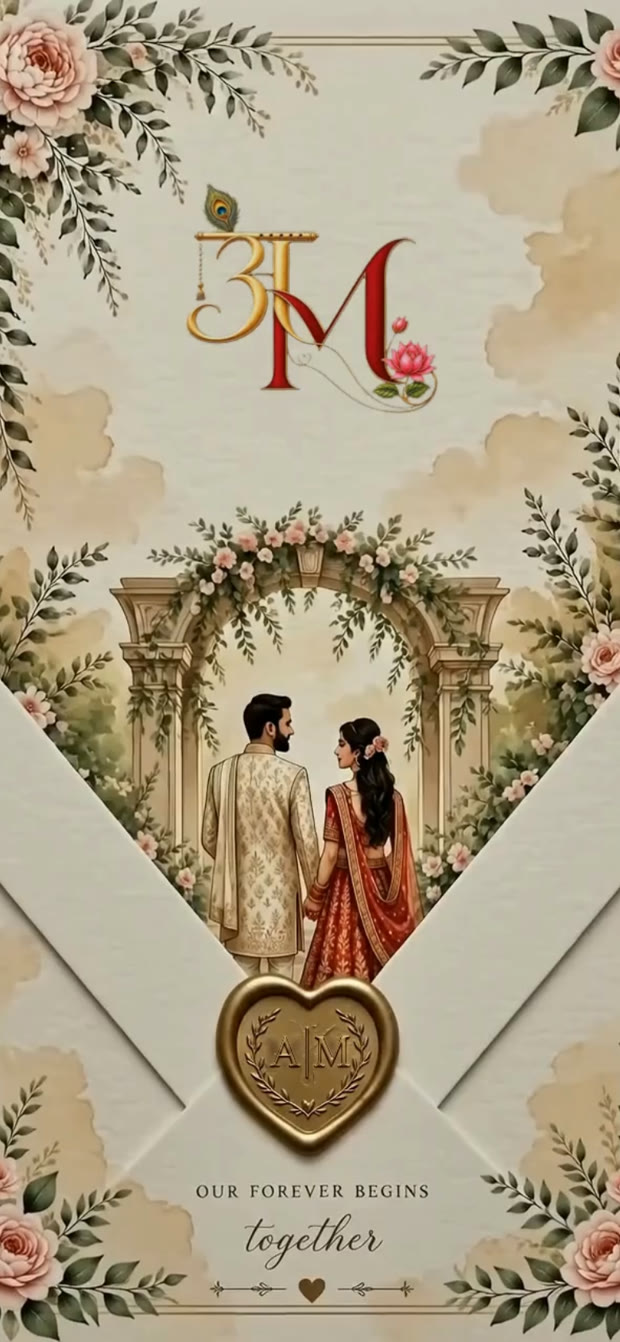
Want these words on a real invitation? See the designs.
Invitation designs
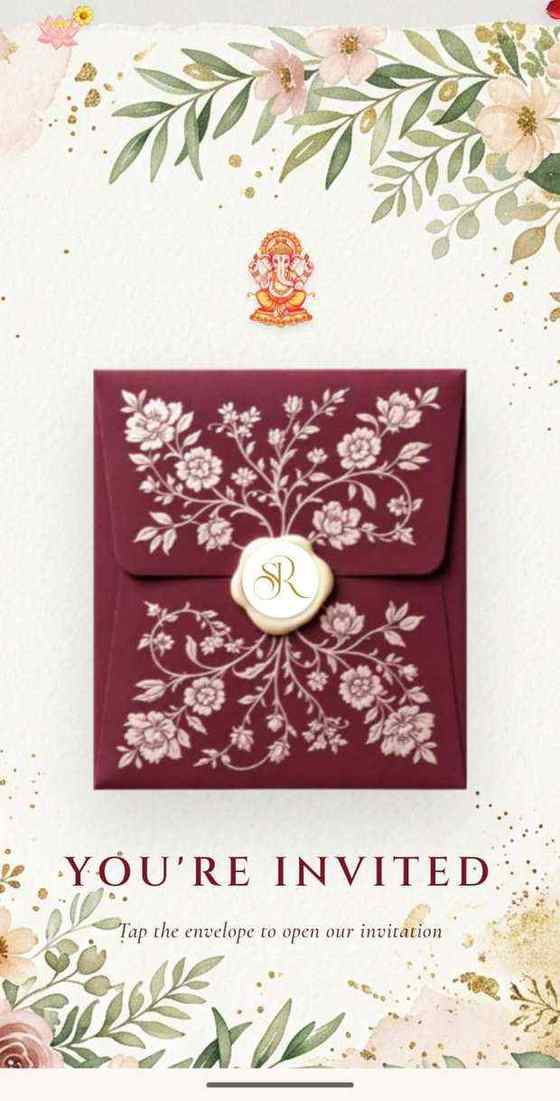
6 designs you can personalise. Open any one to see it full size, with a live demo.

Questions people ask
Whose name goes first on a wedding invitation?
There is no universal rule. Both orders are used and it varies by community. What matters is that both families agree before printing, since in some households the order is read as a statement. When each side sends its own invitation, each puts its own child and family first.
Can the mother's name come before the father's?
Yes, and it is increasingly common. Several families asked us for both mothers' names first this season, on both sides. Many Hindi cards already do it, in the classic form Shrimati evam Shri [Naam].
Should I write Smt. or Mrs. before my mother's name?
Both are correct. Smt. suits a Hindi or traditional card, Mrs. or Mr. and Mrs. an English one. Whichever you choose, use the same style for both families.
How do I mention a parent who has passed away?
Common options are naming them with Late in English or Swargiya in Hindi, adding a blessing line above the host line, or including a short memorial line at the end. In most Indian families they are still named, since leaving them off reads as an erasure.
What is the wording when the couple is hosting?
Open with 'Together with their families, [Bride's name] and [Groom's name] invite you to celebrate their wedding', or in the first person, 'Together with our families, we invite you'. It names both families without putting the parents in the host line.
Should the wedding invitation mention gifts?
Only if you are asking for none. No gifts please, or Blessings only, is gracious. Anything that reads as a request for money or a registry belongs on a website, not on the card. Our no gifts wording guide has lines that sound gracious.
When do I write honour of your presence instead of pleasure of your company?
Honour of your presence is for a ceremony in a place of worship. Pleasure of your company is for everywhere else, including receptions at hotels and banquet halls.
Should I put my home address on the invitation?
Not if the function is elsewhere. Invitations get forwarded well beyond the people you sent them to, so name the venue rather than your house.