On this page
- How to write the host line for your daughter's wedding
- The functions the bride's family usually hosts
- Whom to invite first, and how
- When the bride's father has passed away
- The groom's family's version
- Sending it from your own phone
- A few printed cards for the puja and the elders
- Wording you can copy
- Designs
- Questions
This page is for the parents who write it, pay for it and send it. It covers the host line in English and Hindi, the functions your side usually hosts, the order in which to invite people, what to do when the bride's father has passed away, the groom's family's version, and the few printed cards many families still keep.
How to write the host line for your daughter's wedding
The host line names you as the people inviting. In English the classic form is 'Mr and Mrs [Surname] request the pleasure of your company at the wedding of their daughter', then her name, then the groom's name with his parents'. Use 'honour of your presence' instead if the wedding is in a temple; the wording guide explains why.
In Hindi your daughter's name carries Sau. Kaa. (saubhagyakankshini, a girl who is to be married) or Aayushmati, and the groom's carries Chi. (chiranjeev, may he live long). Each is followed by suputri or suputra and the parents' names. The Hindi guide has every honorific with its meaning.
What bride's parents ask us most
- Both mothers' names before the fathers'. Fine on any card. Write it the same way for both families: Smt. [Mother] and Shri [Father].
- Mr and Mrs instead of Smt. Fine, especially on an English card. Use the same style for the groom's parents.
- A grandparent who has passed. 'Late Shri' in English or स्व. (Swargiya) in Hindi before the name, usually in a blessing line at the top.
- Grandparents who are with you. A blessing line above your names: 'With the blessings of [names]', or आशीर्वाद in Hindi.
- Who gets 'ji'. Families differ. Shri and Smt. already show respect on a card, so many keep ji for their messages. Do the same for both families.
The functions the bride's family usually hosts
Your side usually hosts what happens at your home and at the wedding venue. The details change by community, so treat this as the common pattern rather than a rule.
| Function | What happens | On your invitation |
|---|---|---|
| Mehndi | Henna for your daughter with the women of the family, songs and food. | Often its own, smaller guest list |
| Haldi | Turmeric for the bride at her home. The groom has his own at his. | Morning, family and close friends |
| Sangeet | Music and dance, now often hosted jointly with the groom's side. | Say who is performing, if friends are |
| Mayra or Bhaat | In Marwari, Rajasthani and Haryanvi families, her mama, her mother's brother, arrives with gifts for the family. | A real function with its own time |
| Chooda | In Punjabi families her mama gives the red and white bangles on the wedding morning. | Close family only |
| Baraat welcome | You receive the baraat at the venue, with the swagat or the milni. | The time the baraat arrives |
| Pheras and kanyadaan | The wedding itself, at the muhurat. | The muhurat, in large type |
| Vidaai | Your daughter leaves with her new family. | Usually after the pheras, with no time of its own |
Communities move these around. In Tamil and Telugu weddings the reception is often the evening before the muhurtham; in Bengali weddings the groom's family hosts the Bou Bhaat after the wedding. The Marwari and Punjabi guides list each function in order, and the mehndi guide has wording for that day alone.
Whom to invite first, and how
- Ganesh ji firstIn most Indian homes the first wedding card goes to Ganesh ji, placed at his feet with a few grains of rice. Many families print a few cards for this alone, even when every guest gets a link.
- The elders, in person or by phoneYour parents' generation and the closest relatives should hear it from you. Send the link after the call, so it is a reminder and not the invitation itself.
- FamilyA personal message to each household from your own number. Write sapariwar, or 'with family', so nobody wonders whether the children are invited.
- Your friends and colleaguesA short line in your own words, with only the functions they are invited to.
- RemindersOne message a week before and one the day before, with that day's times and the map.
The messages for each step are below, in English, Hindi and Hinglish. In many families the father writes to his colleagues and the family elders, the mother to her friends and her side of the family, and the bride and her brothers and sisters to their own friends; their messages are in invitation messages for a sister's or brother's wedding.
When the bride's father has passed away
This is the hardest invitation to write, and families handle it in a few ways that are all respectful. Someone still hosts, usually the mother, sometimes with the bride's brother or an uncle, and in many families the father is still named, because leaving him off reads as an erasure.
- The mother as host. 'Smt. [Mother's name] and family request the pleasure of your company at the wedding of her daughter', with 'daughter of the late Shri [Name] and Smt. [Name]' under the bride's name.
- A blessing line at the top. 'With the blessings of the late Shri [Name]'. In Hindi, स्व. श्री [नाम] के आशीर्वाद से, above the host line.
- The brother or an uncle as host. Common when the mother prefers not to be named as host. His name goes in the host line, and the father is named as 'the late' in the bride's line.
- Late or Swargiya. In English write 'the late Shri [Name]'. In Hindi write स्वर्गीय, or its short form स्व., before the name.
On one of our calls in October 2026, a bride and her brother were coordinating her card together because their father had passed away. It is common, and it works well when the work is split: one of you collects the names and checks the wording, the other makes the calls to the elders.
The groom's family's version
The groom's parents will invite their own guests. The easiest way is the same design in their names: his name first, their family listed, and only the functions they host, such as the tilak, the baraat and their reception, with the same wedding date and venue. Guests on both sides see one wedding.
At Invifest this is the 'Invite for the other side': ₹999 on Sindoori and Gulmohar, ₹1,500 on every other design. It reaches you within 2 days of your final invite and has two rounds of changes of its own. See a sample with both sides, or read what changes between the two versions.
Agree one more thing before either card goes out: how much of the other family to print. Usually the groom is written as 'son of Shri and Smt. [names]'. On one Marwari wedding in October 2026, the bride's version listed only the groom's parents and its own family in full, and the groom's version did the reverse.
Sending it from your own phone
Guests trust a message from your number more than a forward. Many mothers and fathers send the invitation themselves, from their own WhatsApp, and the parents we work with ask for exactly that.
If you have three hundred guests and more than one phone in the family sending, Aangan (₹3,000) keeps it in one place. You add the guest list once, every guest gets a personal link from your own WhatsApp, and you can see who has opened it and who is coming. The whole family can use it from their own phones; one family had it open on the parents' and the grandfather's phones at the same time.
Replies to the RSVP form on your invitation go to your private RSVP console, free with the invite. They do not arrive by email one by one: you log in to see them, and you can download them as an Excel sheet for the caterer. RSVP for an Indian wedding explains how to turn those replies into numbers, and sending on WhatsApp how to send three hundred invitations from your own phone.
A few printed cards for the puja and the elders
Even families who send every invitation as a link often keep a handful of printed cards: one for Ganesh ji, one for the family deity or the kuldevi, and a few for elders who like to hold a card. One family asked us for a printable version so the cards could also go into the puja on Dussehra.
The PDF of your invite (₹1,000) is your invitation's own pages laid out page by page in the same design, ready to print. It reaches you within 3 days of your final invite, and if the invite changes later, we make the PDF again once, free. Printing it is up to you and your printer.
Wording and messages you can copy
The card first, in English and Hindi, then the messages for each kind of guest. Change the names, dates and places in [brackets].
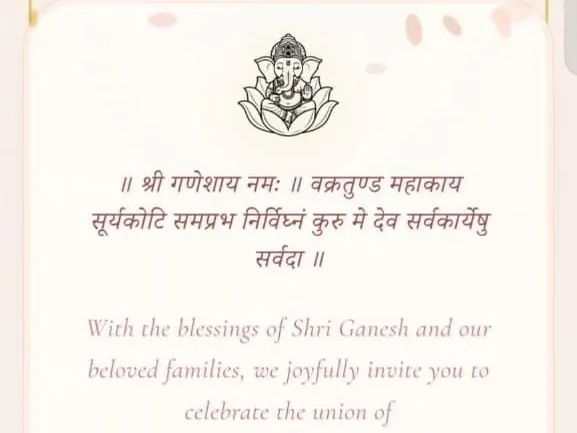
Shree Ganeshaya Namah
Mr and Mrs [Surname]
request the pleasure of your company
at the wedding of their daughter
[Bride's name]
with
[Groom's name]
son of Mr and Mrs [Surname]
[Day, Date] · Muhurat [Time]
[Venue]
Dinner from [Time].
Shree Ganeshaya Namah
Smt. [Mother's name] and Shri [Father's name]
invite you with your family
to the wedding of their daughter
[Bride's name]
with
[Groom's name]
son of Smt. [Name] and Shri [Name]
[Day, Date] · Muhurat [Time]
[Venue]
॥ श्री गणेशाय नमः ॥
सादर निमंत्रण
परमपिता परमेश्वर की कृपा एवं बड़ों के आशीर्वाद से हमारी सुपुत्री
सौ. कां. [वधू का नाम]
का शुभ विवाह
चि. [वर का नाम]
सुपुत्र श्रीमती [नाम] एवं श्री [नाम], [शहर]
के साथ होना निश्चित हुआ है।
इस मंगल बेला पर आप सपरिवार पधारकर वर-वधू को आशीर्वाद प्रदान करें।
बारात आगमन: [दिन, तिथि], सायं [समय]
पाणिग्रहण संस्कार: [समय]
प्रीतिभोज: सायं [समय] से
स्थान: [विवाह स्थल]
दर्शनाभिलाषी: [परिवार के सदस्य]
विनीत: श्रीमती [नाम] एवं श्री [नाम]
Shree Ganeshaya Namah
Sadar Nimantran
Parampita Parmeshwar ki kripa evam badon ke aashirwad se hamari suputri
Sau. Kaa. [Vadhu ka naam]
ka shubh vivah
Chi. [Var ka naam]
suputra Shrimati [Naam] evam Shri [Naam], [Shehar]
ke saath hona nishchit hua hai.
Is mangal bela par aap sapariwar padharkar var-vadhu ko aashirwad pradan karein.
Baraat Aagman: [Din, Tithi], [Samay]
Panigrahan Sanskar: [Samay]
Preetibhoj: [Samay] se
Sthaan: [Vivah sthal]
Vineet: Shrimati [Naam] evam Shri [Naam]
Shree Ganeshaya Namah
With the blessings of the late Shri [Father's name],
Smt. [Mother's name] and family
request the pleasure of your company
at the wedding of her daughter
[Bride's name]
with
[Groom's name]
son of Smt. [Name] and Shri [Name]
[Day, Date] · Muhurat [Time]
[Venue]
॥ श्री गणेशाय नमः ॥
स्व. श्री [पिता का नाम] के आशीर्वाद से
हमारी सुपुत्री सौ. कां. [वधू का नाम]
का शुभ विवाह चि. [वर का नाम]
सुपुत्र श्रीमती [नाम] एवं श्री [नाम]
के साथ [दिन, तिथि] को होना निश्चित हुआ है।
आप सपरिवार पधारकर आशीर्वाद प्रदान करें।
विनीत: श्रीमती [माँ का नाम] एवं परिवार
नमस्ते [नाम] जी,
हमारी बेटी [नाम] की शादी [तिथि] को [शहर] में है। आप सबका आशीर्वाद चाहिए, परिवार सहित ज़रूर पधारिए।
सारे कार्यक्रम, समय और रास्ता इस लिंक पर हैं: [लिंक]
[आपका नाम]
प्रणाम [नाम] जी,
अभी आपसे बात करके मन खुश हो गया। [बेटी का नाम] की शादी का निमंत्रण यह है: [लिंक]
आप आएँगे तो उसे सबसे बड़ा आशीर्वाद मिलेगा।
[आपका नाम]
Hi [Name],
[Daughter's name] is getting married! [Date], in [City].
I want you with me for the mehndi and the wedding. All the timings are on this link: [link]
Please come, I will need my friends that week.
[Your name]
Dear all,
My daughter [Name] is getting married on [Day, Date], and my family would be very happy to have you at the wedding dinner at [Venue], from [Time].
The details and the map are here: [link]
Warm regards,
[Your name]
Sabko namaste,
[Beti ka naam] ki shaadi pakki ho gayi hai! [Tithi] ko [Shehar] mein.
Saare functions, timing aur location is link par hain: [link]
Aap sab sapariwar zaroor aana. Ek-ek ko phone bhi karenge.
[Aapka naam]
मेहंदी की रस्म
[बेटी का नाम] के हाथों में मेहंदी लगेगी, गीत होंगे और ढोलक बजेगी।
[दिन, तिथि] · दोपहर [समय] से
[स्थान]
परिवार की सभी महिलाएँ सादर आमंत्रित हैं।
Our daughter [Name] is getting married to [Groom's name] on [Date], and we would love you to be there with your family.
Everything is on this link: [link]
[Your names]
Kal shaadi hai!
Baraat aagman [Time] par, pheras [Time] par, [Venue] mein.
Dinner [Time] se.
Map aur saari details: [link]
Zaroor aana.
Want these words on a real invitation? See the designs.
Hindu wedding invitation designs
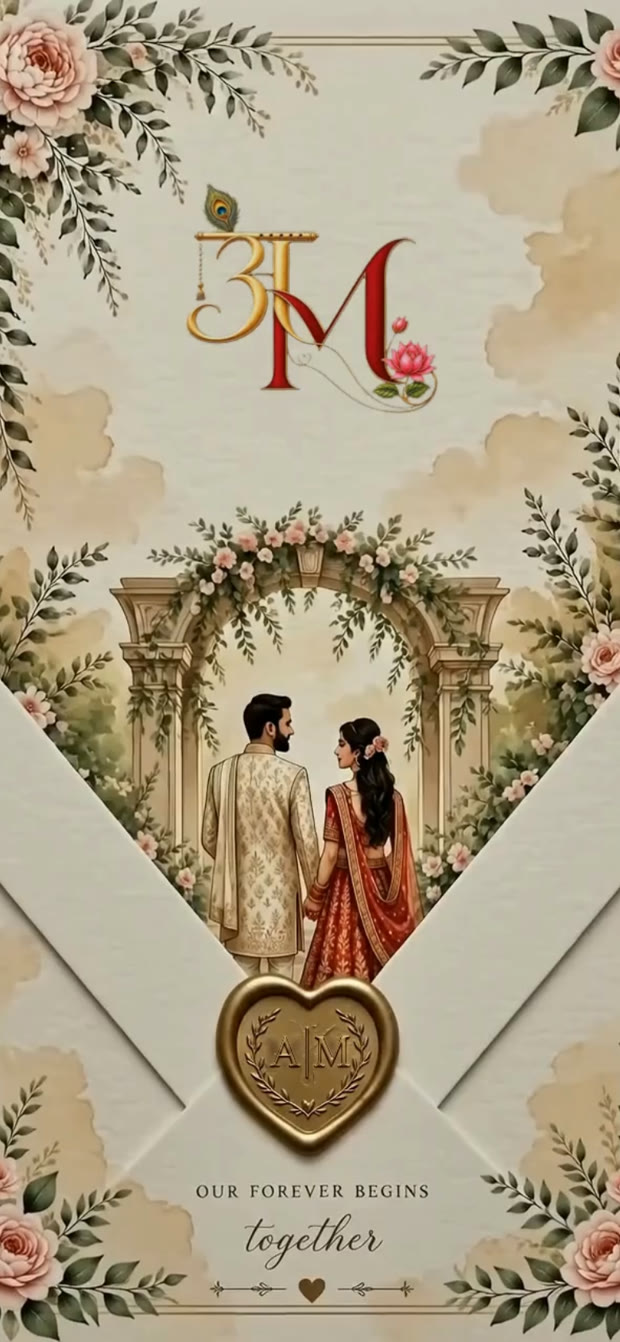
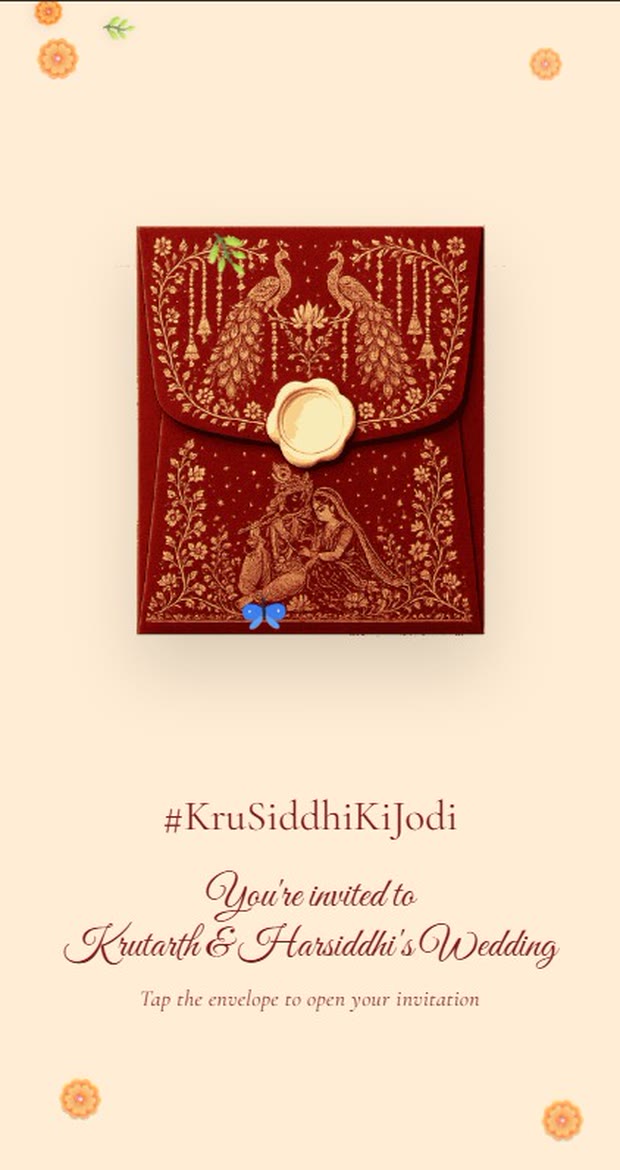
8 designs you can personalise, from ₹2,499. Open any one to see it full size, with a live demo.

Questions people ask
How do I write an invitation for my daughter's wedding?
Open with the host line in your names and 'the wedding of our daughter', then her name, then the groom's name with his parents' names. Add the functions you host with their dates, times and venues, the muhurat, and your family's names at the end.
What is the Hindi wording for a daughter's wedding?
Write her name with Sau. Kaa. (saubhagyakankshini) or Aayushmati, and the groom's with Chi. (chiranjeev), each followed by suputri or suputra and the parents' names. A full Hindi sample is on this page, and the Hindi guide explains each word.
Should the groom's parents be named on the bride's invitation?
Usually yes, as 'son of Shri and Smt. [names]'. Some families print only the other side's parents and their own family in full. Agree it with the groom's family before either card goes out.
Can the groom's family use the same invitation?
Yes, as their own link: the same design, his name first, their family listed and only the functions they host, on the same date. At Invifest it costs ₹999 on Sindoori and Gulmohar and ₹1,500 on other designs.
Who should send the invitation to relatives?
The parents. Call or visit the elders and the closest relatives yourselves, then send the link. Everyone else can get a personal WhatsApp message with the link from your own number.
How do we word the invitation if the bride's father has passed away?
Name him with 'the late' or Swargiya, usually as 'daughter of the late Shri [Name] and Smt. [Name]', and let the mother, a brother or an uncle host. A blessing line at the top is another gentle way.
Do we still need printed cards?
A few. Many families keep printed cards for Ganesh ji, the family deity and elders who prefer paper, and send a link to everyone else. A PDF of the invitation lets you print those few in the same design.