On this page
- The tiers most families use
- Option 1: one link for each tier
- Option 2: a personal link for every guest
- Option 3: one link, and a word in person
- What must not leak
- Wording for a reception-only invitation
- If someone asks why they were not at the haldi
- The bride's side and the groom's side
- Wording you can copy
- Designs
- Questions
Between 10 and 26 October alone, it came up on at least twelve of our calls. Here is how families actually do it, what each option costs at Invifest, the wording that keeps it gracious, and the one rule that matters most: a guest should never see a function they are not invited to.
The tiers most families use
An Indian wedding is a set of functions, and each one has its own guest list. The pattern we see most often has three or four tiers.
| Tier | Usually invited to | Typical guests |
|---|---|---|
| Close family | Every function: haldi, mehndi, sangeet, the wedding and the reception | Grandparents, both sides' uncles and aunts, first cousins, the closest friends |
| The wider circle | The wedding and the reception, sometimes the sangeet | Extended relatives, family friends, neighbours |
| Reception only | The reception | Office colleagues, business contacts, the father's friends |
| Guests with a stay | Their functions, plus a room | Relatives travelling from other cities or from abroad |
Some families go further. One five-day wedding this year had guests for all five days, for four, for three, and for the reception alone. Another separated 'every function with a stay' from 'every function, no stay'. Neither is unusual, and neither is a problem, as long as each guest gets an invitation that shows their functions and only theirs. The wording for each function is in our guides to the haldi, mehndi and sangeet invitations.
Option 1: one link for each tier
The simplest way is one invitation link for close family with every function on it, and a second link for the reception guests with only the reception. Both are the same design with the same names, so it still reads as one wedding, and the reception guest has a complete invitation of their own.
This suits families where the parents will forward the links from their own phones, because two or three links are easy to keep straight. At Invifest, a separate link for one event is ₹999 at checkout, on every design: your names, and only that event's day, time, venue and dress code. For a private link that carries a set of functions rather than one, ask us before you order. Our Terms price it at ₹1,500 a link where the design does not include one, unless we quote you differently. One family this season asked for six links, three for each side.
Option 2: a personal link for every guest
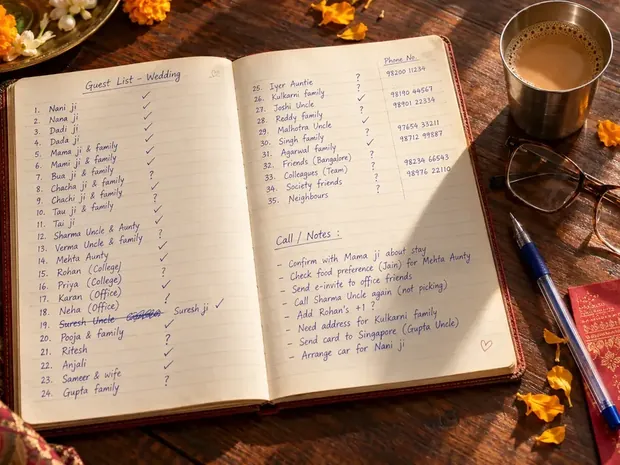
Tiers do not always fit families neatly. The bua's family comes to everything, while her husband's colleagues come only to the reception, and the guest list has a dozen cases like that. Then the answer is a personal link for every guest.
Aangan, our guest dashboard, does this for ₹3,000 with an invitation. You add the guest list once and choose which functions each guest is invited to, and their link greets them by name and shows only those functions. You send it from your own WhatsApp, see who has opened it, who is coming and how many, and the dashboard stays open until 30 days after your last function.
Both options work, and families choose differently. Some who saw the dashboard still chose two or three separate links, because the parents found links easier to forward than a list to manage. Pick the one your family will actually use. Our guide to sending invitations on WhatsApp covers the sending side of both.
Option 3: one link, and a word in person
When the private function is small, some families send one link with every function on it and invite to the private one by a call. An intimate Anand Karaj before a large reception often works this way, and so does a mehndi kept for the women of the family.
Be honest with yourselves about what this means: the link then shows that function to everyone who has it. It works when nobody will mind seeing it, and when the function's own guests are invited personally. If either of those is not true, use option 1 or 2.
What must not leak
Hiding the other functions' cards is not enough. A guest invited to some functions should get everything about their own functions and nothing about the others. This is the checklist we work through on every invitation where different guests see different functions:
- The countdown and the date. If a reception guest's invitation counts down to the wedding morning, they now know there is a wedding morning. Their date and countdown should follow their own function.
- The dress code. Show the looks for their functions only.
- Lines that name other functions. 'See you at the haldi', 'after the pheras', 'seven ceremonies, one celebration'. A title that counts the functions gives the game away too.
- Places. A line naming the ceremony venue and the party venue together tells a reception guest where the ceremony was.
- The RSVP form. Ask about their functions only, so a reception guest is never offered a box for the sangeet.
- Messages, calendar entries and share buttons. If any of them carries the main link, it undoes everything else.
Wording for a reception-only invitation
A reception-only invitation should stand on its own, as our reception guide explains: no apology, no 'only', no mention of the other functions. The reception is an invitation in its own right, usually to the largest guest list of the whole wedding.
One family used 'Aashirwad Samaroh evam Swaruchi Bhoj', a ceremony of blessings and a dinner, on the reception invitation for about 100 business contacts. It is formal and warm, and it asks nothing of anyone. You will find it, with three more versions, in the wording below.
If someone asks why they were not at the haldi
Someone will ask. Keep the answer about the event, never about the person, and keep it short:
- 'The haldi was at home with just the family. There was barely room for us.'
- 'The pheras were at four in the morning because of the muhurat, so we kept them to the family.'
- 'The venue could only take a small number for the ceremony, so we kept that small and the reception big. We were so happy you came.'
- 'Aap aaye, bahut achha laga. Haldi ghar par chhoti si rakhi thi, sirf parivar ke saath.'
What helps most is said before anyone asks. When you call to invite someone to the reception, sound glad about the reception, not sorry about the rest.
The bride's side and the groom's side
Often the tiers are really two families. The bride's family hosts the haldi, the mehndi and the wedding, and the groom's family hosts the baraat and the reception, each with their own guests. The answer then is a second link for the other family: the same design and the same date, with their names first and only the functions they host. Our guide to bride's side and groom's side invitations covers the wording for each.
At Invifest that is Invite for the other side: ₹999 on Sindoori and Gulmohar and ₹1,500 on other designs, with two rounds of changes of its own, ready within 2 days of the first family's final invitation. You can see a sample of the other side's link. Each side's link can carry its own family names too, the swagatotsuk and darshanabhilashi lines families ask for by name, which our Hindi wording guide explains.
Reception-only wording you can copy
Each one stands on its own, with no mention of the other functions. Change the names, the date and the venue. For the main wedding invitation, see our wording guide.
Mr and Mrs [Surname]
request the pleasure of your company
at a reception to celebrate the marriage of their [son / daughter]
[Name]
with
[Name]
[Day, Date] · [Time] onwards
[Venue]
Dinner will be served.
Aashirwad Samaroh evam Swaruchi Bhoj
[Naam] evam [Naam] ke shubh vivah ke upalaksh mein
aap sapariwar sadar aamantrit hain.
[Din, Tithi] · [Samay] se
[Sthaan]
Darshanabhilashi
[Parivar ka naam]
We are married, and now we want to celebrate with you.
[Name] and [Name]
[Day, Date] · [Time] onwards
[Venue]
Dinner, music and far too many photographs.
Namaste [Name] ji,
We would be delighted to have you at the wedding reception of [Name] and [Name] on [date].
The time, the venue and the map are all here:
[link]
Want these words on a real invitation? See the designs.
Invitation designs
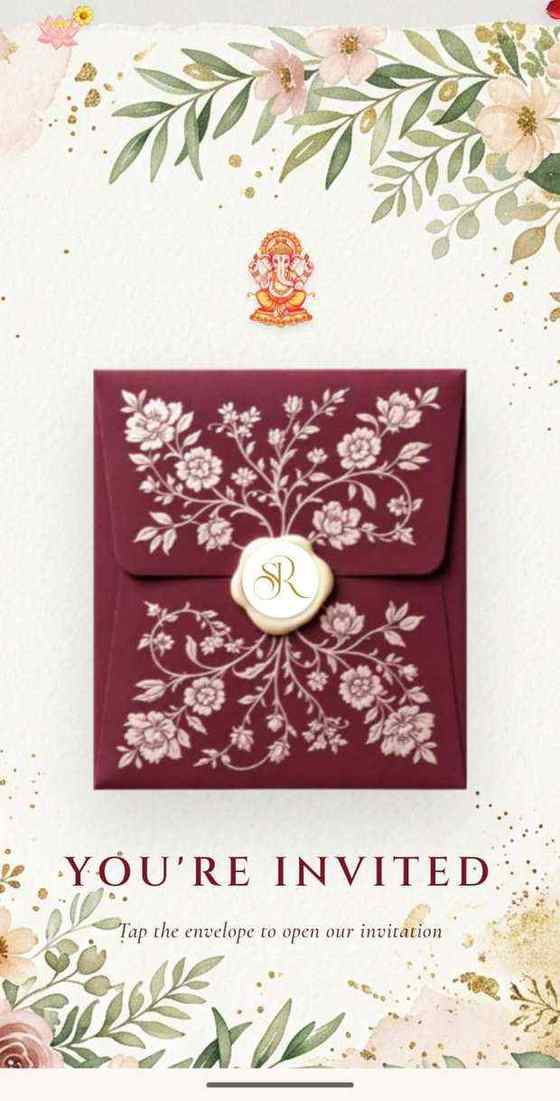
6 designs you can personalise, from ₹2,499. Open any one to see it full size, with a live demo.

Questions people ask
How do I invite someone only to the reception?
Send them a link or a card that carries only the reception: its date, time, venue and the host line, with no mention of any other function. At Invifest, a separate link for one event is ₹999 at checkout.
Is it rude to invite people only to the reception?
No. Colleagues, business contacts and the parents' wider circle are very often invited to the reception alone. It feels rude only when the guest discovers the other functions on the same invitation, so give them an invitation that is complete in itself.
Can one invitation link show different functions to different guests?
Not one shared link: anyone who has the main link sees every function on it. Personal links can, because each one is made for one guest. Invifest's Aangan (₹3,000 with an invitation) gives every guest a link with only their own functions.
How much does a separate link cost at Invifest?
A separate link for one event is ₹999 at checkout, on every design. The other family's link, with their names first and their functions, is ₹999 on Sindoori and Gulmohar and ₹1,500 on other designs. For a private link with a set of functions, ask us before you order.
What if a guest forwards the full invitation?
Whoever receives it sees every function on it. Keep the main link to the people meant to see everything, and give everyone else a link with only their functions, so a forward can only ever pass on what that guest was invited to.
Should the RSVP ask which functions a guest will attend?
Yes, but list only the functions that guest is invited to. A form that lists all five tells a reception guest about the other four. One family removed a fun question, 'Which function are you most excited for?', for exactly this reason.
Do the bride's and groom's families need separate invitations?
Often, yes. When each family hosts different functions for different guests, each sends its own link in the same design, with its own names first and only its own functions.