Wedding invitation timeline: when to send what, on paper and on WhatsApp
The full wedding invitation timeline for India: save the date, invitation, function invites, RSVP deadline, reminders, WhatsApp sends, and festival timing.
Send the invitation 6 to 8 weeks before the wedding, function invitations 4 to 6 weeks before, set the RSVP deadline 3 weeks out, and remind a week and a day before. Guests travelling from abroad need a save the date 10 to 12 months ahead. Many families also start sending on an auspicious day, once the first card has gone to Ganesh ji.
On this page
Almost every invitation problem is a timing problem. Cards ordered too late, sent too early to be remembered, or an RSVP deadline that lands after the caterer needs numbers.
This is the sequence that works for an Indian wedding, counting backwards from the date, with what goes out on paper and what goes on WhatsApp at each step, and from whose phone.
The timeline, counting backwards
| When | Do this | On WhatsApp |
|---|---|---|
| 8 to 12 months | Save the date, if guests are travelling from abroad or it is a destination wedding. Visas and flight prices both need this much notice. | The save the date to each family abroad, one message at a time, with 'the invitation will follow'. |
| 6 to 8 months | Save the date for guests travelling within India. Book the venue and confirm the muhurat, since nothing can be printed until both are fixed. | The save the date to out-of-town family. Call the elders first. |
| 3 to 4 months | Finalise the guest list. Start the invitation design. If you are printing, get quotes now, because good printers book out in season. | Collect every guest's number in one list, with the functions each is invited to and who in the family will send to them. |
| 6 to 8 weeks | Send the invitation. This is the sweet spot: close enough to be remembered, far enough for people to book leave and travel. | Elders first: a call, then the link from the parents' own phones. Then everyone else, a circle at a time, with their name in the first line. |
| 4 to 6 weeks | Send function specific invitations for Sangeet, Mehndi and Haldi, since those guest lists are usually smaller and different. | A separate link for each smaller guest list, showing only its functions. |
| 3 weeks | RSVP deadline. Set it three weeks out, not two, because you will need the week after it to chase people. | Nothing new to send. The reply-by date is already on the invitation and in your message. |
| 2 weeks | Chase the non repliers. Expect roughly a third of your list to need chasing. This is normal and not personal. | One gentle reminder to those who have not replied, then a call. |
| 1 week | Give final numbers to the caterer. Send a reminder message with the link, the timings and the parking situation. | The link again, with the first function's time and where to park. |
| 1 to 2 days | A short message with the next day's timings only. Not the full schedule, just what is happening tomorrow. | Tomorrow's timings and the venue pin, as plain text. |
Festival and muhurat timing
Many families do not start sending on a convenient day. They start on an auspicious one. This season we watched families wait for Navratri to begin, wait until after Dussehra, and wait for the Ganesh ji sthapana at home before a single invitation went out. One family had the muhurat re-checked and asked for the invitations to go out that same night.
The first card usually goes to God, not to a guest: to Ganesh ji at home, to the kuldevta, or for Odia families to Lord Jagannath (Jayee Anukolo). With a digital invitation, families keep the custom by printing that first card, or a few pages of the invite, for the puja. The etiquette guide covers whom to invite next, and how.
Families also avoid starting during the periods they treat as inauspicious for new beginnings, most often Pitru Paksha, and some during Kharmas or Holashtak. The muhurat guide explains each of them, and your pandit will name the day.
When the first sending day is fixed by the calendar, count back from it. The invitation has to be final a few days before, so the details need to reach your designer a week or more ahead. Invifest's first version arrives within 3 days of complete details, or in under 24 hours on request, and you then have 7 days to send your two included rounds of changes.
The digital send plan
- Make one listEvery guest's name, WhatsApp number and the functions they are invited to, in one sheet. Most families start with names on paper, in two or three spreadsheets and in someone's phone. Merge them before anything goes out. The guest list guide shows how families build it.
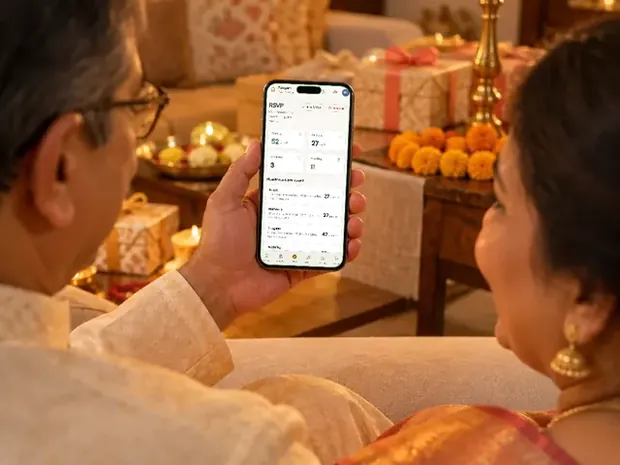
- Decide whose phone sends to whomElders and the parents' friends expect the message from the parents' own number. One family this season opened its guest dashboard on the father's phone, and another on the parents' and the grandfather's phones at the same time, so each could send to their own people.
- Call the elders firstA call, then the link. The call is the invitation; the link carries the details.
- Send a circle at a timePersonal messages in small batches, with gaps between them, are slower than a broadcast and far more likely to be read. WhatsApp's own help pages say a broadcast list reaches only the people who have saved your number.
- Put the reminders in the calendar nowThe day you send, note the RSVP chase, the week-before message and the day-before message, so nobody has to remember them in the busiest fortnight of the year.
The full method, including what to do when a guest says the link will not open, is in how to send wedding invitations on WhatsApp, and the reminder wording is in wedding reminder messages. With Aangan (₹2,999), the list lives in one place, every guest gets a personal link sent from your own WhatsApp, and you can see who has opened it and who is coming.
How many to print
Count households, not people. A family of five gets one card, not five, and this alone usually cuts a list by half.
Then add ten percent. You will forget people, somebody's card will be damaged, and you will want a few to keep.
If you are doing print plus link, print for the households you will visit in person, the elders, the family deity and your own keepsake. In practice that is usually thirty to sixty cards rather than three hundred, and the link covers everyone else.
If you only need a handful, print them from a PDF of the invite itself: the same design, page by page, ready for any printer (see a sample PDF). At Invifest the PDF costs ₹1,000, reaches you within 3 days of the final invite, and is remade once free if the invite changes. The printed or digital guide does the cost maths.
What to collect in the RSVP
- Name and number of guests. Obvious, and still the thing most forms get wrong by not asking for a count.
- Which functions they are attending. Numbers for the Sangeet and the wedding are usually very different.
- Food preference, if you are serving both vegetarian and non vegetarian, or if there are Jain guests.
- Whether they need accommodation, for out of town guests.
- A song request, if there is a Sangeet. It costs nothing to ask and the DJ will thank you.
Our RSVP guide has reply wording that elders do not find abrupt, the reminder plan, and how to turn the replies into numbers for the caterer and the hotel.
The details checklist for your designer
Whoever makes the invitation, the work goes fast when all of this arrives in one message, and stalls when it arrives in pieces over four days.
- Names, spelled exactly, with the honorifics, who gets ji, and which family comes first.
- Parents and grandparents, with Late or Swargiya before anyone who has passed.
- Every function: date, start time, venue, a map pin of the gate guests should use, and the dress code if there is one.
- Who is invited to what, if some guests come only to some functions (how families split it).
- Photos, sent on WhatsApp as documents so they are not compressed, and a song, with the second it should start from (choosing the song).
- The language: English, Hindi, or both side by side.
- One or two contact numbers for guests with questions.
The step-by-step guide to making an invitation website has the full checklist, and the wording guide has a sample for every kind of host.
The messages that go with each stage
Copy any of these and change the names, dates and places. They are written to be read out loud, so they sound right on a phone screen too.
With so much love, we would like you at our wedding.
All the functions, timings and directions are here:
[link]
Do let us know by [date] so we can plan properly.
Namaste [Name] ji,
As we just spoke, here is [child's name]'s wedding invitation, with every function, the timings and the map:
[link]
We will be waiting for you, with family.
Namaste [Naam] ji,
[Naam] ki shaadi ka nimantran bhej rahe hain. Saare karyakram, samay aur raasta is link par hain:
[link]
[Tareekh] tak bata dijiyega ki aap kitne log aa rahe hain.
Gentle reminder, we are finalising numbers this week.
If you have not had a chance yet, it takes a minute:
[link]
Even a no is genuinely helpful right now.
One week to go.
A few things worth knowing: [venue] has parking at [location], the Haldi starts at [time] sharp, and the dress code for the Sangeet is [dress code].
Everything else is still here: [link]
Tomorrow.
Haldi [time] at [venue]
Baraat leaves [time]
Muhurat [time]
See you there.
Want these words on a real invitation? See the designs.
Invitation designs
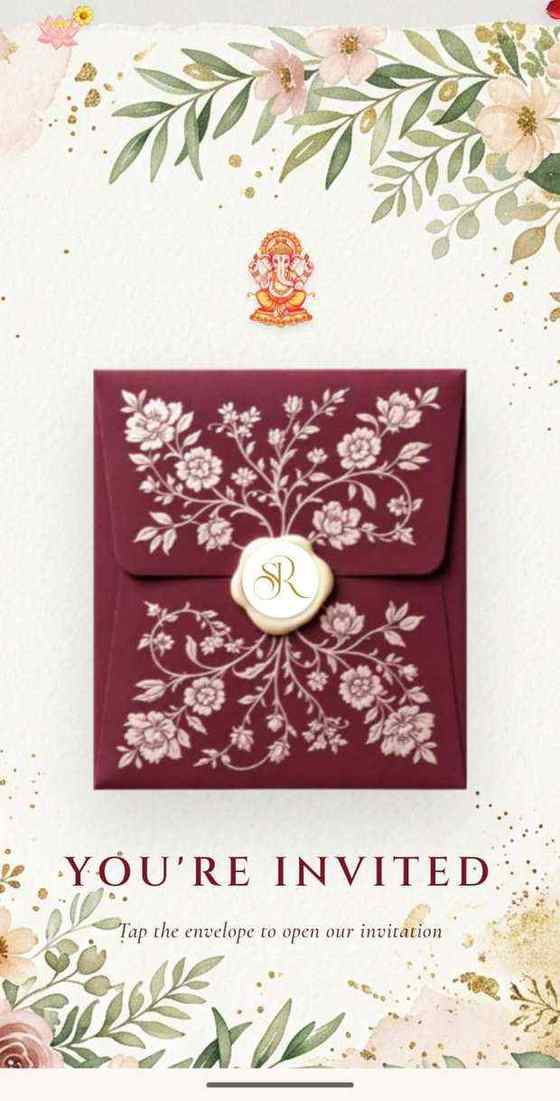
6 designs you can personalise. Open any one to see it full size, with a live demo.


Questions people ask
When should wedding invitations be sent in India?
Six to eight weeks before the wedding. Close enough to be remembered, far enough for guests to book leave and travel. Save the dates go much earlier, six to twelve months depending on distance.
When should the RSVP deadline be?
Three weeks before the wedding, not two. Your caterer will want numbers seven to ten days out and you will need the intervening week to chase, because roughly a third of your list will need chasing.
When should we send WhatsApp invitations?
At the same time as the printed cards, six to eight weeks before. Call the elders first and send them the link from the parents' phones, then send to everyone else a circle at a time, with each guest's name in the first line.
Is there an auspicious day to start sending invitations?
Many families choose one: the start of Navratri, a day after Dussehra, after the Ganesh ji sthapana at home, or a day the pandit names. The first card usually goes to Ganesh ji or the family deity before any guest gets one.
How many wedding cards should we print?
Count households rather than people, then add ten percent. A family of five gets one card. If you are also sending a link, most families print thirty to sixty cards for the people they will visit in person, and a PDF of the invite lets you print a few in the same design.
When do we send invitations for the Sangeet and Mehndi?
Four to six weeks out. Those guest lists are usually smaller and different from the wedding list, so they are worth sending separately and clearly.
What should we ask for in the RSVP?
Name, number of guests, which functions they will attend, food preference and whether they need accommodation. The headcount per function matters most, since catering is the biggest cost driven by a guess.