On this page
This is that order as the families we make invitations for follow it in 2026, with the digital layer most of them now add. Customs differ by region and community, so where your family does something differently, your family's way is the right one.
The first invitation goes to God
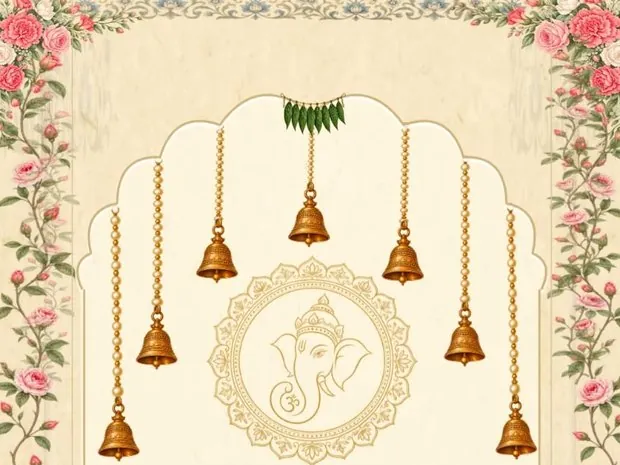
Before a single guest is invited, the first wedding card in most Indian homes goes to Ganesh ji. It is placed at his feet with a few grains of rice and a quiet prayer that everything goes well. Then, before the rest are handed out, someone in the family touches a little kumkum to the corner of every card. Nobody remembers who started it, and nobody ever skips it.
Many families offer the first card to their kuldevta, or at a temple the family is attached to. Odia families take it to Lord Jagannath, often at Puri, a custom called Jayee Anukolo that our Odia wedding guide describes.
A digital invitation has not changed this; families simply do it with what they have. This season, families printed pages of their invitation for the card puja on Dussehra, and others waited for the Ganesh ji sthapana, or for Navratri, before sending the first link. One family had the muhurat re-checked and asked for the invitations to go out that very night.
Who sends the invitation
Whoever hosts. In a traditional wedding that is the parents, so the invitation is in their names and goes out from them: the bride's parents for the functions they host, the groom's parents for theirs. When the couple host the wedding themselves, it comes from the couple, often 'together with our families'.
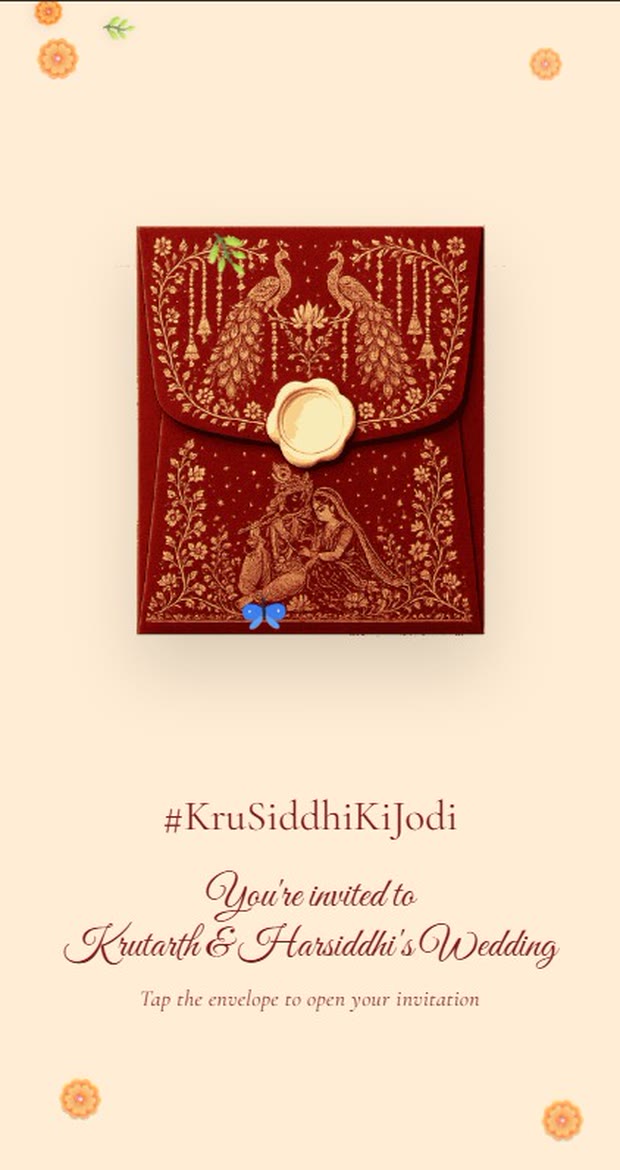
The groom's side usually sends its own invitation to its own guests, with its own family named first. With a digital invitation that is a second link in the same design. The host line in our wording guide shows how each case opens, and the parents' circle should get the message from the parents' own phones.
Whom to invite first, and how
- The family deityThe first card, as above.
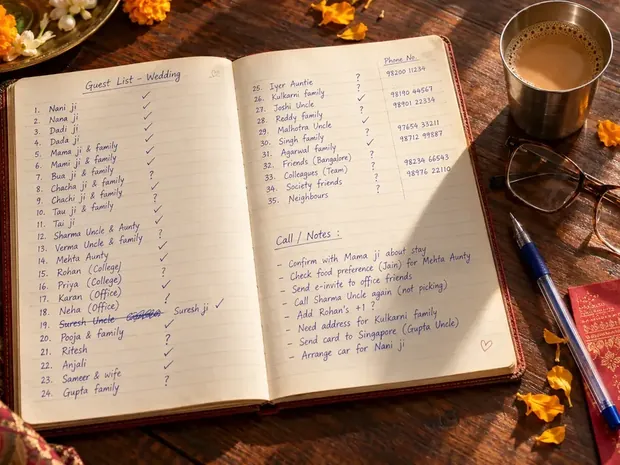
- Grandparents and the eldest relativesIn person, with the card and sweets, or at the very least a call from the parents.
- The mama and bua sidesA visit or a call from the parents, then the card or the link.
- Close family friends and neighboursA call, then the link.
- Friends, colleagues and everyone elseA personal message with the link, their name in the first line.
When to send
| When | What goes out |
|---|---|
| 8 to 12 months before | The save the date, for guests travelling from abroad or to a destination wedding |
| 6 to 8 months before | The save the date for guests travelling within India |
| 6 to 8 weeks before | The wedding invitation |
| 4 to 6 weeks before | Separate invitations for the haldi, mehndi and sangeet, which usually have smaller guest lists |
| 3 weeks before | The reply-by date |
| 1 week before | A reminder with the timings and the parking |
| 1 to 2 days before | A short message with the next day's timings only |
Many families also choose the day the invitations start: after the card puja, on an auspicious day, once the muhurat is confirmed, and not during a period the family avoids. Our muhurat guide explains which periods those are. The full sequence, with wording for each message, is in our invitation timeline, and the save the date has a guide of its own.
Is a WhatsApp invitation acceptable?
For most guests in 2026, yes, with conditions: their name in the first line, a line in your own words, a call before the link for the elders, and a printed card or the PDF of the invitation for those who expect paper. Most couples we make invitations for print thirty to fifty cards instead of three hundred and send the link to everyone else.
Our full answer, with a plan for who gets a visit, a call or a link, is in is it rude to send a wedding invitation on WhatsApp, and digital or printed compares the two honestly.
Sapariwar, plus-ones and children
On a Hindi invitation, 'aap sapariwar padharein' means 'please come with your family'. Leave out sapariwar and the line reads as inviting one person, as our Hindi wording guide explains. When you mean the whole household, say it, and on a digital invitation ask for the headcount on the reply form so the number is theirs to give.
When you cannot invite the whole household, name the people who are invited, on the invitation and in the message: 'Dear Rohan and Priya'. If the wedding is for adults only, say so kindly and early, in the message rather than in small print: 'We love your little ones, but this time we are keeping it to the grown-ups.'
Things that cause offence
- A card with another family's details on it. A template that still carries someone else's names, or another wedding's card with yours typed over it, is always noticed.
- A relative missing from the family list. If the invitation names the extended family, someone will look for their own name. One family we worked with left the paternal and maternal family lists off entirely, so that nobody could be missed.
- Functions a guest is not invited to. A reception guest who opens a link showing the haldi and the mehndi learns what they were left out of. Our guide to inviting guests to only some functions shows how to avoid it.
- A message to a family in mourning, with no word first. Call. In many families a visit is expected.
- Calling the elders last, or not at all.
After the invitation
Two reminders, not ten: a week before and a day before. Answer every blessing and every reply, including the ones that say they cannot come. After the wedding, thank people, from the same phones the invitations went out on.
Keep the replies in one place while they come in, and the thank-you list writes itself. Our RSVP guide shows how families collect them, our reminder messages have the wording for the week before and the day before, and our WhatsApp sending guide covers the sending itself.
Lines for the courtesies
The words that go with the visit, the call and the link. Change the names, the relation and the date.
[Name] ji, aapke aashirwad ke bina yeh shubh kaam adhoora hai.
[Bride's name] aur [Groom's name] ke vivah mein aap sapariwar zaroor padharein.
Namaste [Name] ji. [Bride's name]'s wedding is fixed for [date], and we wanted you to hear it from us first.
I am sending you the invitation on WhatsApp now. Every function and the address are in it.
आदरणीय [नाम] जी,
हमारे [पुत्र / पुत्री] [नाम] के शुभ विवाह के अवसर पर आप सपरिवार सादर आमंत्रित हैं।
सभी कार्यक्रमों का विवरण इस लिंक पर है:
[link]
Thank you for being with us at [Name] and [Name]'s wedding, and for your blessings.
It meant a great deal to the whole family. A few photographs from the day are below.
Want these words on a real invitation? See the designs.
Hindu wedding invitation designs
8 designs you can personalise, from ₹2,499. Open any one to see it full size, with a live demo.


Questions people ask
Who receives the first wedding card?
In most Hindu homes, Ganesh ji or the family deity, then the eldest relatives. Customs differ by region: Odia families offer the first invitation to Lord Jagannath, often at Puri.
Who should send the wedding invitation, the parents or the couple?
Whoever hosts. Traditionally the parents of each side send it in their own names; when the couple host the wedding themselves, it comes from the couple, often together with their families.
Is it rude to invite someone to a wedding on WhatsApp?
Not for most guests today, if it is personal. Call or visit the elders and close family first, then send the link with their name and a line in your own words.
How many weeks before the wedding should invitations go out?
Six to eight weeks before for most guests, with a save the date months earlier for those who travel: six to eight months within India, eight to twelve from abroad.
Should we invite relatives in person?
The elders and close family, yes, with a visit or at least a call from the parents. The card or the link follows.
Is it okay to invite someone only to the reception?
Yes. It is common for colleagues and business contacts. Give them an invitation that carries only the reception, so they never see the functions they are not invited to.