

Vaishnav wedding invitations: invocations, seva and what to write
What makes a Vaishnav wedding invitation different, the invocations used, catering rules that actually matter, and wording you can copy.
On this page
Vaishnav is a broad word. It covers every tradition centred on Vishnu and his forms, which is a very large part of Hindu practice. In Gujarat and Rajasthan, though, when a family says they are Vaishnav they usually mean Pushtimarg, the path established by Shri Vallabhacharya, with Shrinathji at Nathdwara at its centre.
The wedding rituals themselves largely follow the regional pattern, Gujarati or Rajasthani depending on the family. What changes is the framing: the invocations, where blessings are sought, and a set of food rules that are stricter than most caterers expect.
This page covers the parts that actually affect your invitation and your planning. For the invitation itself, Pichwai is our design built around Shrinathji and the Nathdwara pichwai, and Vrindavan paints Radha and Krishna in Braj blues and gold; both are made for Vaishnav families by our designers.
The invocation at the top
Most Hindu wedding invitations open with a Ganesh invocation, usually Shree Ganeshaya Namah. Pushtimarg Vaishnav families very often open instead, or additionally, with Shree Krishnah Sharanam Mama, which means Krishna is my refuge. It is the defining phrase of the tradition and it belongs at the very top.
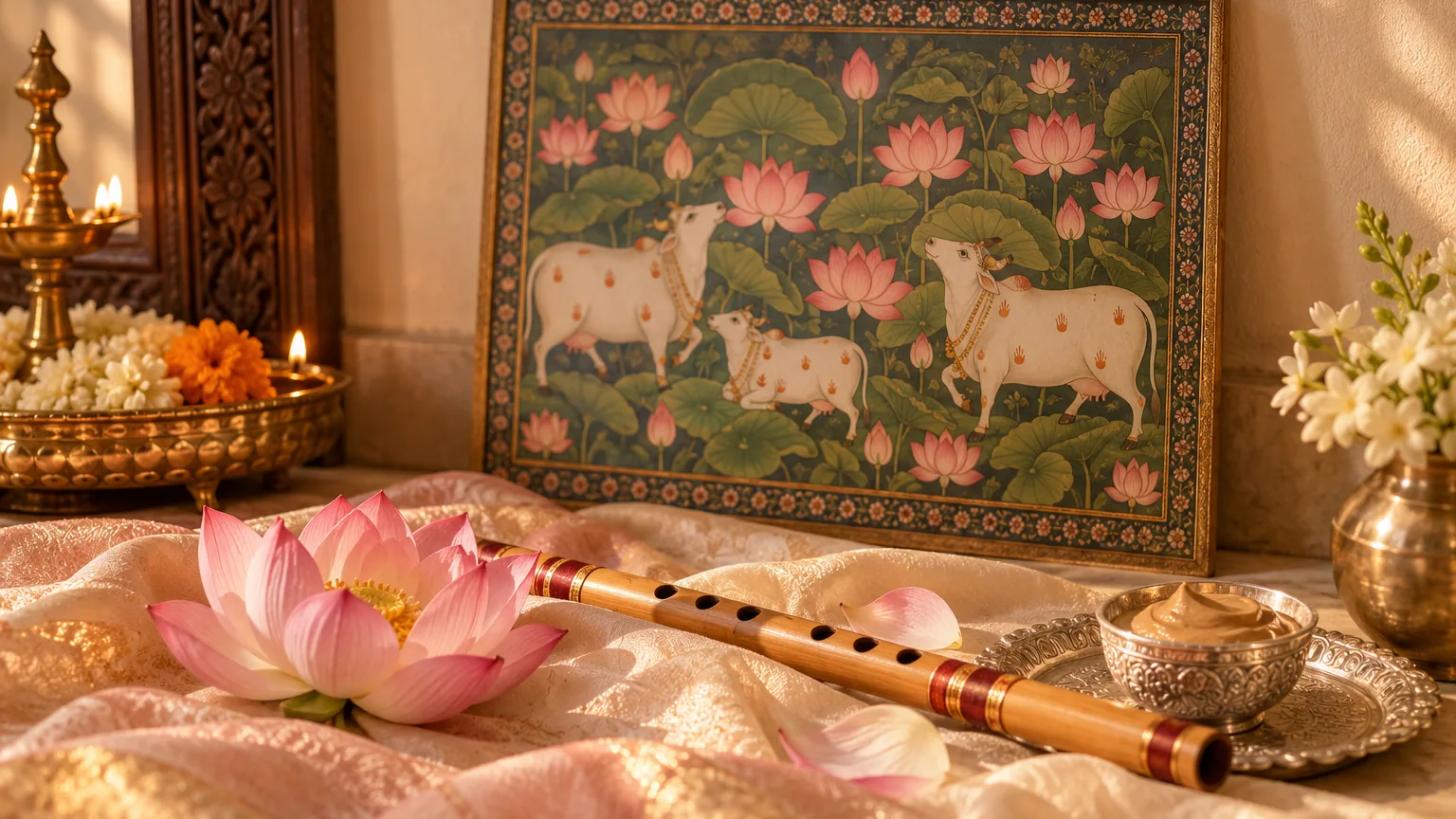
Many families also carry an image of Shrinathji rather than a generic deity motif, and the invitation may mention that the family's seva is at a particular haveli.
If you are having the invitation designed, this is the single detail most worth getting right, because it is the line elders read first.
Food rules your caterer needs in writing
This is where planning most often goes wrong, and it is worth putting on the invitation in some form so guests and vendors both know.
- Strictly vegetarian, and in observant families that extends to no egg in any baked item, which catches out desserts.
- No onion and no garlic in anything served. This is not a preference, it is a rule for many Pushtimarg families, and most banquet kitchens will need it stated repeatedly.
- Prasad and bhog may need to be prepared separately, sometimes by family or by the haveli, and kept apart from the main kitchen.
- Alcohol is generally absent from the functions entirely.
Vaishnav wedding invitation wording you can copy
Copy any of these and change the names, dates and places. They are written to be read out loud, so they sound right on a phone screen too.
Shree Krishnah Sharanam Mama
With the blessings of Shri Nathji and our elders,
we invite you to the wedding of
[Name]
son of [Parents]
with
[Name]
daughter of [Parents]
[Day, Date] · Muhurat [Time]
[Venue]
Shree Krishnah Sharanam Mama
Amara parivar na shubh prasange,
[Naam] ane [Naam] na lagna
[Divas, Tarikh] · [Samay]
[Sthal]
Aap sarve ne sadar aamantran. Bhojan shuddh shakahari, dungli lasan vagar.
Shree Krishnah Sharanam Mama
[Name] and [Name]
[Day, Date] · [Venue]
All meals will be pure vegetarian, prepared without onion and garlic.
Want these words on a real invitation? Browse our Hindu wedding invitation websites.
Hindu wedding invitation designs
Three of our 11 Hindu wedding designs, each made for your family by our designers:
- Pichwai, a Nathdwara pichwai wedding invitation website with Shrinathji, lotus ponds and cows, for Pushtimarg and Gujarati Vaishnav families.
- Vrindavan, a Radha-Krishna wedding invitation website in Braj blues and gold, for Vaishnav, Gujarati and Marwari families.
- Kohinoor, a royal wedding invitation website in gold leaf and deep maroon, for big-fat Indian weddings.
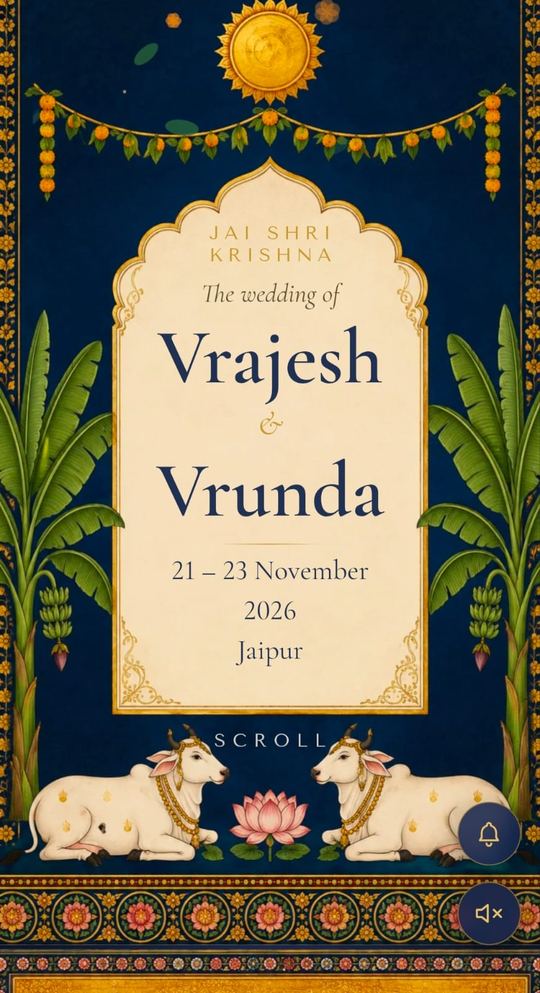
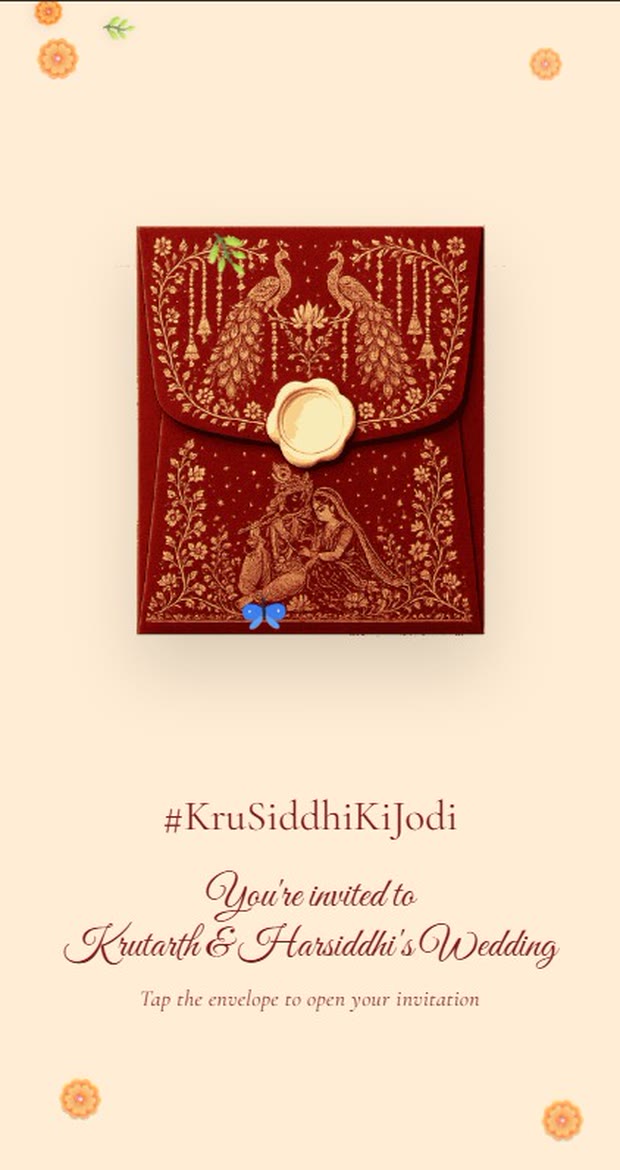

Open any one to see it full size, with a live demo, or browse every Hindu wedding design we make.
Questions people ask
What does Shree Krishnah Sharanam Mama mean?
Krishna is my refuge. It is the defining invocation of the Pushtimarg tradition and it is what most Vaishnav families place at the top of a wedding invitation, in place of or alongside the usual Ganesh invocation.
Is a Vaishnav wedding different from a Gujarati wedding?
The ritual sequence is largely the same if the family is Gujarati. What differs is the framing: the invocation, blessings sought at the haveli, and stricter food rules.
Why no onion and garlic?
Both are treated as rajasic and tamasic in this tradition, unsuited to food offered to the deity and therefore unsuited to food served at an auspicious occasion. For many Pushtimarg families it is a firm rule, not a preference.
Should the food restriction go on the invitation?
It helps, especially if guests outside the community are invited. One plain line is enough, and it prevents confusion at the buffet and awkwardness for the family.
Can we still have a Sangeet and Garba?
Yes. Garba in particular is central to Gujarati Vaishnav celebrations. The devotional framing sits comfortably alongside the music and dancing.


