

Kuan Pujan invitation: card matter in Hindi and English, WhatsApp messages and the card format
Kuan Pujan invitation card matter and WhatsApp messages in Hindi and English, with what the ritual is, when it is held, who invites and the card format.
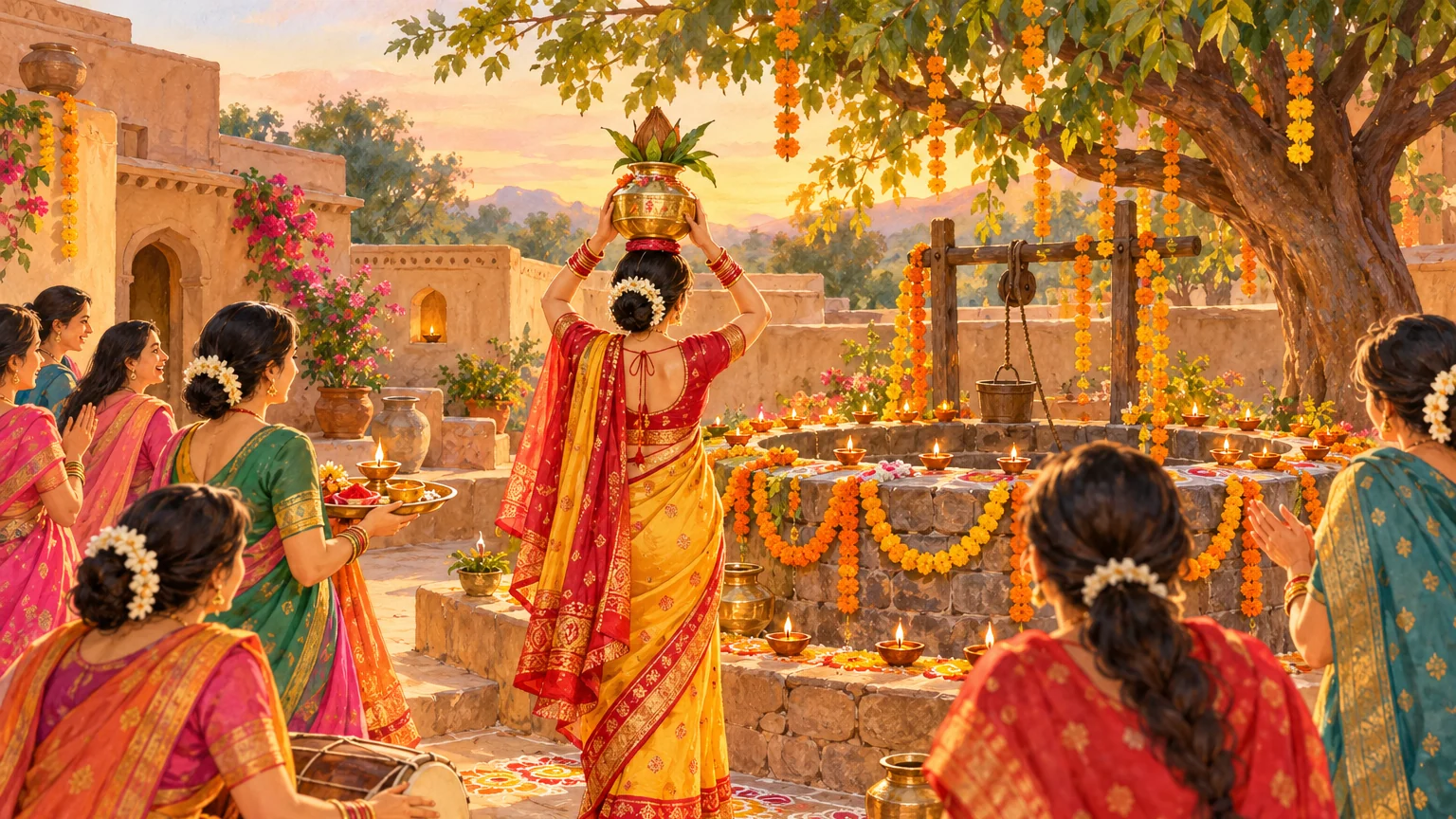
A Kuan Pujan invitation comes from the baby's family, often in the grandparents' names. It gives the happy news, the day, the time of the puja and of the dinner (pritibhoj), the address with a map, and asks guests to come with their families and bless the baby. In Hindi it opens with ॥ श्री गणेशाय नमः ॥ and closes with निवेदक or विनीत. Send it a week or two ahead, with a reminder the day before.
On this page
Kuan Pujan is the well worship that follows a baby's birth in many North Indian homes. The new mother, with the women of the family around her, goes to a well or the house's water source, offers puja to the water and prays for the baby's health and her own. For many families it is also her first proper outing since the birth, and the evening ends with a meal for everyone who came.
The invitation is short, but it follows a format that elders recognise. This page covers what the ritual is and its other names, when it is held, who invites whom, what goes on the card and in what order, card matter in Hindi and English, and how to send it on WhatsApp, as a message or as a video.
What Kuan Pujan is, and its other names
Kuan means a well, and pujan is worship. The ritual thanks the source of the family's drinking water and asks for the well-being of the mother and the newborn. Drik Panchang notes that the muhurta texts call it Jala Puja, water worship, and that it can be done at a river, a water tank, a tap or with a big pitcher of water. That is how many families in towns and cities hold it now, at a tap or a hand pump.
You will see it written as Kuan Pujan, Kuan Poojan, Kua Pujan or Kuan Puja. In Rajasthan the same outing is the Jalwa or Panghat Pujan, and in Hindi it is कुआं पूजन or जलवा पूजन. Families across Haryana, Rajasthan, Uttar Pradesh, Bihar and Madhya Pradesh keep it, each with its own songs and small differences.
Traditionally it was held when a son was born. That has been changing for years. Villages in Haryana's Jind district held it for newborn girls in 2015 and 2016, and in March 2025, as The Tribune reported, mothers in 12 villages of Kaithal district walked to the village wells with a kalash on their heads to celebrate their daughters. Every line of wording on this page works for a boy or a girl.
| What families do | |
|---|---|
| What it is | Worship of a well or the household's water source after a birth, for the mother's and the baby's well-being |
| Other names | Kuan Poojan, Kua Pujan, Jal Pujan; Jalwa or Panghat Pujan in Rajasthan |
| When | At the end of the sutak or later, on a date the pandit picks, often in the evening |
| Where | A well, a hand pump, a tap, or a pitcher of water at home |
| Who takes part | The new mother and the women of the family and the neighbourhood, then everyone invited for dinner |
| What follows | Blessings and gifts for the baby, and a dinner, the pritibhoj |
What happens on the day
Every family has its own order, and the elders will know yours. A common shape for the day:
- The women gather at homeRelatives and neighbours come to the house. The new mother is dressed in new clothes, and the puja thali is made ready with roli, rice, turmeric, a red kalava thread, flowers and sweets.
- The walk to the waterShe carries a kalash on her head, and the women walk with her to the well, the hand pump or the tap, singing as they go. For many mothers this is the first time out of the house since the birth.
- The pujaShe worships the water with the roli, rice, turmeric and thread, offers the sweets, and prays for the baby and the household.
- Blessings at homeBack at the house, the elders bless the mother and the baby, and relatives give their gifts for the baby: clothes, silver, a toy or an envelope.
- The dinnerA pritibhoj for everyone invited, and in some families a bhajan sandhya, an evening of devotional songs.
When it is held
There is no single fixed day. In many families Kuan Pujan marks the end of the sutak, the days of seclusion after a birth. Rajasthani accounts put the Jalwa just after the mother's first full bath, on the sixth or seventh day, or a few days after the naming on the twelfth. Other families wait weeks or months for a good muhurat.
The pandit fixes the date from the panchang. Drik Panchang's rules, for example, avoid the months of Chaitra and Pausha and prefer a Monday, Wednesday or Thursday. The puja is often held in the evening, with dinner after it.
Who invites whom, and when to send it
- The baby's family invites. The puja is usually held at the home of the baby's father, and the card often goes out in the grandparents' names, with the parents named as the baby's parents.
- The women of the family and the neighbourhood walk to the water with the new mother, so invite them for the time the walk starts, not the time of dinner.
- The nanihal, the new mother's own family, hears first, by phone. After a birth they send gifts for her and the baby, called the Chhuchhak in parts of Haryana and Rajasthan. If they are bringing it on the day, give them a line on the card.
- Everyone else is invited for the puja and the dinner: relatives, family friends, neighbours and colleagues.
Because the date depends on the birth and the muhurat, the invitation usually goes out only a week or two ahead. Call the elders and the nanihal first, then send the card or the link, and send a short reminder the day before with the time the women gather and the map.
What to put on a Kuan Pujan card
- An invocation at the top, usually ॥ श्री गणेशाय नमः ॥, or your family deity's name.
- The good news in one line: the birth of a son or a daughter, with the parents' names. Add the baby's name only if the naming is already done.
- The ceremony's name as your family says it: Kuan Pujan, Kuan Poojan or Jalwa Pujan.
- The day and the date, with the time the women gather or the puja starts.
- The pritibhoj, the dinner, with its own start time, so guests know they are expected to eat.
- The address with a map pin, for the house, and for the well or temple if the puja happens there.
- The hosts' names under निवेदक or विनीत, and the family members under दर्शनाभिलाषी or स्वागतकर्ता.
- One or two phone numbers for anyone who needs directions.
The card format, top to bottom
Hindi function cards follow an order that elders recognise, and a Kuan Pujan card keeps it. The same order works for a WhatsApp message or an invitation link:
- The invocation॥ श्री गणेशाय नमः ॥ at the top, or the family deity's name.
- The headingसादर आमंत्रण, a respectful invitation, or शुभ समाचार, good news.
- The newsWho has been blessed with a son or a daughter, with the parents' names and the honorifics your family uses, such as चि. and सौ.
- The invitationOne line inviting guests with their family (सपरिवार) to the Kuan Pujan and the pritibhoj.
- The programmeThe date, the day, the time of the puja and the time of the dinner, one under the other.
- The placeThe full address, with a map pin when it goes out on WhatsApp or as a link.
- The namesनिवेदक or विनीत above the hosts, then दर्शनाभिलाषी above the family who look forward to seeing you.
- The children's lineMany Hindi cards end with a बाल मनुहार, a playful request in the voice of the family's children. There is one in the wording below.
Sending it on WhatsApp
- Call first, then send. Elders and the nanihal expect a phone call, and the message follows it.
- Put the details in the text, not only in a picture or a video. A guest who searches the chat for the time or the address cannot search inside an image.
- Send the location as a map pin of the house gate, not the middle of the colony.
- Send it personally to close family, and once to the family group for everyone else.
- Send a reminder the evening before with the time the women gather and the map.
The WhatsApp guide covers broadcast lists, groups and timing in more detail. It is written for weddings, and the same rules hold for a Kuan Pujan.
A card, a video or a link
Many families send a Kuan Pujan video: twenty or thirty seconds of a baby illustration, a folk song and the date in Hindi, made to forward on WhatsApp. A video is a lovely way to share the news. It is a poor way to carry the details, because a guest cannot tap it for the map, and a changed time means making the video again. If you send one, put the time and the address as text under it. A screen-by-screen script is in the wording below.
A link holds the details: the programme in order, the address under a map button, and a reply form so you know how many are coming to dinner. Kanha, our design painted with baby Krishna, is made for the ceremonies around a new baby, and the Kuan Pujan and the dinner can sit on it as cards of their own, in Hindi or English. Invifest makes invitations and guest management for weddings and every big moment, and a baby's first puja is one of them.
Before the birth, the Godh Bharai, or the Seemantham in South Indian homes, has wording of its own, and so do the Namkaran, the Annaprashan and the Mundan that follow.
Kuan Pujan wording you can copy
Hindi first, then Hinglish and English. Change the names, dates, times and address in [brackets], and choose the son or daughter line that fits.
॥ श्री गणेशाय नमः ॥
सादर आमंत्रण
ईश्वर की असीम कृपा से हमारे सुपुत्र चि. [पिता का नाम] एवं पुत्रवधू सौ. [माता का नाम] को [पुत्र / पुत्री] रत्न की प्राप्ति हुई है।
इस शुभ अवसर पर कुआं पूजन एवं प्रीतिभोज का आयोजन किया गया है। आप सपरिवार पधारकर नवजात शिशु को अपना आशीर्वाद प्रदान करें।
दिनांक: [दिनांक], [वार]
कुआं पूजन: सायं [समय] बजे
प्रीतिभोज: सायं [समय] बजे से
स्थान: [पता]
निवेदक: [दादा-दादी के नाम]
दर्शनाभिलाषी: [परिवार के सदस्यों के नाम]
॥ श्री गणेशाय नमः ॥
हमारे घर लक्ष्मी आई है।
ईश्वर की कृपा से हमारे परिवार में बिटिया का जन्म हुआ है। उसके स्वागत में कुआं पूजन एवं प्रीतिभोज का आयोजन किया गया है।
आप सपरिवार अवश्य पधारें और बिटिया को आशीर्वाद दें।
[दिनांक], [वार]
कुआं पूजन: सायं [समय] बजे
प्रीतिभोज: [समय] बजे से
स्थान: [पता]
विनीत: [परिवार के नाम]
नमस्ते [नाम] जी,
हमारे घर नन्हे मेहमान के आने की खुशी में [दिनांक] को शाम [समय] बजे कुआं पूजन है, उसके बाद भोजन।
आप परिवार के साथ ज़रूर आइए।
पता और मैप: [लिंक]
[आपका नाम]
बाल मनुहार
[मेरे नन्हे भैया / मेरी नन्ही बहना] के स्वागत में
कुआं पूजन है, आप सब ज़रूर आना,
आशीर्वाद देना और मिठाई खाकर जाना।
[बच्चों के नाम]
कल शाम [समय] बजे कुआं पूजन है।
महिलाएं [समय] बजे तक घर पर आ जाएं, यहीं से साथ में [कुएं / मंदिर] चलेंगे।
प्रीतिभोज [समय] बजे से।
मैप: [लिंक]
स्क्रीन 1: ॥ श्री गणेशाय नमः ॥
स्क्रीन 2: हमारे घर नन्हे मेहमान आए हैं
स्क्रीन 3: कुआं पूजन, [दिनांक], सायं [समय] बजे
स्क्रीन 4: प्रीतिभोज [समय] बजे से, [स्थान]
स्क्रीन 5: आप सपरिवार सादर आमंत्रित हैं
स्क्रीन 6: [परिवार का नाम]
वीडियो के साथ यह भी लिखें: समय, पता और मैप: [लिंक]
Namaste [Naam] ji,
Hamare ghar nanhe mehmaan aaye hain! Isi khushi mein [Tithi] ko shaam [Samay] baje Kuan Pujan hai, uske baad khana.
Aap parivaar ke saath zaroor aaiye.
Address aur map: [link]
[Aapka naam]
Shree Ganeshaya Namah
With the blessings of the Almighty and our elders,
we are happy to share that our son [Father's name] and daughter-in-law [Mother's name] have been blessed with a [baby boy / baby girl].
We request the pleasure of your company, with your family, at the
Kuan Pujan and dinner
[Day, Date]
Kuan Pujan: [Time] in the evening
Dinner: from [Time]
[Address]
With regards,
[Grandparents' names] and family
Our little one is home.
[Father's name] and [Mother's name] invite you to the Kuan Pujan of our [son / daughter], [Baby's name].
[Day, Date] · [Time]
[Address]
Dinner follows.
Come and bless the baby, and the new mother.
Lakshmi has come home.
We are celebrating the birth of our daughter with a Kuan Pujan and dinner.
[Day, Date]
Kuan Pujan at [Time] · Dinner from [Time]
[Address]
Please come with your family and bless her.
[Family name]
Hello [Name],
We are holding our baby's Kuan Pujan on [Day, Date] at [Time], with dinner after. We would love you and your family to come and bless the little one.
Time, address and map: [link]
[Your name]
Just the family, at home.
Kuan Pujan for our little one
[Day, Date] · [Time]
The puja will be at home, with dinner after.
[Area], map: [link]
Tomorrow is the Kuan Pujan.
The ladies gather at home by [Time], and we walk to the [well / temple] together.
Dinner from [Time].
Map: [link]
Want these words on a real invitation? See the designs.
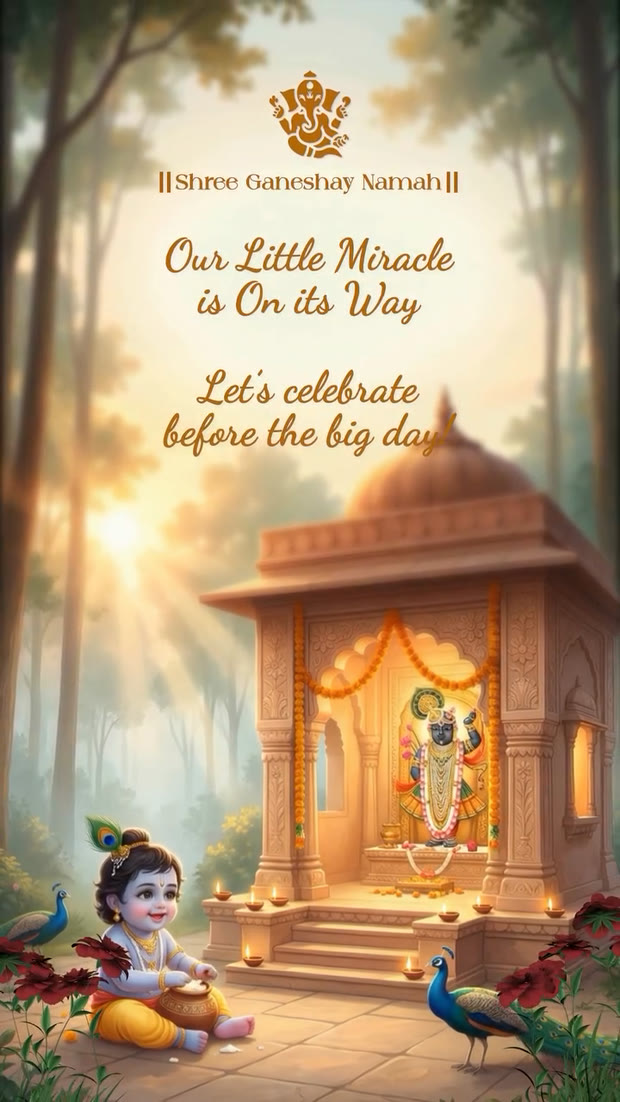
Baby shower invitation designs
2 designs you can personalise. Open any one to see it full size, with a live demo.

Questions people ask
What is Kuan Pujan?
A North Indian ritual after a baby's birth in which the new mother, with the women of the family, worships a well or the household's water source and prays for the baby's health and her own. It is also called Kuan Poojan, Kua Pujan or Jal Pujan, and Jalwa or Panghat Pujan in Rajasthan. It usually ends with a dinner for the guests.
When is Kuan Pujan done after the birth?
There is no single day. Many families hold it at the end of the sutak, the days of seclusion after a birth, and Rajasthani accounts place the Jalwa after the sixth or seventh day or soon after the naming. Others wait weeks or months for a good muhurat. The family pandit fixes the date from the panchang.
What should I write on a Kuan Pujan invitation card?
An invocation such as Shree Ganeshaya Namah, the good news with the parents' names, the ceremony's name, the date, the time of the puja and of the dinner, the address with a map, and the hosts' names. Add the baby's name only if the naming is done.
How do I write a Kuan Pujan invitation in Hindi?
Open with ॥ श्री गणेशाय नमः ॥ and सादर आमंत्रण, give the news (हमारे सुपुत्र ... को पुत्र रत्न की प्राप्ति हुई है), invite guests with their families (आप सपरिवार सादर आमंत्रित हैं), list the कुआं पूजन and प्रीतिभोज times and the address, and close with निवेदक or विनीत above the hosts' names. Full samples are on this page.
What is a good Kuan Pujan invitation card matter in English?
Shree Ganeshaya Namah. With the blessings of the Almighty and our elders, we are happy to share that our son and daughter-in-law have been blessed with a baby. We request the pleasure of your company, with your family, at the Kuan Pujan and dinner, then the date, the two times, the address and the grandparents' names.
What is a short Kuan Pujan message for WhatsApp?
Hello [Name], we are holding our baby's Kuan Pujan on [date] at [time], with dinner after. We would love you and your family to come and bless the little one. Time, address and map: [link]. Hindi and Hinglish versions are in the samples on this page.
Can Kuan Pujan be done for a baby girl?
Yes. It was traditionally held for sons, but families and whole villages now hold it for daughters too. In March 2025 mothers in 12 villages of Haryana's Kaithal district walked to the wells with a kalash on their heads to celebrate their daughters.
Can we do Kuan Pujan without a well?
Yes. Drik Panchang notes the ritual can be done at a river, a water tank, a tap or with a big pitcher of water, and many families now hold it at a hand pump or a tap at home. Say on the invitation where the women should gather.
Should we make a Kuan Pujan invitation video?
A short video is a warm way to share the news, but guests cannot tap it for a map, and a changed time means a new video. If you send one, put the date, the time and the address as text under it, or send a link that holds the details and collects replies.
Who is invited to a Kuan Pujan?
The women of the family and the neighbourhood, who walk to the water with the new mother; the nanihal, her own family; and relatives and friends for the puja and the dinner. Call the elders before you send the message.


