

Seemantham and Valaikappu invitation: what to write in English for Telugu, Tamil and Kannada homes
Seemantham and Valaikappu invitation wording in English for Telugu, Tamil and Kannada homes: the month, who hosts, the bangles, the card and WhatsApp lines.
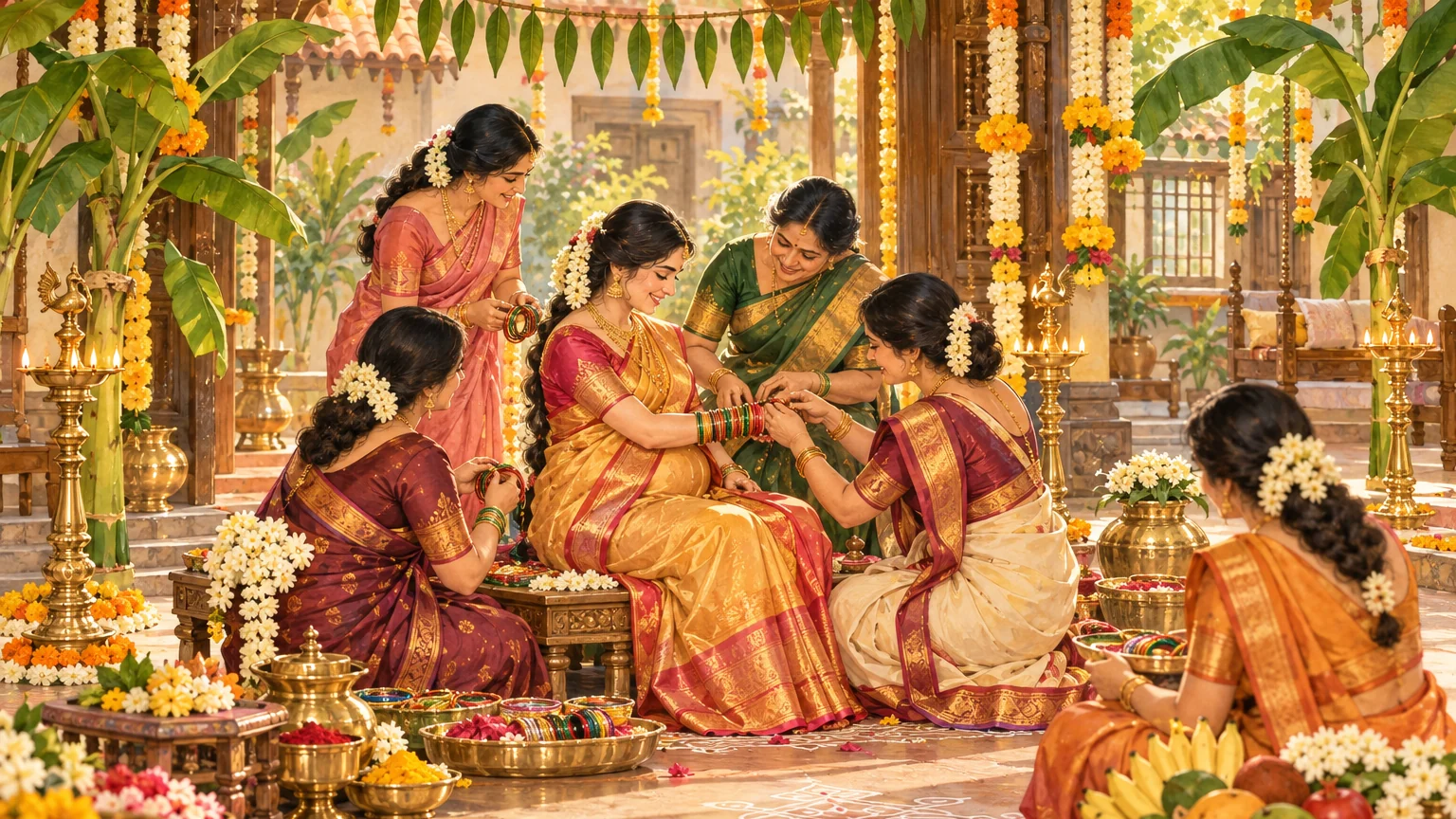
A Seemantham or Valaikappu invitation comes from the family hosting it and gives the mother-to-be's name, the ceremony as your family calls it, the date and muhurtham, the venue with a map and the lunch. Seemantham is the Vedic rite held in Telugu, Kannada and Tamil homes; Valaikappu is the Tamil bangle ceremony, often on the same day. Say whether it is for women only and whether guests should bring bangles.
On this page
- Seemantham, Valaikappu and the other names
- What happens at each
- When it is held, and who hosts
- What to put on the invitation
- Short, light and gender-neutral
- English wording for Telugu, Tamil and Kannada families
- Sending it on WhatsApp
- A Seemantham invitation as a link
- How Invifest does this
- Wording you can copy
- Designs
- Questions
Seemantham and Valaikappu are the South Indian ceremonies for a woman in the later months of her first pregnancy. Seemantham, from the Sanskrit Simantonnayana, is a puja for a safe birth. Valaikappu is the Tamil bangle ceremony, where the women of the family fill her wrists with glass bangles. Many Tamil families hold both on one day, and then the invitation names both.
This page explains the names (Seemantham, Srimantham, Seemantha, Valaikappu and Pumsavana), the month, who hosts, what goes on the invitation, English wording for Telugu, Tamil and Kannada families, and messages for WhatsApp.
Seemantham, Valaikappu and the other names
Simantonnayana means parting the hair upwards. It is the third of the sixteen samskaras, and in its Vedic form the husband parts his wife's hair upward three times, with darbha grass, unripe udumbara (cluster fig) fruits or a porcupine quill, while mantras are chanted (Wikipedia has the detail). The family then blesses her and feeds her, and over time the day has become the South Indian baby shower.
| Name | Who says it | What it is |
|---|---|---|
| Seemantham (సీమంతం, சீமந்தம்) | Telugu, Tamil and Kannada families | The Vedic rite for a safe birth, with a puja and the parting of the hair |
| Srimantham | Telugu families, in everyday speech | Another name for the Seemantham |
| Seemantha (ಸೀಮಂತ) | Kannada families | The Kannada name, traditionally held in the seventh month at her husband's home |
| Valaikappu or Valaikaapu (வளைகாப்பு) | Tamil families | The bangle ceremony (valai means bangle), often held on the same day as the Seemantham |
| Pumsavana | Families who keep the Vedic rites | An older, separate samskara that the texts place in the second to fourth month; some families perform it with the Seemantham as Pumsavana Seemantham |
| Godh Bharai, Shaadh, Dohale Jevan | North India, Bengal, Maharashtra | The same occasion elsewhere in India |
What happens at each
At a Seemantham
- Ganapathi puja and the sankalpamThe priest begins, with the couple seated together.
- The homamIn families that keep the Vedic form, a fire ritual for the mother and the child.
- The parting of the hairThe husband parts her hair upward, and kumkum is put in the parting.
- Blessings and the mealThe elders bless her with akshata, and she is served the dishes she has been craving.
At a Valaikappu
- The first banglesIn many Tamil Brahmin families her mother and mother-in-law begin with three bangles: one of neem leaves, one of silver and one of gold.
- Glass bangles on both wristsThen the married women present, usually those who have children of their own, slide glass bangles onto her wrists, red and green, in odd numbers. The sound of the bangles is believed to reach the baby.
- Sandal, turmeric and flowersSandal paste and turmeric on her hands and face, flowers in her hair, and an aarti.
- Variety riceIn some families she is served seven kinds of rice, tamarind, lemon, curd and coconut among them, and the guests eat with her.
After the Valaikappu she usually goes to her mother's home to rest until the birth. That is why the function often doubles as a send-off, and why her own family often hosts it.
In Karnataka the day turns on her cravings. Her husband's family gives her a new saree and jewellery, her mother-in-law puts kumkum on her, and the kitchen makes the sweets and snacks she has been longing for, chakkuli, laddu and holige among them.
When it is held, and who hosts
- The month. Usually the seventh, but it varies. Tamil families usually choose an odd month, the fifth, seventh or ninth; Telugu accounts give the sixth or eighth; Kannada families traditionally hold the Seemantha in the seventh. The family priest fixes the day and the muhurtham.
- The first pregnancy. Traditionally it is done once, in the first pregnancy. Families differ on whether to repeat it.
- Who hosts. It depends on the family. A Kannada Seemantha is traditionally held at her husband's home. Many Tamil families hold the Valaikappu at her mother's home, and where both are held on one day, the Seemantham is often her husband's family's and the Valaikappu her mother's. The invitation comes from whoever is hosting, and names both families if both are.
- Who comes. The Valaikappu is traditionally performed by the women of the family, and many families keep it that way. The Seemantham's puja includes her husband, the priest and the elders of both families. Say plainly on the invitation whether men are invited.
Send the invitation two to three weeks ahead, with a reminder the day before. Keep the programme short, because she should not have to sit for hours, and be ready to move the date if her doctor asks.
What to put on the invitation
- The ceremony's name as your family says it: Seemantham, Srimantham, Seemantha or Valaikappu, or both names if you hold both.
- Her name and her husband's, with the honorifics your family uses. The card comes from the hosts, so it says our daughter or our daughter-in-law.
- The date and the muhurtham. If both ceremonies are held, give each its own time.
- The venue, with a map pin of the house or the hall.
- The meal. A morning muhurtham usually ends in lunch. Say so, and guests will not eat before they come.
- Bangles. Say whether guests should bring a pair of glass bangles for her, or whether the family will have a tray ready.
- Who is invited: ladies only, or the whole family.
- One or two numbers for relatives with questions.
Short, light and gender-neutral
What families ask for on a baby shower invitation holds for a Seemantham too. The fullest list we heard this year came from one family's call:
- Four swipes, no more. 'Chaar swipe mein' was how the family put it: the blessing, her name, the day and the place, and the reply.
- Colours that do not guess. White, cream or yellow rather than pink or blue. Pink, the family said, would look like a girl.
- No name for the baby. The name comes at the Namkaran.
- No cute labels if they are not you. The same family dropped the 'parents-to-be' and 'proud big brother' lines and kept the invitation about the blessing.
- A guess, just for fun. A boy-or-girl guess in the reply makes guests smile. In India it stays a guess until the birth: under the PCPNDT Act, nobody may tell a family the sex of the baby before it is born.
- No gifts, said kindly. 'Your blessings are the only gift we need. Kindly no gift boxes.' Our no gifts wording has more lines like it.
- A blessing to open, and the full song. Open with Sri Ganeshaya Namaha, the Pillaiyar Suzhi or your family's own line, and send the full track of your song, not a short reel clip that loops.
- The countdown in the right time, if relatives abroad will watch it: it should count down to the muhurtham where the ceremony is held.
English wording for Telugu, Tamil and Kannada families
An English invitation that keeps the ceremony's own name reaches relatives in every city and still reads as yours. A few touches make it feel right to elders:
- Telugu families often open with Srirastu Subhamastu Avighnamastu, and call it Seemantham or Srimantham.
- Tamil families often start with the Pillaiyar Suzhi (உ), the mark Tamil Hindus write before anything new, and name the Valaikappu and the Seemantham together.
- Kannada families call it the Seemantha and give the muhurtha, the Kannada spelling of the muhurtham.
The samples below follow these conventions, with English for everything else. The Telugu, Tamil and Kannada wedding guides explain each language's invitation conventions in more detail.
Sending it on WhatsApp
- Call the elders of both families first, then send the message.
- Write the date, the muhurtham and the venue in the text, not only on a picture, so guests can find them later.
- Send the venue as a map pin of the gate guests should use.
- Send a reminder the day before with the muhurtham and the map.
The WhatsApp guide covers groups, broadcast lists and timing. It is written for weddings, and the same rules hold here.
A Seemantham invitation as a link
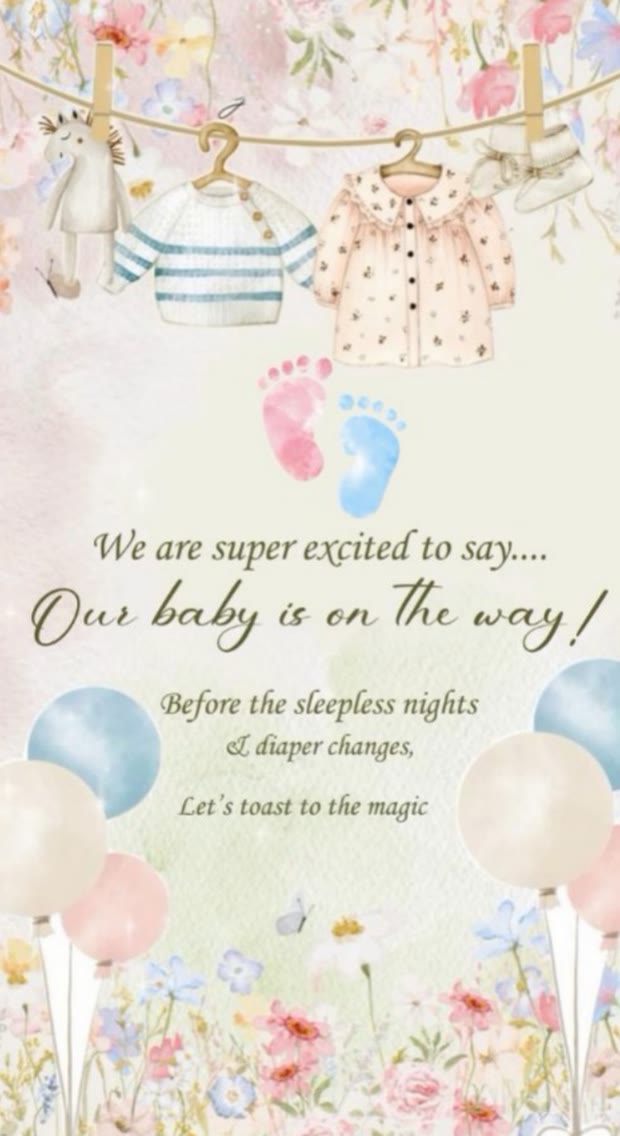
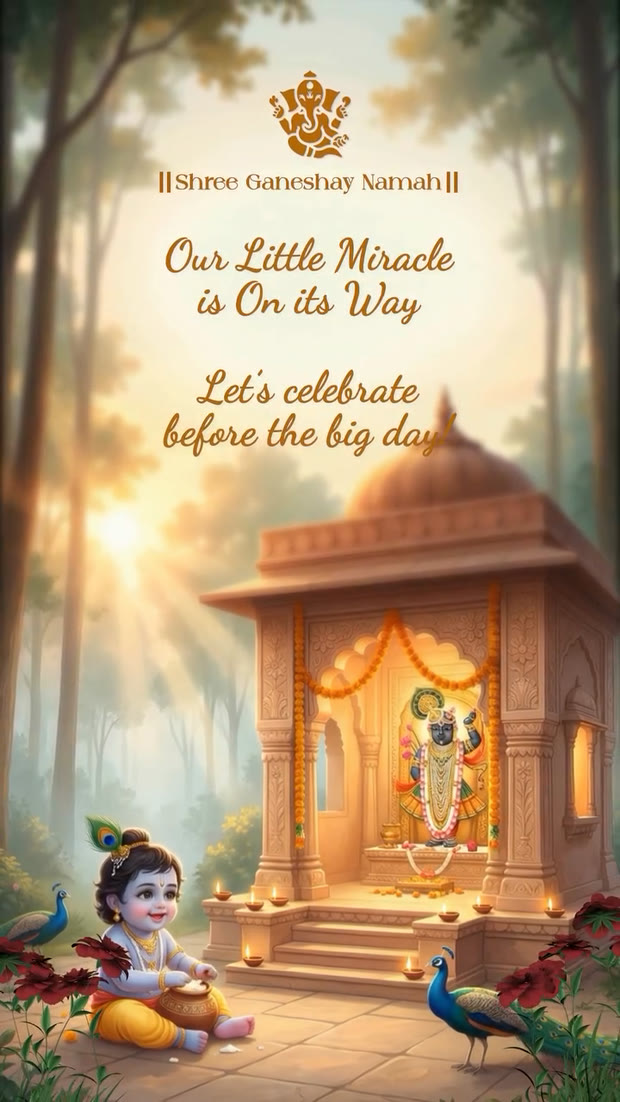
Kilkari, our baby shower design in soft pastels with tiny hand-drawn clothes on a line, is made for a Seemantham or a Valaikappu as much as a Godh Bharai. It opens on your line, and the details follow: both families, the muhurtham, the venue with a map button, your photographs and a reply form. If the Valaikappu and the Seemantham are at different times, each gets its own card, and the wording can be in English, Tamil or Telugu.
Invifest makes invitations and guest management for weddings and every big moment. After the birth come the Namkaran and the Annaprashan, and in North Indian homes the Kuan Pujan, each with wording of its own.
How Invifest does this
Our designers make each family its own invitation website, a Seemantham included, and set it up like this:
- Each ceremony its own card and its own reply. A Valaikappu and a Seemantham at different times get a card each, and guests reply for each, so the lunch has a number.
- A separate link for each group. If the Valaikappu is for the women and the puja for everyone, each group gets its own link, and each guest sees only their own functions.
- Your own questions in the reply, such as the boy-or-girl guess, answered as a poll.
- Aangan for the guest list. With Aangan your list is in one place, each guest gets their own invitation from your own WhatsApp, a tap each, and you see who is coming to which ceremony.
- Changes on the same link. If her doctor moves the date, the link you already shared updates by itself. On our newest invitations you tap the spot and say or type what to change.
- Ready in 3 days from the day we have your details, or in under 24 hours on request.
Seemantham and Valaikappu wording you can copy
English, with each family's own name for the ceremony. Change the names, dates, times and venue in [brackets], and have an elder check the final card.
Sri Ganeshaya Namaha
With the blessings of our elders,
[Father-in-law's name] and [Mother-in-law's name]
invite you with your family to the Seemantham of our daughter-in-law
[Name]
wife of [Husband's name]
[Day, Date] · Muhurtham at [Time]
[Venue], [City]
Lunch will be served.
Your blessings for the mother and the little one are all we ask.
Sri Ganeshaya Namaha
[Father's name] and [Mother's name]
invite you to the Seemantham of our daughter
[Name]
wife of [Husband's name]
[Day, Date] · Muhurtham at [Time]
[Venue], [City]
Please come with your family and bless her. Lunch follows.
Srirastu Subhamastu Avighnamastu
[Hosts' names]
invite you with your family to the Srimantham of
[Name]
wife of [Husband's name]
[Day, Date] · Muhurtham at [Time]
[Venue], [City]
Please come and bless her. Lunch follows the muhurtham.
உ
With the blessings of [Family deity],
[Hosts' names]
invite you to the Valaikappu and Seemantham of our [daughter / daughter-in-law]
[Name]
wife of [Husband's name]
[Day, Date]
Valaikappu at [Time] · Seemantham at [Time]
[Venue], [City]
Lunch follows. Please come with your family and bless her.
Sri Ganeshaya Namaha
[Hosts' names]
invite you with your family to the Seemantha of our daughter-in-law
[Name]
wife of [Husband's name]
[Day, Date] · Muhurtha at [Time]
[Venue], [City]
Do stay for lunch.
A ladies' Valaikappu for [Name]
[Day, Date] · [Time]
[Venue]
Please bring a pair of glass bangles for her if you can. Lunch follows.
Bangles, flowers and a lot of blessings.
Please join us for [Name]'s Valaikappu
[Day, Date] · [Time]
[Venue]
We will have the bangles ready. Just bring your blessings.
Hello [Name],
We are celebrating [Name]'s Seemantham on [Day, Date] at [Time], with lunch after. We would love you to come and bless her and the baby.
Time, venue and map: [link]
[Your name]
Vanakkam [Name],
[Name]'s Valaikappu is on [Day, Date] at [Time]. Come and put a bangle on her wrist, and bless her and the little one.
Details and map: [link]
[Your name]
Tomorrow is [Name]'s Seemantham.
The muhurtham is at [Time], so please come by [Time].
Map: [link]
Sri Ganeshaya Namaha
With the blessings of our elders, we are celebrating [Name]'s Seemantham.
[Day, Date] · Muhurtham at [Time]
[Venue]
Your blessings are the only gift we need. Kindly no gift boxes.
Will you join us?
Yes, I will be there / Sorry, I cannot come
Just for fun: boy or girl, your guess?
Boy / Girl / Either way, a blessing
Want these words on a real invitation? See the designs.
Baby shower invitation designs
2 designs you can personalise. Open any one to see it full size, with a live demo.
Questions people ask
What is Seemantham?
A ceremony in the later months of a first pregnancy, held for a safe birth. Its Sanskrit name, Simantonnayana, means parting the hair upwards: in the Vedic form the husband parts his wife's hair upward while mantras are chanted, and the family then blesses and feeds her. Telugu families also call it Srimantham, and in Kannada it is the Seemantha.
What is the difference between Seemantham and Valaikappu?
Seemantham is the Vedic rite, with a puja and the parting of the hair, held in Telugu, Kannada and Tamil homes. Valaikappu is the Tamil bangle ceremony, in which married women fill her wrists with glass bangles. Many Tamil families hold both on the same day and name both on the invitation.
In which month is Seemantham done?
Usually the seventh month of the first pregnancy. Tamil families usually pick an odd month, the fifth, seventh or ninth; Telugu accounts give the sixth or eighth; Kannada families traditionally hold the Seemantha in the seventh. The priest fixes the day and the muhurtham.
Who hosts the Seemantham or Valaikappu?
It depends on the family. A Kannada Seemantha is traditionally held at her husband's home, while many Tamil families hold the Valaikappu at her mother's home, after which she stays there until the birth. The invitation comes from whoever hosts, and names both families if both do.
What should a Seemantham invitation say?
The ceremony's name, the mother-to-be's name and her husband's, the date and muhurtham, the venue with a map, and the lunch, from the hosts. Add whether it is for women only and whether guests should bring bangles.
How do I write a Valaikappu invitation in English?
Name her and the ceremony, give the date, time and venue, and add one line about bangles. For example: Please join us for [Name]'s Valaikappu on [date] at [time], at [venue]. Please bring a pair of glass bangles for her if you can. Lunch follows.
How do I write a Seemantham invitation for a Telugu, Tamil or Kannada family?
Keep the card in English and the ceremony's own name: Seemantham or Srimantham, often under Srirastu Subhamastu Avighnamastu, for a Telugu family; Valaikappu and Seemantham, often under the Pillaiyar Suzhi (உ), for a Tamil family; Seemantha, with the muhurtha, for a Kannada family. Samples for each are on this page.
Is Valaikappu only for women?
Traditionally it is performed by the women of the family, and many families keep it that way. Others invite everyone, especially when a Seemantham with a puja is held the same day. Say which on the invitation.
Should guests bring bangles to a Valaikappu?
Only if the invitation asks. Some families ask each woman to bring a pair of glass bangles to put on her wrists, others keep a tray of bangles ready, and many send the women guests home with bangles too.
What is Pumsavana?
An older samskara that the texts place in the second to fourth month of pregnancy. Some families perform it on the same day as the Seemantham, as Pumsavana Seemantham, and the invitation can name both.
Can we add a boy or girl guess to the invitation?
Yes, as a game in the reply: boy, girl, or either way a blessing. Choose colours that do not hint either way, such as white, cream or yellow. In India it stays a guess until the birth, because under the PCPNDT Act nobody may tell a family the sex of the baby before it is born.
How do we say no gifts on a Seemantham invitation?
In one warm line at the end: 'Your blessings are the only gift we need. Kindly no gift boxes.'


