

Mata ki Chowki and Jagran invitations: wording in Hindi and English, and what to put on the card
Mata ki Chowki and Jagran invitation wording in Hindi, English and Punjabi, how a chowki differs from a jagran, and what the card needs.
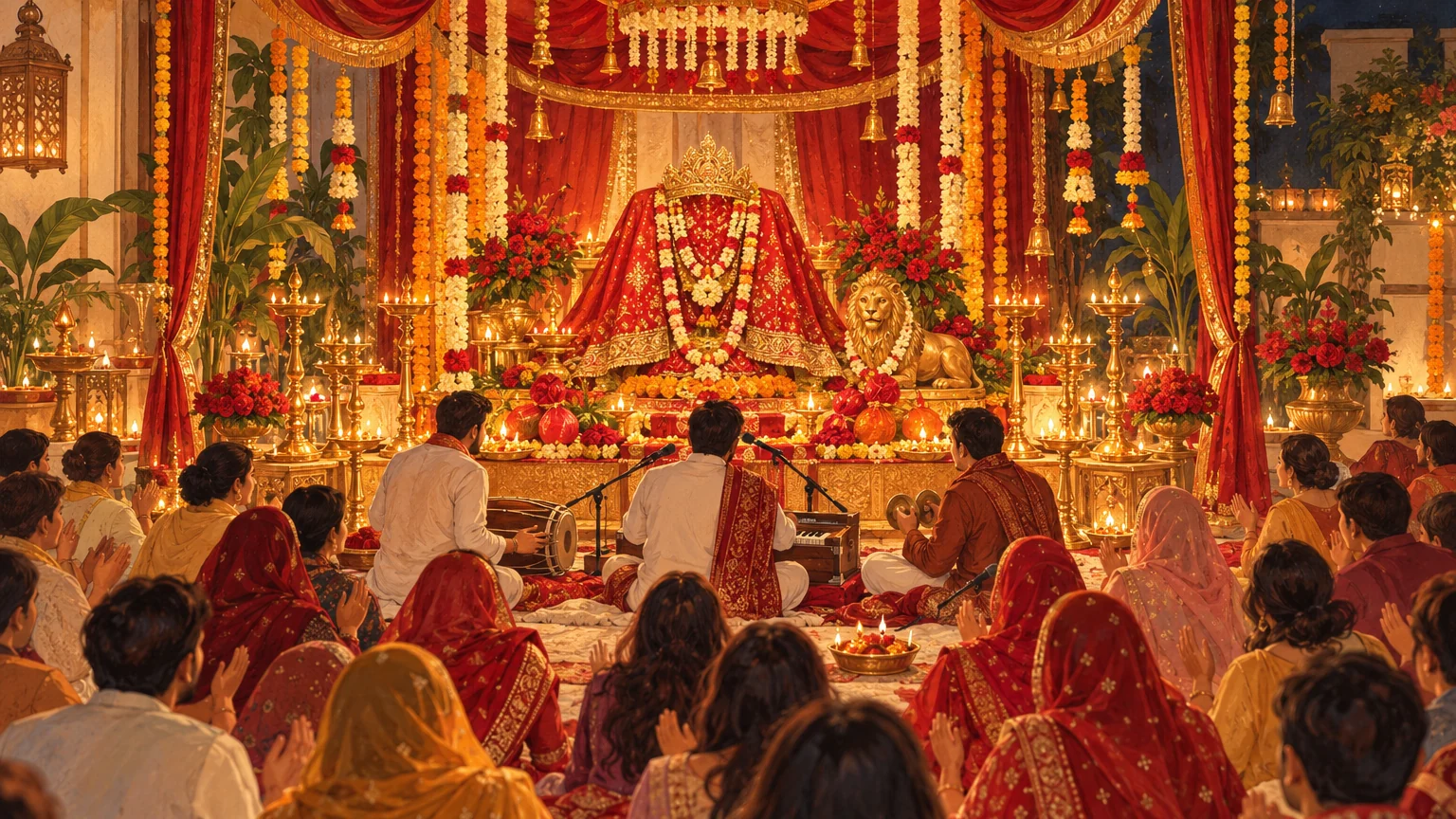
A Mata ki Chowki is an evening of bhajans for Mata Rani, usually two to four hours, ending with aarti and prasad. A Mata ka Jagran is the all-night version, with the Katha of Tara Rani before the aarti at dawn. The card needs the day, the start time, the aarti, the meal and a map. Send it about a week ahead. Wording in Hindi, English and Punjabi is below.
On this page
- What a Mata ki Chowki is
- Mata ki Chowki or Mata ka Jagran: the difference
- When the invitation goes out, and who sends it
- What to put on a chowki or jagran card
- The Hindi words for the card
- How a chowki or jagran card looks
- A video, a card or a link
- Sending it on WhatsApp
- What we have seen on the invitations we make
- Wording you can copy
- Designs
- Questions
A chowki invitation has an easy job: which evening, when the bhajans start, when the aarti is, and where to come. A jagran invitation has a harder one. The night runs past midnight, the date on the card can be read two ways, and guests need to know whether they can come for part of it.
This page explains the two, so the card names the right one. Then it covers who sends the invitation and when, what goes on it, the Hindi words families use, a video or a link, and wording in Hindi, English, Hinglish and Punjabi you can copy.
What a Mata ki Chowki is
A Mata ki Chowki is an evening of bhajans and bhents sung in praise of Mata Rani, the Goddess worshipped as Durga, Sherawali and Vaishno Devi, in front of her darbar: her picture or murti on a decorated chowki, with a red chunri, flowers and a jyot lit before her. It usually lasts two to four hours, starts with a Ganesh vandana, and ends with the aarti and prasad. It is also written chauki.
Families keep a chowki at home, in a community hall or at a temple. Some sing the bhajans themselves; many call a bhajan mandali, a group with a singer, a dholak and a harmonium. It is held in Navratri, and on family occasions: a new house, a birthday, an engagement, before a wedding, or simply to say thank you to Mata.
Mata ki Chowki or Mata ka Jagran: the difference
The difference is the night. A chowki is an evening of a few hours. A jagran, also called a jagrata or jagraata, goes on all night and ends with the aarti at dawn. The word comes from jaagna, to stay awake. A big public one, held by a sabha or a mandal, is often billed as a Bhagwati Jagran or a vishal Bhagwati Jagran.
| Mata ki Chowki | Mata ka Jagran | |
|---|---|---|
| How long | Two to four hours | All night |
| When | Usually the evening, for example 7 to 10 pm | From late evening, around 9 to 11 pm, until the aarti at dawn |
| Where | Home, a community hall or a temple | A bigger space: a hall, an open ground, a tent outside the house, or home |
| Who sings | Family and friends, or a small bhajan mandali | Usually a jagran mandali with a lead singer |
| Tara Rani ki Katha | Optional | Customary, told in the last part of the night |
| How it ends | Aarti and prasad, often dinner | The dawn aarti, then prasad |
| Often held for | Navratri and family occasions | Navratri, family occasions, and to give thanks when a mannat comes true |
At a jagran, the Katha of Tara Rani is customary. Mandalis tell it late in the night or just before sunrise, and many families hold that a jagran is not complete without it. At a chowki it is up to the family. Mandalis and families differ on the order of the night, so ask yours for the timings before you print any of them.
When the invitation goes out, and who sends it
- The family hosting it sends it, usually in the names of the elders, or of the couple for a chowki before their wedding. A public jagran comes from the sabha, mandal or committee, by name.
- About a week before for a chowki, and a week to ten days for a jagran, because people plan a late night. In Navratri, send it earlier and name the night, since many families nearby may be holding one too.
- Call the elders first, then send the message or link to everyone else.
- A short reminder the day before, with the start time, the aarti time and the map. For a jagran, add when the katha is likely to be, for guests who cannot stay the whole night.
What to put on a chowki or jagran card
- Jai Mata Di at the top. Most cards open with it.
- Which one it is, Mata ki Chowki or Mata ka Jagran. Guests plan an evening and an all-nighter very differently.
- The occasion, if there is one: a griha pravesh, a birthday, a wedding, a mannat. Guests like knowing why.
- The day and the date. For a jagran, write 'the night of Saturday, [date]' and say it runs until the morning aarti, so nobody turns up on the wrong evening.
- The start time and the aarti time. For a jagran, also the katha, if your mandali gives you a time.
- The meal: prasad only, dinner, or a bhandara or langar, with the time it starts. Guests decide from this whether to eat before they come.
- The mandali or singer, if you want to name them. Public jagrans usually do.
- The address with a map pin of the gate, and for a jagran in a lane or a ground, where the tent is.
- A reply, if you are cooking for a number. For prasad alone you rarely need one.
- The family's name, after vineet or darshanabhilashi in Hindi.
The Hindi words for the card
Hindi chowki and jagran cards use a small set of phrases. Here are the common ones, with what each means. The full messages are in the samples below.
| Hindi | Read as | Means |
|---|---|---|
| ॥ जय माता दी ॥ | Jai Mata Di | Victory to Mata: the line a card opens with |
| माँ भगवती की असीम कृपा से | Maa Bhagwati ki aseem kripa se | With the boundless grace of Maa Bhagwati |
| माता की चौकी का आयोजन | Mata ki chowki ka aayojan | A Mata ki Chowki is being held |
| माँ भगवती का जागरण | Maa Bhagwati ka jagran | The all-night jagran |
| तारा रानी की कथा | Tara Rani ki katha | The story told in the jagran, before the dawn aarti |
| आरती एवं प्रसाद | Aarti evam prasad | The aarti and the prasad that close the evening |
| भंडारा | Bhandara | The meal served to everyone who comes |
| सपरिवार सादर आमंत्रित | Sapariwar saadar aamantrit | You and your family are warmly invited |
| इष्ट-मित्रों सहित | Isht-mitron sahit | With your friends too |
| विनीत / दर्शनाभिलाषी | Vineet / Darshanabhilashi | Yours humbly / hoping to see you, before the hosts' names |
How a chowki or jagran card looks
Chowki and jagran cards are usually red and gold, the colours of Mata's chunri, with her darbar, a jyot, marigolds and bells. Keep to one picture of Mata, in the form your family worships, rather than a collage, and leave room for the timings: on a phone, the words are what guests come back to.
When we painted the chowki for one family's invitation in 2026, we deliberately drew the darbar rather than the Devi: a red shrine draped in a chunri, glowing at its heart, with no murti and no face. It still reads as Mata's evening at a glance.
A video, a card or a link
Many families send a short video for a chowki or a jagran: a picture of Mata, a bhent playing, the date on screen. It feels right the first time it plays. The trouble comes on the day, when a guest who wants the address has to scroll back up the chat, find the video and play it again. Whatever you send, put the day, the time and the address in the message text as well.
A link can carry both. The bhajan plays softly while guests read, the timings sit in order, and the map opens with one tap. If you also want something to forward, we can make the invitation into a short film. Our comparison of a video invitation and an invitation website goes through both.
Sending it on WhatsApp
- Call the eldersPhone the grandparents and the close relatives yourself. To many elders, a forwarded message alone does not feel like an invitation.
- Send the message with the linkOne short line on top, Jai Mata Di and the evening, then the link or the card. The WhatsApp samples below are written for this.
- Remind the day beforeThe start time, the aarti time and the map, nothing else. For a jagran, add when the katha is expected.
Our guide to sending invitations on WhatsApp covers sending from your own number, a few people at a time.
What we have seen on the invitations we make
A chowki or a jagran often sits inside a bigger celebration rather than on a card of its own. On the invitations we made in 2026, one wedding opened with a Mata ki Chowki at 6 pm, two days before the wedding day, listed like any other function. A Ganeshotsav invitation had a chowki on one evening of the utsav, after a Satyanarayan Katha that morning. And a groom's family put their reception and a Mata Rani Jagran at home on the same Saturday.
We make invitation websites for weddings and for celebrations at home. Darshan, our Ganpati invitation, has a painted card for a Mata ki Chowki evening, for families who keep one during the utsav. We do not have a ready design for a chowki or a jagran on its own. If you want yours as a link, with Jai Mata Di at the top, the timings, the address on a map, your bhajan and a reply form for the bhandara, ask us on WhatsApp and we will make it as a custom invitation, in Hindi, English or both.
For the other pujas at home, the Satyanarayan Puja, Griha Pravesh and Diwali guides have wording of their own.
Mata ki Chowki and Jagran wording you can copy
Hindi first, then English, Hinglish and Punjabi. The Punjabi is in Roman letters for WhatsApp; for Gurmukhi on a printed card, have someone who reads it check every letter. Change the names, dates, times and places in [brackets].
॥ जय माता दी ॥
माँ भगवती की असीम कृपा से हमारे निवास पर माता की चौकी का आयोजन किया गया है।
आप सपरिवार सादर आमंत्रित हैं।
दिन: [दिन, तारीख़]
चौकी: सायं [समय] बजे से
आरती: रात [समय] बजे
आरती के बाद प्रसाद एवं भोजन
पता: [पता]
विनीत,
[परिवार का नाम]
जय माता दी!
[दिन, तारीख़] को शाम [समय] बजे हमारे घर माता की चौकी है। माँ के भजन, आरती और प्रसाद, सब साथ में।
ज़रूर आइए।
पता और लोकेशन: [लिंक]
[नाम]
॥ जय माता दी ॥
नए घर की शुरुआत माँ के आशीर्वाद से हो, इसी कामना के साथ गृह प्रवेश के शुभ अवसर पर हमारे नए निवास पर माता की चौकी रखी गई है।
[दिन, तारीख़] · सायं [समय] बजे से
चौकी के बाद आरती, प्रसाद और भोजन
नया पता: [पता]
आप सपरिवार अवश्य पधारें।
[परिवार का नाम]
॥ जय माता दी ॥
[नाम] के जन्मदिन के उपलक्ष्य में माता रानी का धन्यवाद करने के लिए हमारे घर माता की चौकी रखी गई है।
[दिन, तारीख़] · शाम [समय] बजे से
आरती के बाद प्रसाद और भोजन
[पता]
माँ का आशीर्वाद और आपका साथ, दोनों चाहिए। ज़रूर आइए।
[परिवार का नाम]
॥ जय माता दी ॥
[वर या वधू का नाम] के शुभ विवाह के उपलक्ष्य में माता की चौकी का आयोजन किया गया है।
[दिन, तारीख़] · सायं [समय] बजे से
[स्थान]
आप सपरिवार पधारकर माता रानी का आशीर्वाद प्राप्त करें।
दर्शनाभिलाषी,
[परिवार का नाम]
॥ जय माता दी ॥
माता रानी की कृपा से [अवसर] के शुभ अवसर पर हमारे यहाँ माँ भगवती का जागरण रखा गया है।
[दिन, तारीख़] की रात [समय] बजे से सुबह की आरती तक
तारा रानी की कथा: लगभग [समय] बजे
भंडारा: रात [समय] बजे से
स्थान: [स्थान]
आप सपरिवार एवं इष्ट-मित्रों सहित पधारें।
दर्शनाभिलाषी,
[परिवार का नाम]
॥ जय माता दी ॥
माँ ने हमारी मनोकामना पूरी की है। उनका धन्यवाद करने के लिए [दिन, तारीख़] की रात हमारे यहाँ माँ भगवती का जागरण है।
रात [समय] बजे से सुबह की आरती तक
[स्थान]
आप सपरिवार पधारकर माँ के दरबार में हाज़िरी लगाएँ।
[परिवार का नाम]
॥ जय माता दी ॥
[सभा या समिति का नाम] की ओर से
विशाल भगवती जागरण
[दिन, तारीख़] की रात [समय] बजे से सुबह की आरती तक
स्थान: [स्थान]
भजन: [गायक या मंडली का नाम]
भंडारा: [समय] बजे से
सभी भक्तजन सपरिवार सादर आमंत्रित हैं।
[सभा या समिति का नाम]
जय माता दी!
कल शाम [समय] बजे माता की चौकी है। आरती [समय] बजे होगी, उसके बाद प्रसाद और भोजन।
पता और मैप: [लिंक]
Jai Mata Di
With Mata Rani's blessings, we are holding a Mata ki Chowki at our home, and we would love you and your family to be there.
[Day, Date]
Bhajans from [Time]
Aarti at [Time], then prasad and dinner
[Address]
With love,
[Family name]
Jai Mata Di!
Mata ki Chowki at ours on [Day, Date], from [Time]. Bhajans, the aarti at [Time], then prasad and dinner.
Do come with the family. Address and map: [link]
Jai Mata Di
On the occasion of [occasion], we are holding a Mata ka Jagran, and you are invited with your family.
The night of [Day, Date], from [Time] until the morning aarti
Tara Rani ki Katha: around [Time]
Bhandara from [Time]
[Venue]
Come for as long as you can.
[Family name]
Jai Mata Di
[Day, Date] at [Venue]
Dinner from [Time]
Mata Rani's Jagran from [Time], until the morning aarti
Do eat with us first, then stay for the bhajans as long as you like.
[Family name]
Hi all,
We are holding a Mata ki Chowki at home on [Day, Date]: an evening of bhajans for the Goddess, from [Time] to about [Time].
You are welcome to come for any part of it. The aarti is at [Time] and dinner follows, and you do not need to bring anything.
The address and the map are here: [link]
Jai Mata Di!
Is [Din] hamare ghar Mata ki Chowki hai, shaam [Samay] baje se. Bhajan, aarti aur prasad, sab saath mein.
Zaroor aana, aur bachchon ko bhi laana.
Address aur map: [link]
Jai Mata Di
Mata Rani di kirpa naal, [mauka] di khushi vich saade ghar Mata Rani da jagrata rakhya gaya hai.
[Din, Tareekh] di raat [Samaa] vaje ton savere di aarti tak
Langar: [Samaa] vaje ton
Pata: [Pata]
Aap ji nu parivar samet pahunchan di benti hai.
[Parivar da naam]
Jai Mata Di
Mata Rani di kirpa naal saade ghar Mata di chowki rakhi gayi hai.
[Din, Tareekh], shaam [Samaa] vaje ton
Aarti ton baad prasad te khaana
Pata: [Pata]
Parivar samet zaroor aana ji.
[Parivar da naam]
Want these words on a real invitation? See the designs.
Invitation designs our families start from
8 designs you can personalise. Open any one to see it full size, with a live demo.


Questions people ask
What do you write on a Mata ki Chowki invitation card?
Open with Jai Mata Di, say it is a Mata ki Chowki and the occasion if there is one, then give the day and date, the time the bhajans start, the aarti time, whether prasad, dinner or a bhandara follows, and the address with a map pin. Close with your family's name.
How do I write a Mata ki Chowki invitation in Hindi?
Open with ॥ जय माता दी ॥, then write: माँ भगवती की असीम कृपा से हमारे निवास पर माता की चौकी का आयोजन किया गया है। आप सपरिवार सादर आमंत्रित हैं। Add the date, the time and the address, and close with विनीत and your family's name. The full message is on this page, with a Copy button.
What is the difference between a Mata ki Chowki and a Jagran?
A chowki is an evening of bhajans, usually two to four hours, ending with aarti and prasad. A jagran, or jagrata, goes on all night, includes the Katha of Tara Rani, and ends with the aarti at dawn. The card should say which one it is, because guests plan for them differently.
What should a jagran invitation card say?
Jai Mata Di at the top, the occasion, 'the night of' the day and date with the start time and that it runs until the morning aarti, the katha time if your mandali gives one, when the bhandara or langar starts, the place with a map, and who is inviting. A public jagran also names the mandali or singer.
How do I write a jagran invitation in Punjabi?
Start with Jai Mata Di, then: Mata Rani di kirpa naal saade ghar Mata Rani da jagrata rakhya gaya hai. Give the night, the time and the place, and close with: Aap ji nu parivar samet pahunchan di benti hai. The wording on this page is in Roman letters; for Gurmukhi, have someone who reads it check every letter.
Can I send a Mata ki Chowki invitation as a video?
Yes, many families do. Put the day, the time and the address in the message text as well, because guests look for them again on the day and nobody wants to replay a video to find an address. A link can play your bhajan and keep the timings and a map in one place.
How long before should the invitation be sent?
About a week before a chowki, and a week to ten days before a jagran. In Navratri send it earlier and name the night. Call the elders first, and send a short reminder the day before with the start time, the aarti time and the map.
Is Tara Rani ki Katha part of a Mata ki Chowki?
It can be, but at a chowki it is the family's choice. At a jagran it is customary: mandalis tell it late in the night or before the dawn aarti, and many families hold that a jagran is incomplete without it.


