

Ganesh sthapana invitation: the first function on a wedding card, with wording in Hindi and English
Ganesh sthapana invitation wording in Hindi and English for a wedding: when the puja is held, who is invited, the first card for Ganesh ji and when to send it.
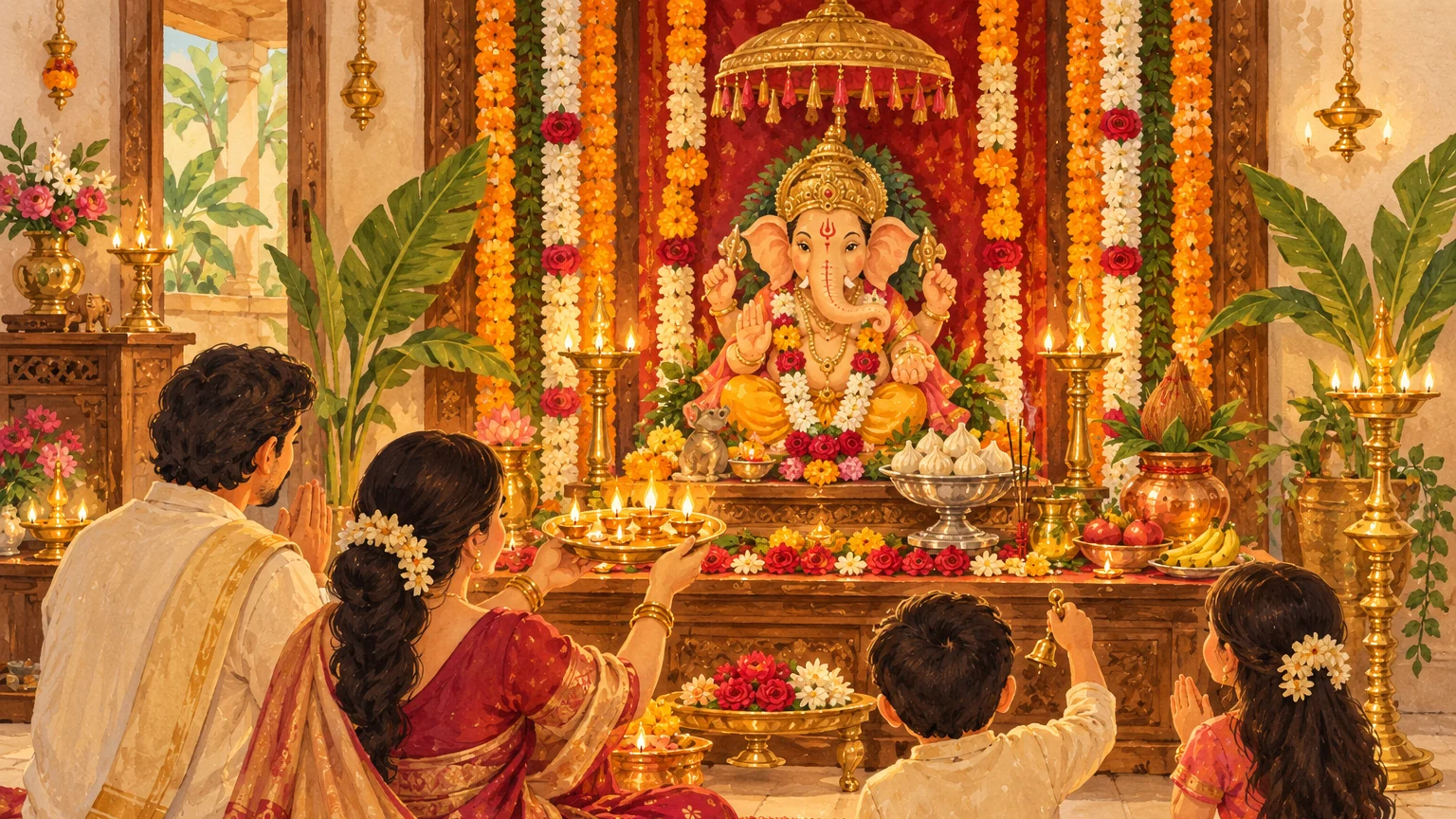
Ganesh sthapana is the puja that opens the wedding days in many Rajasthani, Marwari and Gujarati families: Ganesh ji is installed at home, a few days before the wedding, at the muhurat the pandit gives, so that the wedding goes without obstacles. Put it first on the card with its date and muhurat, usually only on the hosting family's own link. Some families send the invitation only after it.
On this page
- What Ganesh sthapana is in a wedding
- What families call it
- When it is held, and what to print
- Who is invited, and whose invitation carries it
- Send the invitation after Ganesh ji is seated
- The top of the card: Shri Ganeshaya Namah or the Vakratunda shloka
- How Invifest does this
- Wording you can copy
- Designs
- Questions
On many Marwari and Gujarati wedding cards, the first function is not the haldi. It is a puja held at home before anything else begins: the Ganesh sthapana, the Vinayak sthapana, the mandap muhurat or a griha shanti.
Many families we spoke to this October opened their invitation with one of these. One family would not let the invitation go out until Ganesh ji was seated. Two printed it for a card puja before sending. This page covers what the sthapana is, what goes on the card, who sees it, when to send, and wording in Hindi and English.
What Ganesh sthapana is in a wedding
Ganesh ji is Vighnaharta, the remover of obstacles, and a Hindu ceremony begins with him. Before a wedding, the family installs an idol or a picture of Ganesh ji at home on a decorated chowki, with marigolds and mango leaves, and the pandit leads the puja: mantras, haldi and kumkum, flowers, fruit and sweets, and a prayer that the wedding goes without obstacles. The bride's family and the groom's family each hold their own, at their own homes.
Other pujas often follow it: a griha shanti for the planets, and in Gujarati families the mandap muhurat, where the ground for the mandap is worshipped before it goes up. Some families install Ganesh ji at the wedding venue too.
What families call it
| Name on the card | Who uses it | What it is |
|---|---|---|
| Ganesh sthapana, Ganpati sthapana | Rajasthani, Marwari and Gujarati families, and many others | Ganesh ji installed at home to open the wedding days |
| Vinayak sthapana, Ganesh poojan | Marwari and Rajasthani families | The same puja: Vinayak is Ganesh ji |
| Mandap muhurat | Gujarati families | The ground for the mandap is worshipped before it goes up; on some cards, 'followed by lunch' |
| Griha shanti | Gujarati and Marwari families | A puja for the planets, held after the sthapana or the mandap muhurat |
| Navchandi and Vastu | Some Gujarati families | A havan to the goddess Chandi and a puja for the home, before the wedding |
| Vinayakyantra puja | Jain families | Held at both homes to remove obstacles before the wedding begins |
| Ganesh puja and mehendi | Families who join the two | The puja and the mehendi on one day, listed as one entry |
Use the name your family says: elders look for the name they know. Our Marwari, Gujarati and Jain guides list the functions that follow it.
When it is held, and what to print
- A few days before the wedding, at the muhurat your pandit gives. Marwari families often hold it about two days before; some families hold it a week or two earlier, and send the invitation after it.
- Print the muhurat as the start time, with the day and the date, and say if lunch or prasad follows. One Gujarati family called its mandap muhurat the official start of the wedding, 'followed by lunch'.
- Each home on its own day. The bride's side and the groom's side hold separate sthapanas, so the two invitations can show different dates and times.
- The home address, with a map pin, for relatives who have not been to the house, on the invitations that carry the puja and nowhere else.
Who is invited, and whose invitation carries it
The sthapana is a family puja. Usually only the hosting family's relatives and close friends come, so it belongs on that family's own invitation, not on the one that goes to everybody. One bride kept her Ganesh puja and mehendi off the link that went to the groom's side. Colleagues and the wider circle, invited to the wedding or the reception, do not need to see it at all.
- Your family's link: the sthapana first, then the haldi, the mayra or bhaat and the rest.
- The other family's link: their own puja if they want it shown, or none.
- The reception-only link: no pujas at all. Our guide to inviting guests to only some functions explains how to split them.
Send the invitation after Ganesh ji is seated
Ganesh ji is invited first. In most homes the first card is placed before him, at home or at the family's temple, before any guest is invited; our invitation etiquette guide describes the custom. In Rajasthan many families post the first card to Trinetra Ganesh ji, in the temple inside Ranthambore Fort.
A digital invitation fits the custom. This is what families did this season:
- A printed page for the card puja. Two families printed a page of the invitation and did the puja with it before sending the link.
- The send waited for the sthapana. One family wanted the invitation opened only after the puja ('Ganesh ji baithne ke baad kholna tha'). The finished link waited, checked and ready, and went out once Ganesh ji was seated.
- A shubh din for the first send. Others chose a day in Navratri, or the card puja on Dussehra.
- Not final by the muhurat? Send it to one family member at the muhurat, so the first send happens on time, and finish the changes on the same link. Everyone after that gets the final version.
The top of the card: Shri Ganeshaya Namah or the Vakratunda shloka
An invitation that opens with the sthapana opens with Ganesh ji too. These are the lines families put at the top, and the heading over the list of functions:
| On the card | Read as | What it means |
|---|---|---|
| ॥ श्री गणेशाय नमः ॥ | Shri Ganeshaya Namah | Salutations to Shri Ganesh |
| वक्रतुण्ड महाकाय सूर्यकोटि समप्रभ। निर्विघ्नं कुरु मे देव सर्वकार्येषु सर्वदा॥ | Vakratunda Mahakaya Suryakoti Samaprabha, Nirvighnam Kuru Me Deva Sarva Karyeshu Sarvada | O Lord with the curved trunk and the mighty body, shining like a crore suns, keep all my work free of obstacles, always |
| मांगलिक कार्यक्रम | Mangalik karyakram | The auspicious functions: the heading over the list, with the sthapana first |
| गणेश स्थापना / विनायक स्थापना | Ganesh sthapana / Vinayak sthapana | The installation of Ganesh ji |
Some families want a particular Ganpati on the invitation: the murti of their family temple or their town. Say so before the design starts, and send a clear photo of him.
How Invifest does this
Invifest makes invitations and guest management for weddings and every big moment. Our designers make each family its own invitation website, and for a wedding that opens with Ganesh ji that means:
- The sthapana gets its own card. Sindoori, Kesariya, Kohinoor and Pichwai open the functions with a Ganesh puja card, with its date, muhurat, place and a map button.
- A separate link for each side or group. The sthapana shows on your family's link and nowhere else; the other side, the friends and the office see only their own functions.
- Ready before the puja, sent after it. The first version reaches you within 3 days of your details, or in under 24 hours on request, so the link can be checked and waiting before the sthapana. Nothing reaches a guest until you send it.
- Hindi and English. The wording can be in Hindi exactly as on a printed card, and on many designs a switch turns the invitation between English and Hindi for the elders.
- Changes on the same link. When the pandit moves a time, the link you already shared updates by itself. On our newest invitations you tap the spot and say or type what to change.
- Aangan for the guest list. With Aangan your list is in one place, each guest gets their own invitation from your own WhatsApp, a tap each, and you see who is coming to which function, so you know how many will stay for lunch after the puja.
- A page to print for the card puja. The invitation can also come as a PDF to print.
Ganesh sthapana wording you can copy
Hindi first, then English, Gujarati in Roman letters and WhatsApp messages. Change the names, dates, times and places in [brackets], and take the muhurat from your pandit.
॥ श्री गणेशाय नमः ॥
वक्रतुण्ड महाकाय सूर्यकोटि समप्रभ।
निर्विघ्नं कुरु मे देव सर्वकार्येषु सर्वदा॥
मांगलिक कार्यक्रम
गणेश स्थापना: [दिन], [तिथि], [समय]
हल्दी: [दिन], [तिथि], [समय]
महिला संगीत: [दिन], [तिथि], [समय]
पाणिग्रहण संस्कार: [दिन], [तिथि], [समय]
स्थान: [स्थान]
॥ श्री गणेशाय नमः ॥
हमारे [पुत्र / पुत्री] [नाम] के शुभ विवाह के मांगलिक कार्यक्रमों का शुभारंभ
श्री गणेश स्थापना से होगा।
आप सपरिवार पधारकर श्री गणेश जी का आशीर्वाद ग्रहण करें।
गणेश स्थापना एवं पूजन: [दिन], [तिथि], [समय]
तत्पश्चात् प्रसाद एवं भोजन
स्थान: [घर का पता]
विनीत
[परिवार का नाम]
॥ श्री गणेशाय नमः ॥
शुभ विवाह के उपलक्ष्य में
विनायक स्थापना
[दिन], [तिथि], [समय]
[घर का पता]
पधारो सा, आपकी उपस्थिति प्रार्थनीय है।
[परिवार का नाम]
Shri Ganeshaya Namah
The functions
Ganesh Sthapana: [Day, Date], [Time], at [Home or venue]
Haldi: [Day, Date], [Time]
Sangeet: [Day, Date], [Time]
Wedding: [Day, Date], Muhurat [Time]
[Venue], [City]
Shri Ganeshaya Namah
The wedding days of [Name] and [Name] begin with Ganesh ji.
Please join us for the Ganesh Sthapana at home, and stay for lunch.
[Day, Date] · [Time]
[Home address]
With love,
[Family name]
Shree Ganeshaya Namah
Amara parivar na shubh prasange, aapne sahkutumb padharva aagrahbhari vinanti.
Ganesh Sthapana: [Divas, Tarikh], [Samay]
Mandap Muhurat: [Divas, Tarikh], [Samay]
Graha Shanti: [Divas, Tarikh], [Samay]
Tyar baad bhojan
Sthal: [Sthal]
[Parivar nu naam]
Jai Shri Ganesh!
[Name] ki shaadi ke karyakram Ganesh ji ki sthapana se shuru ho rahe hain. [Din, Tithi] ko [Samay] baje ghar par pooja hai, aap sab zaroor aaiye.
Pata aur map: [link]
[Naam]
जय श्री गणेश!
श्री गणेश जी विराजमान हो गए हैं। उन्हीं के आशीर्वाद से [नाम] के शुभ विवाह का निमंत्रण आपके लिए:
[लिंक]
सभी कार्यक्रम, समय और स्थान इसी लिंक पर हैं।
[नाम]
Jai Shri Ganesh!
Ganesh ji is seated, and with his blessings, here is the invitation to [Name] and [Name]'s wedding:
[link]
Every function, time and venue is on the link.
[Your name]
Want these words on a real invitation? See the designs.
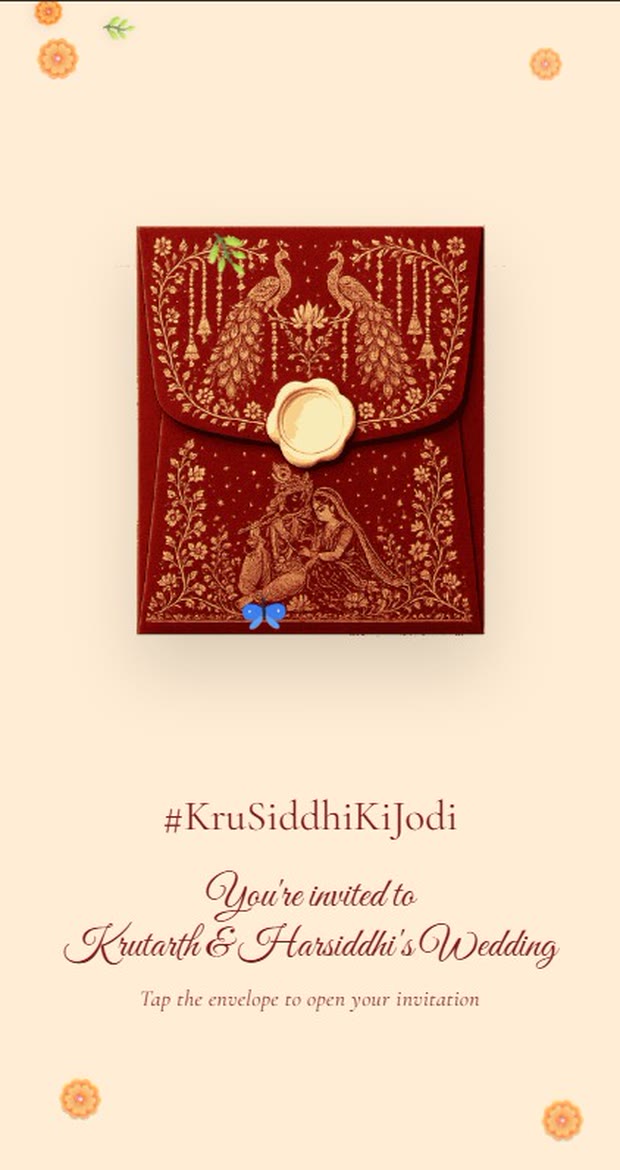
Hindu wedding invitation designs
8 designs you can personalise. Open any one to see it full size, with a live demo.


Questions people ask
What is Ganesh sthapana in a wedding?
The puja that opens the wedding days in many Hindu families. Ganesh ji, the remover of obstacles, is installed at home on a decorated chowki, and the pandit performs a puja so that the wedding goes without obstacles. The bride's and the groom's families each hold their own.
How many days before the wedding is Ganesh sthapana done?
Usually a few days before, at the muhurat the family pandit gives. Marwari families often hold it about two days before the wedding, and some families hold it a week or two earlier. Ask your pandit before you print a date.
Is Ganesh sthapana done at both the bride's and the groom's homes?
Yes, in most families each side holds its own, at its own home and its own muhurat. That is why the sthapana usually appears only on each family's own invitation.
Who should be invited to the Ganesh sthapana?
The hosting family's relatives and close friends. It is a family puja, so it goes on the family's own link and is usually left off the invitations sent to colleagues and the wider circle.
What should we write for Ganesh sthapana on the wedding card?
List it first under the functions, with the day, the date and the muhurat. In Hindi: गणेश स्थापना: [दिन], [तिथि], [समय]. In English: Ganesh Sthapana: [Day, Date], [Time]. Add the home address with a map pin, and the meal if one follows.
Should the first wedding card go to Ganesh ji?
In most Hindu homes, yes: the first card is placed before Ganesh ji or the family deity before anyone else is invited. With a digital invitation, families print a page of it for the card puja, or send the link only after the sthapana.
Can we send the digital invitation before the Ganesh sthapana?
That is your family's call. Families who wait keep the finished link ready and send it after the puja. If it is not final by the muhurat, send it to one family member at the muhurat and finish the changes on the same link.
What is mandap muhurat in a Gujarati wedding?
A puja held by each family a few days before the wedding, in which the ground where the mandap will stand is worshipped before it goes up. It follows the Ganesh sthapana, a griha shanti is often held after it, and some families serve lunch once it is done.
Is Ganesh sthapana for a wedding the same as on Ganesh Chaturthi?
No. On Ganesh Chaturthi, Ganpati is welcomed home for the festival, with darshan, aarti and visarjan. Before a wedding, Ganesh ji is installed to open the wedding days. The festival has its own invitation messages, in our Ganpati guide.
What is the Vakratunda shloka?
A prayer to Ganesh ji printed at the top of many wedding cards: Vakratunda Mahakaya Suryakoti Samaprabha, Nirvighnam Kuru Me Deva Sarva Karyeshu Sarvada. It asks the Lord with the curved trunk, shining like a crore suns, to keep all work free of obstacles, always.


