Mayra and bhaat invitation: the nyota to the mama, the card for relatives, and Hindi wording to copy
Mayra and bhaat invitation wording in Hindi and English: the bhaat nyota to the mama, the card for relatives, WhatsApp messages and what to write on it.
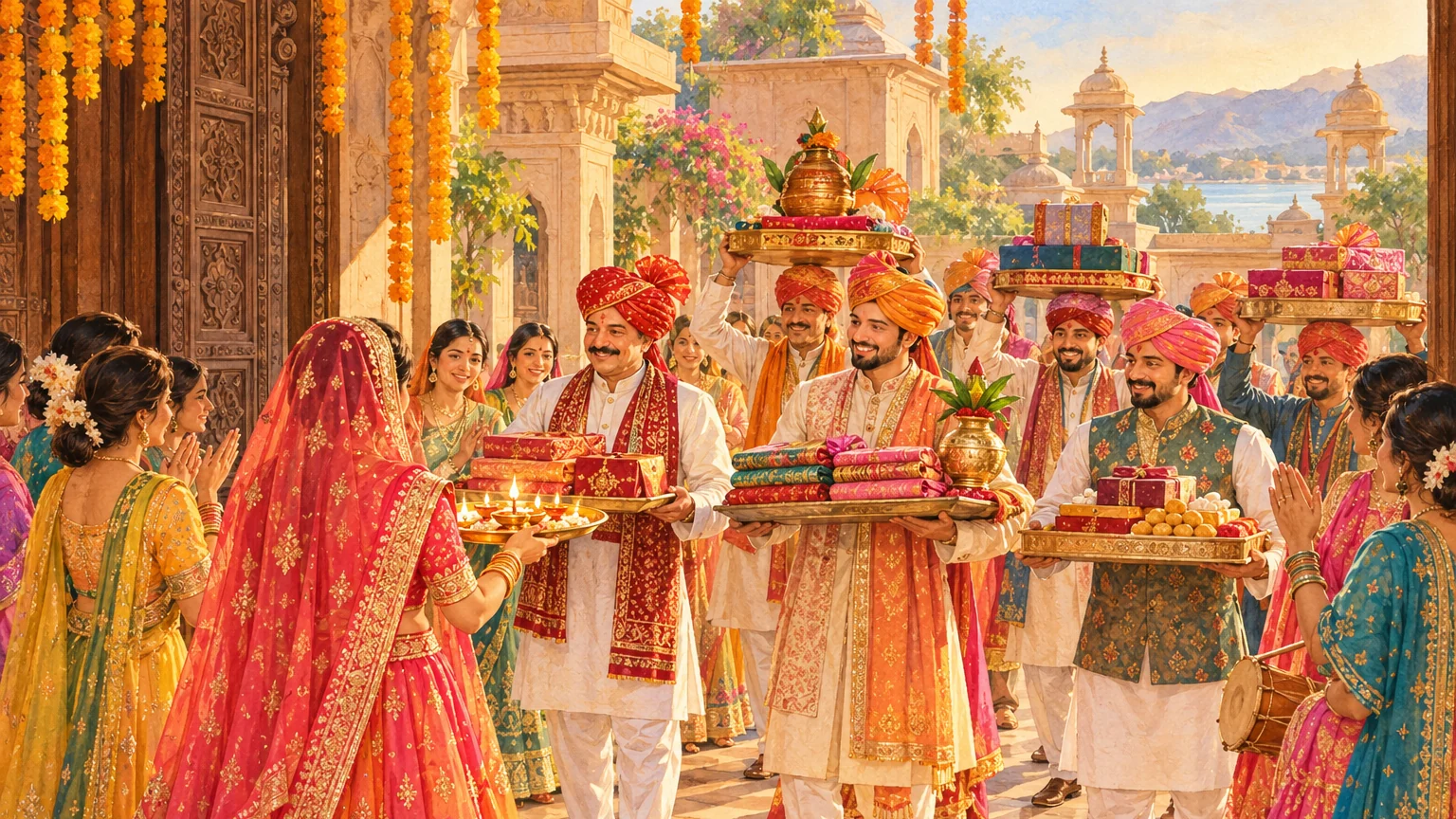
The mayra, or bhaat, is the day the mother's brothers bring gifts for her child's wedding. It has two invitations: the bhaat nyota, when the mother goes to her parents' home to invite her brother in person, and a card or message telling relatives when the mayra arrives. On the card, name the maternal family and their town, the day, the time and the place, and keep the gifts off it.
On this page
- What the mayra or bhaat is
- Two invitations: the nyota and the card
- The bhaat nyota: how the mother invites her brother
- What happens on the mayra day
- What to put on a mayra or bhaat card
- On the wedding card, or a card of its own
- Sending it on WhatsApp
- How Invifest makes a mayra card
- Wording you can copy
- Designs
- Questions
In Rajasthani and Marwari families, and in Haryana and western Uttar Pradesh, a wedding has a moment that belongs to the mother: the day her brothers arrive with the mayra. They bring the wedding clothes and jewellery for her son or daughter and gifts for her whole household, and the women of the house receive them at the door with songs.
Rajasthani and Marwari families call it the mayra (मायरा), mayro or mahira dastoor; in Haryana and Uttar Pradesh it is the bhaat (भात), and some cards say chaak bhaat. Its invitation is unusual, because it begins with a visit and not a card. This page covers both halves: the bhaat nyota, when the mother invites her brother, and the card or message for everyone else, with wording in Hindi and English.
What the mayra or bhaat is
The mayra is the maternal family's part in a wedding. When a woman's son or daughter marries, her brothers, often with her father, fill the mayra: they bring the wedding outfit and jewellery for the bride or groom, clothes for their sister, her husband and the rest of her household, sweets, and cash. Aaj Tak, reporting on a mayra in Nagaur, put it in one line: "मायरा (भात) बहन के बच्चों की शादी में ननिहाल पक्ष द्वारा निभाई जाने वाली एक प्राचीन परंपरा है", an old tradition the maternal family keeps at the wedding of a sister's children (Aaj Tak, December 2024).
It happens on both sides. The bride's mother receives a mayra from her brothers and the groom's mother from hers, each at her own home. One wedding we made invitations for this season had the bride's bhaat at six in the evening, and the groom's on the same card as his mehndi and haldi.
The names, region by region
| Where | Name | What to know |
|---|---|---|
| Rajasthan and Marwari families | Mayra (मायरा), mayro, mahira dastoor | Women sing mayra songs as the brothers arrive |
| Haryana and western Uttar Pradesh | Bhaat (भात) | Inviting it is the bhaat nyota; bringing it is bhaat bharna |
| Rajasthan and Madhya Pradesh | Chaak bhaat (चाक भात) | Rajasthan Patrika uses it as another name for the mayra |
| Gujarat | Mameru or mosalu | The bride's mama brings the panetar saree, jewellery and gifts a few days before the wedding |
| Punjab | The chooda | The bride's mama gives her the chooda, her wedding bangles |
On our calls this October, the mayra or bhaat came up again and again, and families spelled it every way: Mayra, Myra, Maayra, Mayera and Mahera, and for the bhaat, chaak bhaat, chak bhaat or simply mama ka bhaat. One Jain family called the afternoon of its mayra and mehendi "Nani ka ghar". Write it the way your family says it: relatives look for their own word first.
Two invitations: the nyota and the card
A mayra has two invitations, sent by two different people:
| The bhaat nyota | The mayra card or message | |
|---|---|---|
| Who sends it | The mother of the bride or groom | The family hosting the wedding |
| Who gets it | Her brothers and their families, at her parents' home | Relatives, neighbours and friends who should be there to welcome the mayra |
| How | In person, with jaggery and rice, a tilak and sweets | With the wedding card, or as a card or message of its own |
| When | A few days to a month before the wedding, by family custom | Two to three weeks before, with a reminder the day before |
There is often a third. The mama's family brings its own relatives along, and sends them a message with the day and the time they set off. News reports from Rajasthan describe mayras arriving with a band, on decorated bullock carts, or in a long line of cars.
The bhaat nyota: how the mother invites her brother
The nyota is the old way of inviting, and in many families it still happens in person. On a day the elders choose, the mother goes to her parents' home, her peehar, and asks her brothers to bring the bhaat for her child's wedding. Rajasthani families call this the battisi nutna (बत्तीसी नूतना), and Haryanvi families the bhaat nyotna.
- Before she goesIn some families she puts on mehendi before she sets out.
- What she takesJaggery and rice, in many families with moong, a coconut and sweets. One guide to Maheshwari customs puts it at one and a quarter kilos each of rice and jaggery.
- The tilakShe puts a tilak on her brother's forehead, and on her sister-in-law's, offers sweets, and asks him to bring the bhaat.
- Her send-offIn many families, before she leaves, they put a tilak on her and give her a saree.
If her brother lives abroad or in another city, the visit becomes a phone call and then a message. One is written for that in the wording below.
What happens on the mayra day
The mayra arrives a day or two before the wedding, or on the wedding morning, at the sister's home or at the wedding venue. Every family has its own order; a common one:
- The welcome at the doorThe sister and the women of the house come to the door singing, and she puts a tilak on her brothers, their wives and their children.
- The chunariIn many Rajasthani families the brothers together drape a chunari over their sister.
- The giftsThe wedding outfit and jewellery for the bride or groom, clothes for the sister, her husband and the household, and cash, given openly.
- The aartiShe performs the aarti, and in many families the brothers place envelopes on the aarti plate.
- The mealThe mama's family is seated and fed first.
On the invitations we made this season, mayras ran from morning to evening: one opened a seven-function wedding at eleven in the morning, one was at two in the afternoon, one at four in the afternoon on the bride's side, and one family held the haldi and the bhaat together at seven in the morning.
On our calls, families put it in one of three places: the afternoon of the day before the wedding; the first day, before the evening's sangeet ("pehle myra, shaam ko sangeet"); or straight after the mehndi, at a venue of its own. One family had already held its mayra before the invitation went out, and left it off.
What to put on a mayra or bhaat card
| Line | What to write | On a Hindi card |
|---|---|---|
| The blessing | Shri Ganeshaya Namah, or your family deity | ॥ श्री गणेशाय नमः ॥ |
| The ritual's name | As your family says it: Mayra, Bhaat, Chaak Bhaat or Mahira Dastoor | मायरा / भात / चाक भात |
| Whose wedding | The bride's or groom's name | आयुष्मती [नाम] के शुभ विवाह के उपलक्ष्य में |
| The maternal family | The nana and the mamas, with their town: this is their day | ननिहाल पक्ष: श्री [नाम] एवं परिवार, [शहर] |
| Day, date and time | When the mayra arrives | [दिन, तिथि], [समय] बजे |
| The place | The home or the venue, with a map pin | स्थान: [पता] |
| The meal | If one follows | भोजन: [समय] से |
| The hosts | The sister and her husband, often with the grandparents | निवेदक: श्रीमती [नाम] एवं श्री [नाम] |
The maternal family's line matters most, because it is their day. One family put it above the venue on their chaak bhaat card: the mama's name and family with their town, and a second relative beside them.
The bhaat line, and the families who bring it
A line families put under the heading: "chak ki pooja, mama ka bhaat, apno se saji har baat" (चाक की पूजा, मामा का भात, अपनों से सजी हर बात). Under it go the families bringing the bhaat, each with its town in brackets, beside the ननिहाल पक्ष list. The wording to copy is below.
Expect that list to grow. Families sent us names to add even after the card had gone out, so check every name and town with the mama's family before it is sent, and keep the list somewhere it can still be changed.
On the wedding card, or a card of its own
Many families put the mayra on the wedding card as one of the functions, with its own time. The Marwari card in our Hindi wedding card guide lists it as मायरा (माहेरा दस्तूर), between the pithi and the mahila sangeet, with a ननिहाल पक्ष line at the bottom.
A card or a message of its own makes sense when the mayra is at home and the wedding at a venue, when only close family is expected for it, or when the mama's family is inviting its own relatives to come along.
Bride's card or groom's card?
The mayra goes on the card of the side whose mother's family brings it. The bride's mother receives a mayra from her brothers, so it belongs on the bride's side's card; when the groom's mother receives one from hers, the groom's card carries it. Almost every family who talked to us about it this October put it on the invitation, and we saw it both ways:
- On the bride's card only. "Groom side me bhaat ka function add nahi karna hai", one family told us, and another: "ladki walon ko mayra dikhega".
- On the groom's card. At another wedding the groom's card carried his mother's mayra, brought by her brothers.
- On both, each its own. When both mothers receive a mayra, each side's version shows its own, at its own time and place.
Because the mayra belongs to one mother's family, it appears only on that side's version of the invitation. One groom's link this season said only 'Mehendi', because, as his family told us, the mayra was not from his side, while the bride's version of the same wedding read 'Mayra & Mehendi'. A Marwari family titled its mayra 'Padharo Sa' and wrote 'Mayra' under it, so the elders knew which function it was. Our guide to bride's side and groom's side invitations covers the two versions.
Sending it on WhatsApp
- The nyota comes firstSend nothing to the mama's family before the mother has been to her peehar. A forwarded card that reaches them before the nyota can hurt.
- Then the relativesSend the mayra card or message with the wedding invitation, or two to three weeks before.
- Guests invited to the mayra aloneSome families invite a few guests to the mayra only. Send them an invitation that shows only the mayra, with its time, place and map, and ask how many are coming: the meal after it is cooked for a number.
- Share the map with the mama's familyThey travel as a group: send the address, a map pin on the gate and where the cars can park.
- A reminder the day beforeWith the time the mayra arrives, so the family is at the door to receive it.
For guests invited to only some functions, see inviting guests to selected functions, and for sending to a long list, how to send invitations on WhatsApp.
How Invifest makes a mayra card
Invifest makes invitations and guest management for weddings and every big moment: our designers make each family its own invitation website, with every function and every reply on one link. For a mayra, that means:
- The mayra on its own side's link. The bride's side and the groom's side each get their own link in the same design, so the mayra shows only on the side it belongs to, under the name your family uses.
- A mayra-only invitation. Guests invited to the mayra alone get a link that shows only the mayra. With Aangan, our guest dashboard, you tick the mayra for each of them, send every guest their own link from your own WhatsApp, and see who has opened it.
- A headcount for the meal. Replies come function by function, so you know how many are coming to the mayra, not only to the wedding.
- Names added late, on the same link. When another family joins the bhaat after the invitation has gone out, the names go on the same link, and everyone who opens it sees them. On the private review link we can send with the first version, you type the names yourself, so every spelling is exact.
- The moment, drawn. Families have asked us for the mayra itself on the card: the mother in the centre with her brothers in traditional dress, the mayra laid out behind them, the groom in his safa. One family wanted their own photograph there instead.
- Hindi, English or both, with one tap between them. The first version arrives within 3 days of your complete details, or in under 24 hours on request, and opens on any phone from WhatsApp, with no app and no login.
Kesariya, our saffron and marigold design for Marwari, Rajput and Rajasthani families, gives the mahira dastoor a card of its own beside the ganesh puja, the haldi, the mehndi, the sangeet, the baraat and the pheras, each with its time, a map button and a reply form.
The Marwari wedding guide lists the other dastoors in order, and the tilak guide covers the function the groom's family hosts.
Mayra and bhaat wording you can copy
Cards in Hindi and English first, then the bhaat nyota to the brother, then WhatsApp messages. Change the names, dates, times and places in [brackets].
॥ श्री गणेशाय नमः ॥
मायरा
हमारी सुपुत्री आयुष्मती [नाम]
के शुभ विवाह के उपलक्ष्य में
ननिहाल पक्ष मायरा लेकर पधार रहे हैं।
[दिन, तिथि] · [समय] बजे
स्थान: [घर या स्थान का नाम], [शहर]
ननिहाल पक्ष: श्री [नानाजी का नाम], श्री [मामाजी के नाम] एवं परिवार, [शहर]
आप सपरिवार पधारकर मायरे की शोभा बढ़ाएँ।
निवेदक: श्रीमती [नाम] एवं श्री [नाम]
|| Shri Ganeshaya Namah ||
Mayra
Hamari suputri Aayushmati [Naam]
ke shubh vivah ke upalakshya mein
nanihal paksh mayra lekar padhaar rahe hain.
[Din, Tithi] · [Samay] baje
Sthaan: [Ghar ya sthaan ka naam], [Shehar]
Nanihal Paksh: Shri [Nanaji ka naam], Shri [Mamaji ke naam] evam parivar, [Shehar]
Aap sapariwar padharkar mayre ki shobha badhaayein.
Nivedak: Shrimati [Naam] evam Shri [Naam]
॥ श्री गणेशाय नमः ॥
सादर निमंत्रण
हमारी सुपौत्री एवं सुपुत्री
आयुष्मती [वधू का नाम]
के शुभ विवाह के उपलक्ष्य में
मायरा: [दिन, तिथि], [समय] बजे
स्थान: [स्थान का नाम], [शहर]
मायरा लेकर पधारेंगे:
नानाजी-नानीजी: श्री [नाम] एवं श्रीमती [नाम]
मामाजी-मामीजी: श्री [नाम] एवं श्रीमती [नाम], श्री [नाम] एवं श्रीमती [नाम]
[शहर]
आप सपरिवार पधारकर ननिहाल पक्ष का स्वागत करें।
आशीर्वाद: पूज्य [दादाजी का नाम] एवं [दादीजी का नाम]
निवेदक: श्रीमती [माताजी का नाम] एवं श्री [पिताजी का नाम]
स्वागतोत्सुक: [भाई-बहनों के नाम]
॥ श्री गणेशाय नमः ॥
भात
हमारे सुपुत्र चि. [नाम] के शुभ विवाह के अवसर पर
भात की रस्म [दिन, तिथि] को [समय] बजे होगी।
भात भरेंगे: श्री [मामाजी का नाम] एवं परिवार, [गाँव या शहर]
स्थान: [पता]
आप सपरिवार पधारें।
निवेदक: [परिवार का नाम]
|| Shri Ganeshaya Namah ||
Bhaat
Hamare suputra Chi. [Naam] ke shubh vivah ke avsar par
bhaat ki rasm [Din, Tithi] ko [Samay] baje hogi.
Bhaat bharenge: Shri [Mamaji ka naam] evam parivar, [Gaon ya shehar]
Sthaan: [Pata]
Aap sapariwar padharein.
Nivedak: [Parivar ka naam]
चाक की पूजा, मामा का भात,
अपनों से सजी हर बात।
भात लेकर पधारेंगे:
श्री [नाम] एवं परिवार ([शहर])
श्री [नाम] एवं परिवार ([शहर])
ननिहाल पक्ष: श्री [नानाजी का नाम], श्री [मामाजी के नाम] एवं परिवार, [शहर]
मांगलिक कार्यक्रम
गणपति स्थापना: [तिथि], प्रातः [समय]
मायरा: [तिथि], [समय]
ननिहाल पक्ष: श्री [नानाजी का नाम] एवं [मामाजी का नाम] परिवार, [शहर]
महिला संगीत: [तिथि], सायं [समय]
पाणिग्रहण: [तिथि], शुभ मुहूर्त [समय]
प्रीतिभोज: [तिथि], [समय] से
Shree Ganeshaya Namah
Mayra
On the wedding of our daughter [Name],
her maternal family,
[Grandfather's name] and [Uncles' names] of [City],
bring the mayra.
[Day, Date] · [Time]
[Venue]
Please be with us to welcome them.
[Parents' names]
भैया-भाभी को प्रणाम,
[नाम] की शादी [तिथि] को तय हुई है। [दिन, तिथि] को मैं भात न्योतने घर आ रही हूँ।
आप सब भात लेकर ज़रूर आना। आपके बिना यह शादी अधूरी है।
आपकी बहन,
[नाम]
Bhaiya-Bhabhi ko pranam,
[Naam] ki shaadi [Tithi] ko tay hui hai. [Din, Tithi] ko main bhaat nyotne ghar aa rahi hoon.
Aap sab bhaat lekar zaroor aana. Aapke bina yeh shaadi adhoori hai.
Aapki behen,
[Naam]
Bhaiya,
[Name]'s wedding is fixed for [Date]. I wanted to come home with the gur and rice for the bhaat nyota myself. Since you are so far away, please take this as my nyota: come with Bhabhi and the children, and bring the bhaat.
The mayra is on [Day, Date] at [Time]. Everything else is here: [link]
Your sister,
[Name]
नमस्ते [नाम] जी,
[नाम] की शादी में मायरा [दिन, तिथि] को [समय] बजे आ रहा है। ननिहाल वाले [शहर] से आ रहे हैं। आप भी परिवार सहित ज़रूर आइए, स्वागत में साथ रहिए।
पूरी जानकारी: [लिंक]
[आपका नाम]
Namaste [Naam] ji,
[Naam] ki shaadi mein bhaat [Din, Tithi] ko [Samay] baje aa raha hai. Mamaji ka parivar [Shehar] se aa raha hai. Aap bhi parivar sahit zaroor aaiye.
Details aur map: [link]
[Aapka naam]
राम-राम [नाम] जी,
हमारी बहन [नाम] की बेटी [नाम] की शादी है। [दिन, तिथि] को हमें मायरा लेकर [शहर] जाना है। [समय] बजे [जगह] से निकलेंगे।
आप परिवार सहित साथ चलिए।
[नाम]
Hello [Name],
[Name]'s wedding is on [Date], and her mama's family brings the mayra on [Day, Date] at [Time]. We would love you there to welcome them.
Address and map: [link]
[Your name]
Namaste [Name] ji,
[Name]'s mayra is on [Day, Date] at [Time], when [his / her] mama's family brings the bhaat. We would love you there to welcome them.
[Place] · map: [link]
Please tell us how many of you are coming, so we can plan the meal.
[Your name]
कल [समय] बजे मायरा आएगा।
सब [समय] तक पहुँच जाइए, स्वागत दरवाज़े पर होगा।
नक्शा: [लिंक]
Want these words on a real invitation? See the designs.
Hindu wedding invitation designs
8 designs you can personalise. Open any one to see it full size, with a live demo.

Questions people ask
What is the mayra ceremony?
The maternal family's part in a wedding, kept by Rajasthani, Marwari, Haryanvi and western Uttar Pradesh families. When a woman's child marries, her brothers, often with her father, bring the mayra: the wedding clothes and jewellery for the bride or groom, clothes for her and her household, sweets and cash. It is also called the bhaat, the mahira dastoor or the chaak bhaat, and families spell it Myra, Maayra, Mayera or Mahera too.
Is the mayra written on the bride's card or the groom's card?
On the card of the side whose mother's family brings it. The bride's mother's brothers bring the bride's mayra, so it goes on the bride's side's card; the groom's mother's brothers bring the groom's, so it goes on his. When both mothers receive one, each side's card shows its own.
What is bhaat in a wedding?
The Haryanvi and Uttar Pradesh name for the mayra: the gifts the mother's brothers bring for her child's wedding. Inviting them is the bhaat nyota, and bringing it is bhaat bharna. It is not the Bengali Bou Bhaat, which is a reception.
What is the bhaat nyota?
The invitation to the bhaat. The mother of the bride or groom goes to her parents' home, usually with jaggery and rice, puts a tilak on her brother, offers sweets and asks him to bring the bhaat for her child's wedding. Families do it anywhere from a few days to a month before the wedding.
Who gives the mayra, and who receives it?
The mother's family gives it: her brothers, and often her father. She receives it at her home, with her husband, her household and the child who is getting married. The bride's mother and the groom's mother each receive one from their own brothers.
When is the mayra held?
A day or two before the wedding, or on the wedding morning. On the invitations we made this season, mayras and bhaats ran from seven in the morning, together with the haldi, to six in the evening.
What should a mayra invitation card in Hindi say?
॥ श्री गणेशाय नमः ॥, the heading मायरा or भात, whose wedding it is for, the day, date, time and place, the maternal family's names with their town after ननिहाल पक्ष, आप सपरिवार पधारें, and the hosts' names after निवेदक. Leave the gifts and any amounts off.
How do I write a bhaat invitation message?
For relatives: their name, whose wedding, the day and time the bhaat arrives, where, and a map. For the brother himself, the nyota is a visit; a message is for fixing the day of the visit, or for a brother who lives far away. Both are on this page in Hindi, Hinglish and English.
Is the mayra the same as the mameru?
They are close cousins. The Gujarati mameru, also called mosalu, is the bride's maternal uncle bringing her the panetar saree, jewellery and gifts a few days before the wedding. The mayra is the Rajasthani and Marwari form, with gifts for the whole household.
What if the mother's brother has passed away?
Families follow their own custom, and in many the nyota goes to his sons. Ask the elders on her side what yours does before planning the visit.
How do we write the names of the families bringing the bhaat?
Under the heading, after a line such as चाक की पूजा, मामा का भात, अपनों से सजी हर बात, list each family with its town in brackets, beside the ननिहाल पक्ष names. Check every spelling with the mama's family, and expect names to be added late: on an invitation link they go on the same link, while a printed card needs a reprint.
Can we invite some guests only to the mayra?
Yes. Send them an invitation that shows only the mayra, with its time, place and map, and ask how many are coming, so the meal can be planned.