

Tilak ceremony invitation: what to write on the card in Hindi, English and Marathi, and who sends it
Tilak ceremony invitation card wording in Hindi, English and Marathi: who sends it, what goes on it, WhatsApp messages and a video script to copy.
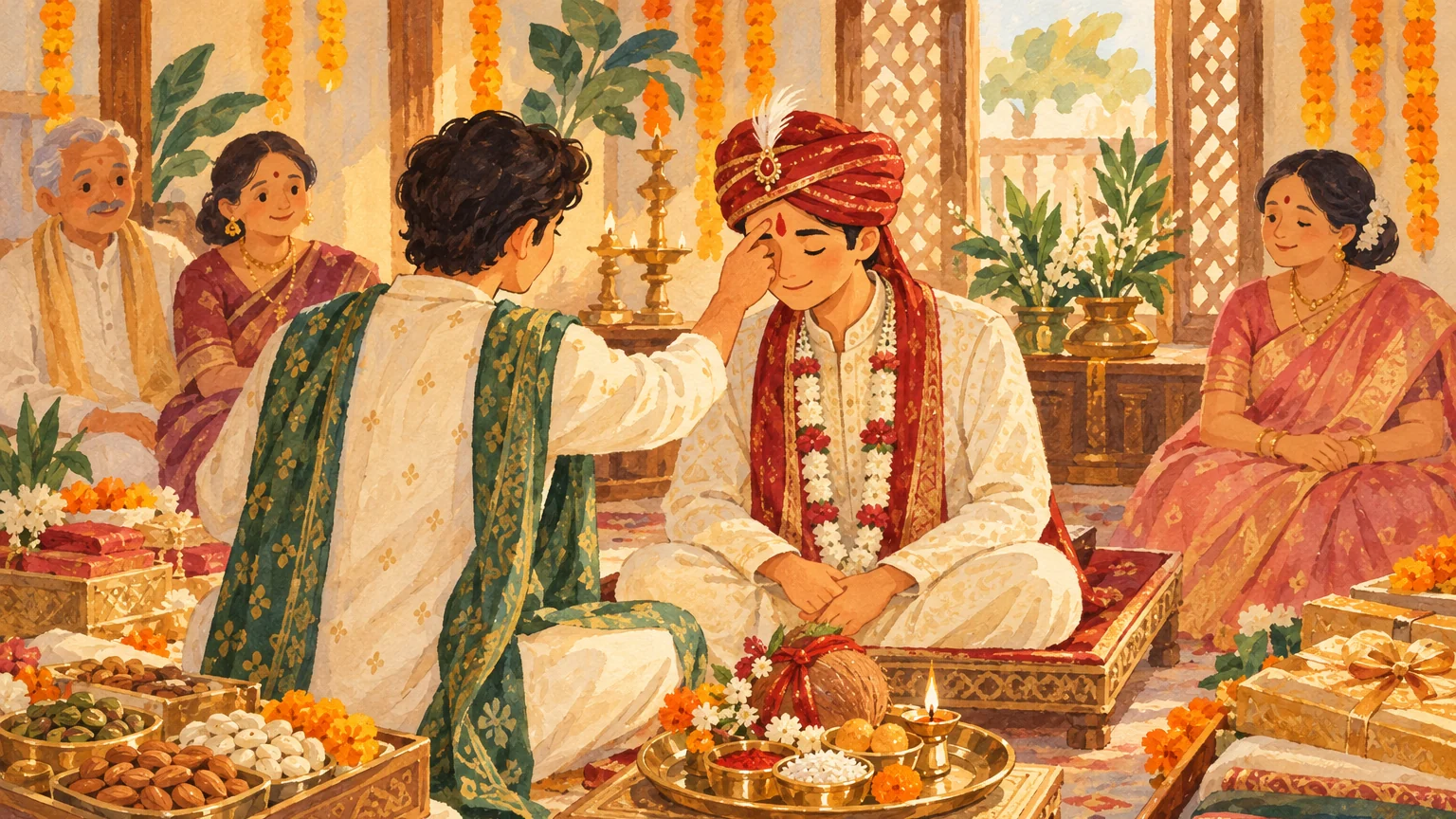
A tilak ceremony invitation is sent by the groom's family, because the tilak is usually at their home: the bride's brother or father and the men of her family put a tilak on the groom and bless him. The card names the groom and the bride's family, gives the day, time and place with a map, and says if a meal follows. In Hindi it is headed तिलकोत्सव. It often shares a day with the sangeet or the ring ceremony.
On this page
- What a tilak ceremony is
- Who comes, and who sends the invitation
- When the tilak falls, and when to send the invitation
- What a bariksha is, and why it is not the wedding
- What to put on a tilak invitation
- The words on a Hindi tilak card
- A tilak invitation in Marathi
- A card, a video or a link
- Sending it on WhatsApp
- How Invifest makes a tilak invitation
- Wording you can copy
- Designs
- Questions
The tilak is the day the bride's family comes to the groom. Her brother or her father puts a tilak of roli and rice on his forehead, the men of her family give him gifts, and from then on he is family. In Uttar Pradesh, Bihar and much of North India it is a function with its own guests and its own invitation, sent by the groom's parents.
This page explains what happens at a tilak and who comes, how to put it on one card with the sangeet or the ring ceremony, what a bariksha is, what goes on the card, and the Hindi words a tilak card uses. Then come card matter in Hindi (in Devanagari and in Roman script), English and Marathi, WhatsApp messages for each kind of guest, and a frame-by-frame script for a short video invitation.
What a tilak ceremony is
A tilak ceremony, written Tilakotsav (तिलकोत्सव) or Tilak Samaroh (तिलक समारोह) on Hindi cards, is a Hindu pre-wedding ritual in which the bride's family formally accepts the groom. The men of her family, led by her brother or her father, go to the groom's home, put a tilak on his forehead and give him gifts. Rajasthani families call it the tika or teeka (टीका), and Marwari families the mudda tikka, which our Marwari wedding guide lists first among their rituals.
The idea is an old one. Every year devotees from Janakpur in Nepal, Sita's home, carry the tilak to Ayodhya for the Ram-Janaki wedding, with sweets, fruit, dry fruit and clothes, as PTI reported in November 2024. The bride's side brings the tilak to the groom's side. A family's tilak works the same way.
What happens at a tilak
- A pujaMany families begin with a short puja or a havan, led by a priest, at the groom's home. A few hold the whole tilak at a temple.
- The tilakThe bride's brother or father puts roli or kumkum on the groom's forehead with a few grains of rice, and the elders of her family bless him one by one.
- The giftsThe bride's side gives the groom clothes, sweets, fruit and dry fruit, and often the clothes, shoes and jewellery he will wear at the wedding. In Bihar the bride's side also brings a decorated water pot and thaals of unpolished rice, betel nuts and whole turmeric.
- The gifts backThe groom's parents send something back with the bride's family. In Bihar this can be trays for the bride: a nath, a maang tikka and clothes for her wedding.
- The mealThe function ends with lunch or dinner for both families and the groom's guests.
Who comes, and who sends the invitation
The groom's family hosts the tilak, so the invitation is theirs. It goes to the people they want there: grandparents, uncles, aunts and cousins, neighbours, friends, and in a village or a small town, a good part of the neighbourhood.
| Who | What they do | What to send them |
|---|---|---|
| The groom's parents | Host the tilak at their home or in a hall | They send the invitation |
| The groom's relatives, neighbours and friends | Watch the tilak, bless the groom, stay for the meal | The card or the message, with the time and a map |
| The bride's father, brothers and uncles | Come to put the tilak on the groom and give the gifts | Not a card. A call, then the time, the address and a map pin, so they arrive on time |
| The bride | Traditionally does not attend | Nothing, unless the families have decided she comes |
| The women of the bride's family | Stay back in many families; some now come along | Agree it between the two families first |
Families differ most on the last two rows. In some homes the bride's mother does not go either; in others the bride and the women of both families sit together through the tilak. Settle it before the card goes out, and if the bride is coming, word the card for both of them.
If each side sends its own invitation, the tilak goes on the groom's side. The bride's side card usually leaves it off, because her family's guests are not hosted at it; her father, brothers and uncles get the time, the address and the map pin directly.
When the tilak falls, and when to send the invitation
There is no fixed day. Some families hold the tilak weeks or months before the wedding, as the formal engagement. Others hold it in the last days, before the haldi and the mehndi. Many now put it on the same day as the ring ceremony. The tilak invitations we made this season show the range:
- Five days before. A tilak at two in the afternoon at the groom's home, and the wedding five days later in a hall in the next city.
- Three days before, after a puja. One family held a two-day Akhand Ramayan puja, then the tilak at half past four, three days before the baraat. They changed the word on the card from Shagun to Tilak and back again: the same day goes by both names, and each side's elders may know it by a different one.
- With the engagement. One groom's family had the engagement and the tilak an hour apart on one evening, with the bariksha the same night.
- With the sangeet. Another family put the tilak at ten in the morning and the sangeet at eleven on a single card.
If the tilak has a card of its own, send it two to three weeks ahead, after calling the elders. If it is on the wedding card, list it first among the functions with its own time and place, because it is usually the first one guests come to. Either way, send a short reminder the evening before with the time and the map.
If the tilak is months before the wedding and the wedding date is already fixed, add one line with it. It is the first thing everyone at a tilak asks.
Two functions on one card
Among the families we spoke to this October who had a tilak, most held it on the same day as another function. On the card, they did it in two ways:
- "Tilak & Sangeet" as one entry. One heading, the day and the venue once, then the tilak's time and the sangeet's time under it. One family put both on a single page, at one venue.
- "Engagement & Tilak" as a day of its own. The ring ceremony, the tilak and the bariksha on one day, for all the guests, under that one title, with the wedding invitation sent separately, later.
Either way, give every ritual its own time, and one map if they share a venue. The wording for both is below.
What a bariksha is, and why it is not the wedding
Bariksha (बरीक्षा, also written barichha or beriksha) is a ceremony that fixes the match, held by many families in Uttar Pradesh. Close family from the bride's side come to the groom's family, at home or in a hall, with gifts and auspicious things such as a coconut and sweets. A priest leads a short puja, and the groom accepts the gifts. Today it often takes the place of the engagement, and it can share a day with the ring ceremony and the tilak: one family this season held all three on one day, for all its guests.
It is not the wedding. The word confuses people who do not use it, and the question is always the same: is this the shaadi? On one family's call this season, we asked it ourselves. So put a short line under the name, such as "Bariksha: the bride's family blesses the groom and the match is fixed", and if the wedding is on a later date, say that its invitation will follow.
What to put on a tilak invitation
| Line | What to write | On a Hindi card |
|---|---|---|
| The blessing | Shri Ganeshaya Namah, or your family deity | ॥ श्री गणेशाय नमः ॥ |
| The elders | The grandparents whose blessing the card carries, if you want them named | पूज्य [दादाजी] एवं [दादीजी] के आशीर्वाद से |
| In memory | "In loving memory of Late Shri [name]", for a grandparent who has passed, if your family wants the line | स्व. श्री [नाम] की पुण्य स्मृति में |
| The groom | His name, as the son of his parents, with his degree or title after it if your family prints one | चि. [नाम] ([उपाधि]), सुपुत्र श्रीमती [नाम] एवं श्री [नाम] |
| The bride's family | Her name, her father's name and their town: they are the ones bringing the tilak | सौ. कां. [नाम], सुपुत्री श्री [नाम], [शहर] |
| The ceremony | Tilak, Tilakotsav or Tilak Samaroh, as your family says it | तिलकोत्सव |
| Day, date and time | When the tilak begins, not when the food is served | [दिन], [तिथि], [समय] बजे |
| The place | The house or the hall, with a map pin on the gate | स्थान: [पता] |
| The meal | Lunch or dinner after the tilak, so guests do not eat before they come | प्रीतिभोज: [समय] से |
| The hosts and the family | The parents, then the wider family and the children's line | विनीत, दर्शनाभिलाषी, स्वागतोत्सुक, बाल मनुहार |
| A number | One or two numbers for relatives with questions | संपर्क: [नंबर] |
The words on a Hindi tilak card
Hindi cards use a set of words every relative recognises. These are the ones a tilak card needs; our Hindi wedding card guide explains the rest of the card.
| Hindi | Read as | Means |
|---|---|---|
| तिलकोत्सव | Tilakotsav | The tilak ceremony, as a celebration: the usual heading |
| तिलक समारोह | Tilak samaroh | The tilak ceremony, a plainer heading |
| चि. | Chi., for chiranjeev | Before the groom's name: may he live long |
| सौ. कां. | Sau. Kaa., for saubhagyakankshini | Before the bride's name: she who wishes for a happy married life |
| सुपुत्र / सुपुत्री | Suputra / suputri | Son of / daughter of |
| प्रीतिभोज | Preetibhoj | The meal after the ceremony |
| विनीत | Vineet | Humbly: the hosts' names follow |
| दर्शनाभिलाषी | Darshanabhilashi | Those who long to see you: the wider family |
| स्वागतोत्सुक | Swagatotsuk | Those eager to welcome you: brothers, sisters and cousins |
| बाल मनुहार | Baal manuhar | A line from the children of the house |
A tilak invitation in Marathi
Marathi has the word टिळा (tila) for the mark itself, and some Marathi families use it for the day the match is fixed. A Marathi engagement is more often the sakharpuda, when the groom's family gives the bride a packet of sugar and a saree and the bride's family gives the groom a coconut and a coin. If the day your family is holding is the sakharpuda, call it that on the card. The elders will read it by that name.
A tilak worded in Marathi keeps the Marathi conventions: चि. before the groom's name, चि. सौ. कां. before the bride's, सहकुटुंब सहपरिवार for 'with your whole family', स्नेहभोजन for the meal and आपले नम्र above the hosts' names. A full card and a short message are in the wording below, and the Marathi wedding card guide covers the rest of the Lagna Patrika.
A card, a video or a link
A card or an image suits a tilak at home with family and neighbours. Every card and message on this page is free to copy, with a Copy button, and card makers such as Crafty Art have tilak designs to put the words on. Our guide to free invitation makers compares them.
A short video works when you want something families will forward. Keep it to thirty or forty-five seconds, put the groom's name and the date in the first five seconds, and end on a frame that holds still with the day, the time and the place, so it can be paused and read. Send the map in a separate message, because nobody can tap a map inside a video. A script is in the wording below, and our guide to the wedding invitation video covers who makes them.
A link suits a tilak that is one of several functions. Each function has its own time and map, guests reply with how many are coming, and if a time changes, it changes for everyone at once.
Sending it on WhatsApp
- Call the elders firstGrandparents, the eldest uncles and anyone who would mind hearing about it from a forward. Then send the card or the link.
- Send the bride's family the practical detailsThey do not need the card. They need the time, the address, a map pin on the gate and a number to call if they lose the way.
- Start with the guest's nameA message that opens with 'Namaste [Name] ji' gets read. A card forwarded without a word often does not.
- Remind everyone the evening beforeThe time, the map and one line about the meal.
Inviting some people only to the tilak, or only to the wedding? Our guide to inviting guests to selected functions shows how to word it, and sending invitations on WhatsApp covers lists, link previews and pacing.
How Invifest makes a tilak invitation
Invifest makes invitations and guest management for weddings and every big moment: our designers make each family its own invitation website, with every function and every reply on one link. For a tilak, that means:
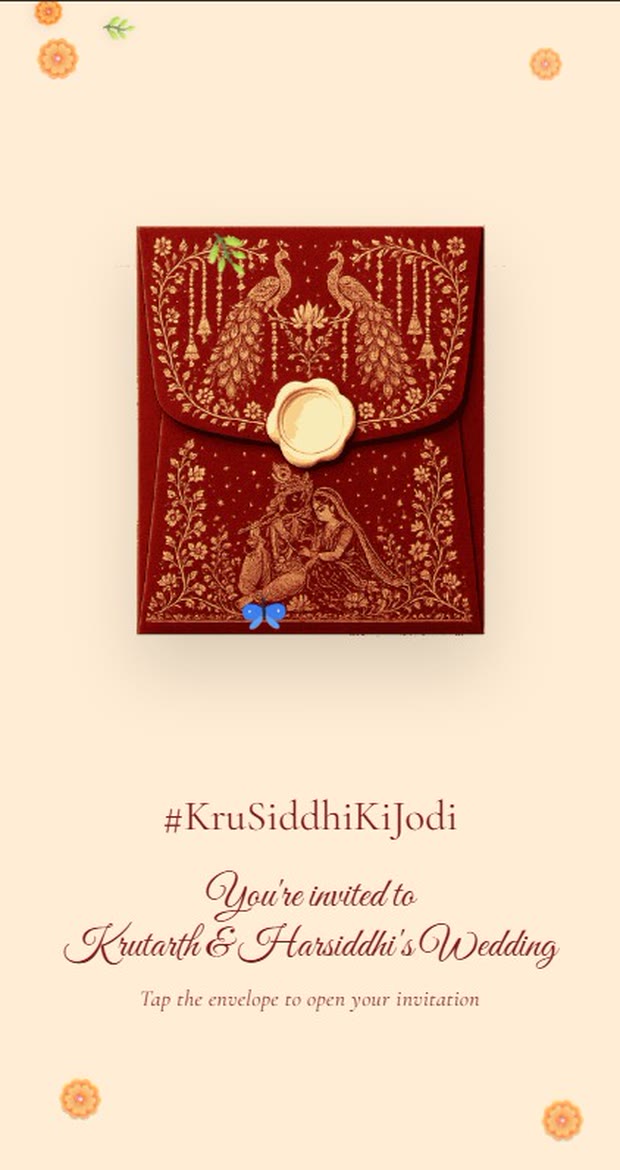
- The tilak on its own card. Its day, time, venue, map button and the meal after. Sindoori keeps the look of the old Hindi card, sindoor red with a seal, and gives each function a card of its own with its time, a map button and a reply form. If the tilak shares an evening with the ring ceremony, Morpankh, our engagement design, has a card for each ritual.
- Two functions as one entry, when they share a day: "Tilak & Sangeet" or "Engagement & Tilak" under one heading, with each ritual's own time.
- The groom's side link. If the bride's family invites its own guests, they get a link of their own in the same design, with their names first and only their functions, so the tilak stays on the groom's side.
- Names the way your family writes them. The grandparents' blessing, "In loving memory of Late Shri", the groom's title after his name, and Hindi and English on one link on the designs that carry the switch.
- Replies for the meal. On the reply form, where the design has one, guests say whether they are coming to the tilak and how many. With Aangan, every guest gets a personal link with only their functions, sent from your own WhatsApp, and you see who is coming to which.
- The two of you on the card, if you like. Families asked for the couple's art on the tilak card too: our caricature add-on draws you from your photos into every ceremony card.
- Ready in 3 days. The first version within 3 days of your complete details for most designs, or in under 24 hours on request. The tilak is usually the first function guests come to, so settle it first.
The other functions of the family have guides of their own: the roka, the mayra and bhaat, and every function in order in Indian wedding functions.
Tilak invitation wording you can copy
Hindi first, in Devanagari and in Roman script, then English, Marathi, WhatsApp messages and a video script. Change the names, dates, times and places in [brackets], list rituals that share a day in the order your family holds them, and have an elder read the final card.
॥ श्री गणेशाय नमः ॥
सादर निमंत्रण
पूज्य [दादाजी का नाम] एवं [दादीजी का नाम] के आशीर्वाद से
हमारे सुपुत्र
चि. [वर का नाम]
का शुभ विवाह
सौ. कां. [वधू का नाम]
सुपुत्री श्रीमती [नाम] एवं श्री [नाम], [शहर]
के साथ होना निश्चित हुआ है।
इस शुभ अवसर पर
तिलकोत्सव
[दिन], [तिथि] को [समय] बजे
[स्थान का नाम], [शहर] में आयोजित है।
आप सपरिवार पधारकर वर को आशीर्वाद प्रदान करें।
प्रीतिभोज: [समय] से
विनीत: श्रीमती [नाम] एवं श्री [नाम]
दर्शनाभिलाषी: [परिवार के सदस्यों के नाम]
स्वागतोत्सुक: [भाई-बहनों के नाम]
बाल मनुहार: "मेरे चाचू के तिलक में ज़रूर आना" - [बच्चों के नाम]
|| Shri Ganeshaya Namah ||
Sadar Nimantran
Pujya [Dadaji ka naam] evam [Dadiji ka naam] ke aashirwad se
hamare suputra
Chi. [Var ka naam]
ka shubh vivah
Sau. Kaa. [Vadhu ka naam]
suputri Shrimati [Naam] evam Shri [Naam], [Shehar]
ke saath hona nishchit hua hai.
Is shubh avsar par
Tilakotsav
[Din], [Tithi] ko [Samay] baje
[Sthaan ka naam], [Shehar] mein aayojit hai.
Aap sapariwar padharkar var ko aashirwad pradaan karein.
Preetibhoj: [Samay] se
Vineet: Shrimati [Naam] evam Shri [Naam]
Darshanabhilashi: [Parivar ke sadasyon ke naam]
Swagatotsuk: [Bhai-behnon ke naam]
Baal Manuhar: "Mere chachu ke tilak mein zaroor aana" - [Bachchon ke naam]
॥ श्री गणेशाय नमः ॥
तिलकोत्सव
चि. [वर का नाम]
सुपुत्र श्रीमती [नाम] एवं श्री [नाम]
[दिन, तिथि] · [समय] बजे
[स्थान], [शहर]
आप सपरिवार सादर आमंत्रित हैं।
विनीत: [परिवार का नाम]
मंगल कार्यक्रम
तिलकोत्सव: [दिन, तिथि], [समय], [स्थान]
हल्दी: [दिन, तिथि], [समय]
मेहंदी एवं संगीत: [दिन, तिथि], [समय]
बारात प्रस्थान: [दिन, तिथि], [समय], [स्थान] से
पाणिग्रहण: [दिन, तिथि], शुभ मुहूर्त [समय]
प्रीतिभोज: [दिन, तिथि], [समय] से
॥ श्री गणेशाय नमः ॥
सगाई एवं तिलकोत्सव
चि. [वर का नाम]
संग
सौ. कां. [वधू का नाम]
[दिन], [तिथि]
बरीक्षा: [समय]
तिलक: [समय]
सगाई: [समय]
प्रीतिभोज: [समय] से
[स्थान], [शहर]
आप सपरिवार सादर आमंत्रित हैं।
विवाह का निमंत्रण अलग से भेजा जाएगा।
विनीत: [परिवार का नाम]
Shree Ganeshaya Namah
With the blessings of our elders,
Mrs [Mother's name] and Mr [Father's name]
invite you and your family
to the Tilak ceremony of their son
[Groom's name]
The tilak will be performed by the family of
[Bride's name], daughter of Mrs [Name] and Mr [Name], [City]
[Day, Date] · [Time]
[Venue]
Dinner follows.
[Groom's name]'s Tilak
[Bride's name]'s family is coming to bless him and make it official, and we want you there.
[Day, Date] · [Time]
[Venue], map: [link]
Lunch after the tilak.
[Groom's name] and [Bride's name]
Tilak · [Time]
Ring ceremony · [Time]
Dinner · from [Time]
[Day, Date]
[Venue]
Please come for both. The map is here: [link]
Engagement & Tilak
[Groom's name] and [Bride's name]
[Day, Date]
Bariksha · [Time]
Tilak · [Time]
Ring ceremony · [Time]
Dinner · from [Time]
[Venue], [City]
At the bariksha, [Bride's name]'s family blesses [Groom's name] and the match is fixed. The wedding invitation will follow.
Tilak & Sangeet
[Day, Date] · [Venue]
Tilak · [Time]
Sangeet · [Time]
One map for both: [link]
॥ श्री गणेशाय नमः ॥
सस्नेह निमंत्रण
आमचे चिरंजीव
चि. [वराचे नाव]
यांचा टिळा समारंभ
चि. सौ. कां. [वधूचे नाव]
(कन्या श्री. [वडिलांचे नाव], [गाव])
यांच्या कुटुंबीयांकडून
[वार], [दिनांक] रोजी [वेळ] वाजता
[ठिकाण] येथे होणार आहे.
या शुभप्रसंगी आपण सहकुटुंब सहपरिवार उपस्थित राहावे, ही नम्र विनंती.
स्नेहभोजन: [वेळ] पासून
आपले नम्र,
[आई-वडिलांची नावे]
नमस्कार!
चि. [नाव] यांचा टिळा [वार], [दिनांक] रोजी [वेळ] वाजता आहे. आपण सहकुटुंब नक्की या.
वेळ, पत्ता आणि नकाशा या लिंकवर: [लिंक]
[नाव]
नमस्ते [नाम] जी,
[दिन, तिथि] को हमारे बेटे [नाम] का तिलक है, [समय] बजे, [स्थान] पर। आप परिवार सहित ज़रूर आइए, तिलक के बाद भोजन भी है।
समय, पता और नक्शा इस लिंक पर: [लिंक]
[आपका नाम]
Namaste [Naam] ji,
[Din, Tithi] ko [Naam] ka tilak hai, [Samay] baje, [Sthaan] par. Aap parivar sahit zaroor aaiye, tilak ke baad khana bhi hai.
Details aur map: [link]
[Aapka naam]
प्रणाम [नाम] जी,
तिलक के लिए [दिन, तिथि] को [समय] बजे आप सबकी प्रतीक्षा रहेगी।
घर का नक्शा: [लिंक]
रास्ते में कोई परेशानी हो तो [नंबर] पर फ़ोन कर लीजिए।
[आपका नाम]
Hi [Name],
[Groom's name]'s tilak is on [Day, Date] at [Time]. It is the ceremony where [Bride's name]'s family comes to bless him, and it ends with dinner. We would love you there.
Address and map: [link]
Frame 1: ॥ श्री गणेशाय नमः ॥
Frame 2: तिलकोत्सव
Frame 3: चि. [वर का नाम]
Frame 4: [दिन, तिथि] · [समय] बजे
Frame 5: [स्थान], [शहर]
Frame 6: आप सपरिवार सादर आमंत्रित हैं। विनीत: [परिवार का नाम]
Hold the last frame for five seconds, and send the map in a separate message.
कल [समय] बजे [नाम] का तिलक है।
स्थान: [स्थान]
नक्शा: [लिंक]
आप सबका इंतज़ार रहेगा।
Want these words on a real invitation? See the designs.
Hindu wedding invitation designs
8 designs you can personalise. Open any one to see it full size, with a live demo.


Questions people ask
What is a tilak ceremony?
A Hindu pre-wedding ritual in which the bride's family formally accepts the groom. Her brother or father puts a tilak of roli and rice on his forehead at the groom's home, the men of her family give him gifts, and both families eat together. Hindi cards call it Tilakotsav or Tilak Samaroh, and Rajasthani families the tika.
Who sends the tilak ceremony invitation?
The groom's family, because the tilak usually happens at their home and they host the meal. The bride's family does not need a card, since they are the ones coming to perform the tilak: send them the time, the address and a map pin instead.
What should a tilak ceremony invitation card in Hindi say?
Start with ॥ श्री गणेशाय नमः ॥, then हमारे सुपुत्र चि. [नाम], the bride's name with her family's town, the heading तिलकोत्सव, the day, date, time and place, आप सपरिवार सादर आमंत्रित हैं, the meal after प्रीतिभोज, and the hosts' names after विनीत. A full card is on this page in Devanagari and in Roman script.
Is there free wording or a template for a tilak invitation?
Yes. Every card and message on this page is free to copy, with a Copy button: change the names, dates and place in the brackets. To put the words on a design, card makers such as Crafty Art have tilak templates.
Do women go to the tilak ceremony?
Traditionally the men of the bride's family go and the bride stays at home, and in some families her mother does not go either. Many families now include the bride and the women of both families. Agree it between the two families before the invitation goes out.
How many days before the wedding is the tilak?
There is no fixed gap. Some families hold it weeks or months ahead as the formal engagement, others a few days before the wedding, before the haldi and the mehndi, and many on the same day as the ring ceremony.
How do I write a tilak ceremony invitation in Marathi?
Use चि. before the groom's name and चि. सौ. कां. before the bride's, write यांचा टिळा समारंभ with the day, date, time and place, ask guests to come सहकुटुंब सहपरिवार, give the meal as स्नेहभोजन, and sign with आपले नम्र. If the ceremony is really the sakharpuda, call it that.
What should a tilak invitation video include?
The groom's name and the date in the first five seconds, then the time and the place, and a last frame that holds still long enough to read. Keep it to thirty or forty-five seconds, and send the map in a separate message.
Can the tilak be on the same day as the ring ceremony or the sangeet?
Yes, and many families now hold them together: "Tilak & Sangeet" as one entry, or "Engagement & Tilak" with the ring ceremony and sometimes the bariksha. Give each ritual its own time on the invitation, with the meal after, so relatives know what they are coming for.
What is a bariksha ceremony?
A ceremony, held by many families in Uttar Pradesh, that fixes the match: close family from the bride's side come to the groom's family with gifts, a short puja is held, and the groom accepts the gifts. It is not the wedding. It can share a day with the ring ceremony and the tilak.
Does the tilak go on the bride's side invitation?
Usually not. The groom's family hosts the tilak, so it goes on the groom's side card or link. The bride's father and brothers, who perform it, get the time, the address and a map pin directly.


