

Love marriage wedding invitation: how much of your story to tell, and wording both families are happy with
Love marriage wedding invitation wording in English and Hindi: how much of your story to tell, what to keep off the elders' link, and lines both families like.
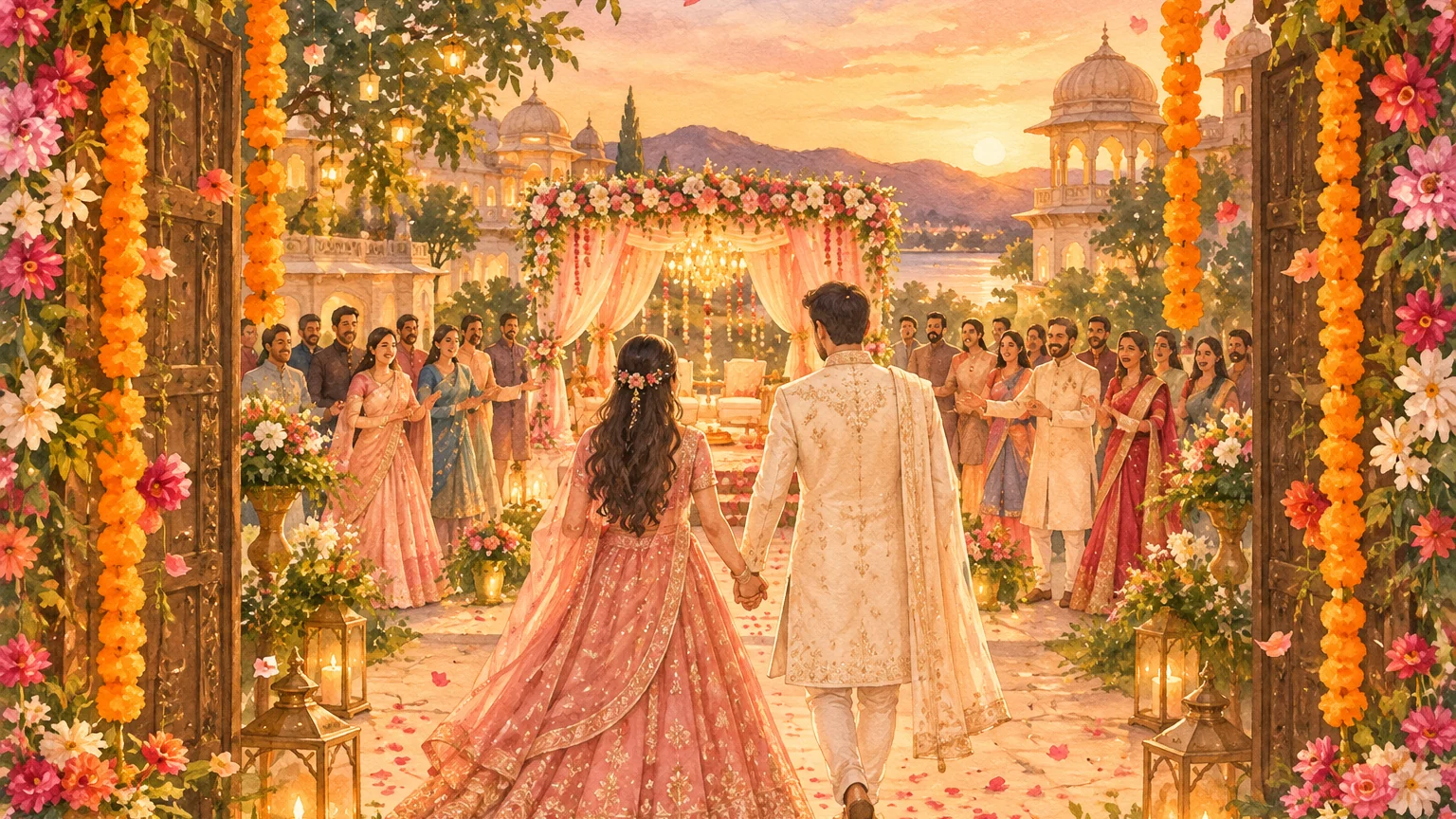
A love marriage invitation still comes from the families: name both sets of parents as hosts and keep the line about the elders' blessings. The story is optional. If you tell it, keep it to two or three true details, such as where you met and both your home cities, put it after the functions, and leave it off the link that goes to relatives who do not know, or to senior colleagues.
On this page
The first thing we ask a couple is 'love or arranged?'. The answer decides whether the invitation has a story at all. Arranged couples usually skip it ('mile hi do baar hain', we have only met twice). Love-marriage couples usually want one, though not always for everyone.
Many families we spoke to this October raised the story: what to tell, how much, and who should not see it. This page covers what they decided, wording that keeps both families comfortable, and lines you can copy in English and Hindi.
Love or arranged: why we ask first
The answer decides whether there is a story section, and often which photos go on the invitation. It is the first fork in the design, so settle it before anything is drawn.
- Arranged: usually no story. A line about the two families is enough, if anything.
- Love marriage, and everyone knows: a short story with small, true details.
- Love marriage, and not everyone knows: the story on the friends' link only, and a traditional invitation for everyone else.
How much of the story to tell
| Not at all | In one line | A short story | |
|---|---|---|---|
| What guests see | A traditional invitation: the families, the functions, the blessings | One line under your names, such as 'Two cities, one story' | Three or four moments: where you met, the first date, the day you told your families |
| Suits | Families where elders are sensitive about it, and formal guest lists | Most families, as a middle path | Couples whose families are happy to share it |
| Where it goes | Nowhere | Under your names, or on the save the date | After the functions, never on the opening screen |
| Photos | None, or one formal photo | A few, such as engagement photos | A few from your years together |
The details couples ask for are small and true: where you met, the first date, both your home cities, a monogram with both initials. Small details read as yours. A long paragraph reads as a speech, and nobody reads a speech on a phone.
When relatives do not know it is a love marriage
One family left the story out because their relatives did not know it was a love marriage. Another kept it from senior colleagues. You do not have to choose between telling everyone and telling no one: give those guests an invitation without the story, and keep it for the friends who were there.
- Neutral words on every version. 'With the blessings of our elders' says nothing about how you met, and is true either way.
- No couple photos on the relatives' version, if the photos give it away.
- The story on the friends' version, with the photos from your years together.
- Links get forwarded. Anyone who has a link sees all of it, so send the friends' version to friends. Our guide to a private wedding website covers the rest.
Elders may not follow the story, and that is fine
On one call a family said their elders could not make out what the story section was for ('kisi ko samajh nahi aa raha'). It is not for them. It is for your friends, and one day for your children. Put it after the functions, so the elders reach the date and the venue first.
Pictures of the story can confuse guests too. When one couple's story art went out, some guests took it for AI, so the family added a sign to the picture: 'This is where it all began'. A caption under every story picture saves a lot of questions.
Two communities, one invitation
Many love marriages join two communities, and the invitation has to belong to both. Three couples on our calls held two wedding ceremonies, one in each family's tradition. Others wrote each side's part in its own script, and checked colours that belong to one side only: red and white, for instance, reads as Bengali.
Give each family its own version, with its own names first and its own functions, in one shared design, so both read as one wedding. Our guides to the bride's side and the groom's side and to two families of different faiths go through each change.
Wording that keeps both families with you
- Both families invite. Name both sets of parents as hosts, even if the two of you planned every detail.
- Keep the invocation and the blessings line that your family's cards always carry. Elders look for them.
- Leave the words 'love marriage' off the card. The story says it, to the guests you choose.
- Speak as a couple only where friends read it. 'We are getting married' suits the friends' version and the save the date; the family's version keeps the parents' voice.
- One line can say it gracefully, if both families are proud of it: 'Our children chose each other, and we gave them our blessings.'
How Invifest does this
Invifest makes invitations and guest management for weddings and every big moment. Our designers make each family its own invitation website, and for a love marriage that means:
- A separate link for each side or group. A traditional version for the relatives, one with your story and photos for friends, and the other family's own version with their names first. Each guest sees only their own functions.
- Your story, as long or as short as you like. How you met, both families, a gallery and one song for the whole invitation, or none of it.
- English and Hindi. On many designs a switch turns the invitation into Hindi for the elders, and each family's version can be in its own language or script.
- Aangan for the guest list. With Aangan you keep every guest in one place, send each one their own invitation from your own WhatsApp, a tap each, and see who is coming to which function. Parts of the invitation can be switched on or off guest by guest, where the design allows it.
- Changes by voice. If an elder wants a line softened after seeing the first version, our newest invitations let you tap the spot and say or type the change. The link you already shared updates by itself.
- Ready in 3 days from the day we have your details, or in under 24 hours on request.
Love marriage invitation wording you can copy
English and Hindi, from the families' traditional version to the friends' version with your story. Change everything in [brackets].
With the blessings of our elders
[Bride's parents' names]
and
[Groom's parents' names]
invite you with your family to the wedding of
[Bride's name]
and
[Groom's name]
[Day, Date] · [Time]
[Venue], [City]
बड़ों के आशीर्वाद से
[वधू का नाम] एवं [वर का नाम]
के शुभ विवाह में
आप सपरिवार सादर आमंत्रित हैं।
[दिन, तिथि] · [समय]
[स्थान], [शहर]
निवेदक
[वधू के माता-पिता के नाम]
[वर के माता-पिता के नाम]
Two cities, one story.
With the blessings of both our families,
[Bride's name] and [Groom's name]
are getting married.
[Day, Date] · [City]
दो शहर, एक कहानी।
दोनों परिवारों के आशीर्वाद से
[वधू का नाम] और [वर का नाम]
विवाह के बंधन में बँधने जा रहे हैं।
[दिन, तिथि] · [शहर]
Our children chose each other,
and we gave them our blessings.
[Parents' names]
invite you to celebrate the wedding of
[Bride's name] and [Groom's name]
[Day, Date] · [Venue]
हमारे बच्चों ने एक-दूसरे को चुना,
और हमने उन्हें आशीर्वाद दिया।
[वधू का नाम] एवं [वर का नाम] के विवाह की खुशियों में
आप सपरिवार सादर आमंत्रित हैं।
[दिन, तिथि] · [स्थान]
[दोनों परिवारों के नाम]
We found each other, and our families said yes.
[Bride's name] and [Groom's name]
[Day, Date] · [City]
With love,
[Both families' names]
We met at [place] in [year].
[One small true detail: the first chai, the first trip, the song you both knew].
[Number] years later, with both our families beside us, we are getting married.
This is where it all began: [place], [year]
यहीं से शुरू हुई थी हमारी कहानी: [जगह], [साल]
With the blessings of both our families
[Bride's name] and [Groom's name]
will be married in two ceremonies:
[First ceremony]: [Day, Date], [Time]
[Second ceremony]: [Day, Date], [Time]
[Venue], [City]
Hi [Name]!
You were there for most of it, so you have to be there for this. We are getting married on [Date].
Everything is here, the functions, the venues and a bit of our story:
[link]
[Your names]
Want these words on a real invitation? See the designs.
Invitation designs
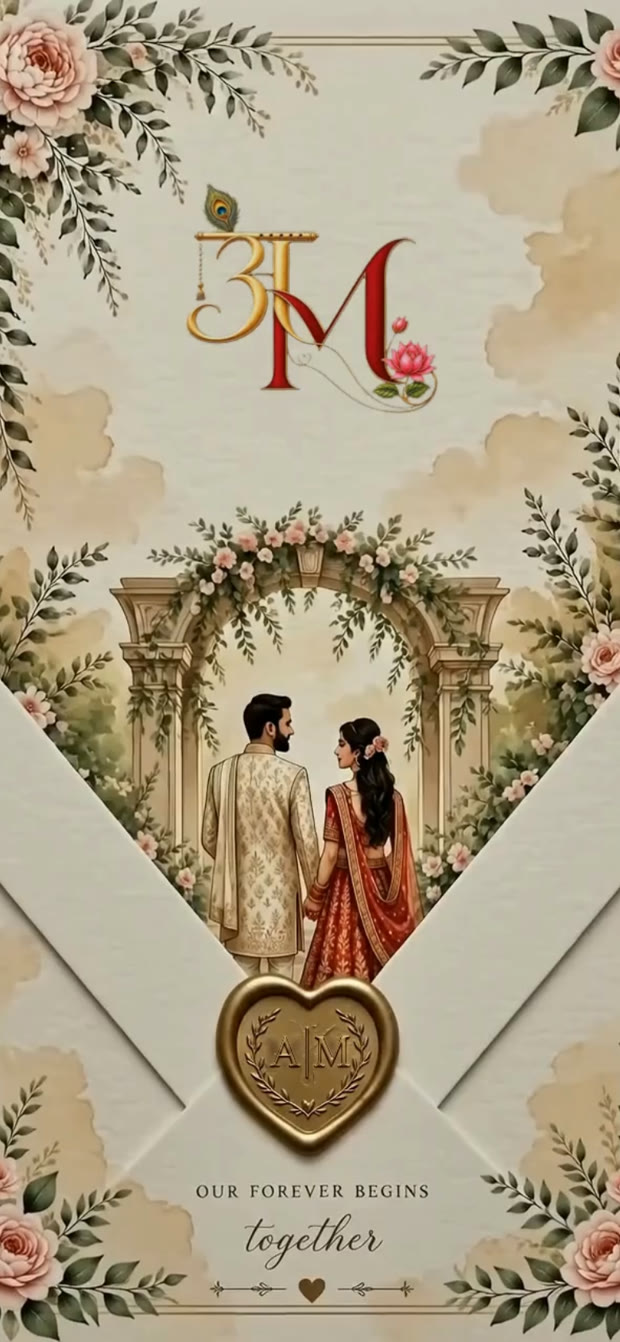
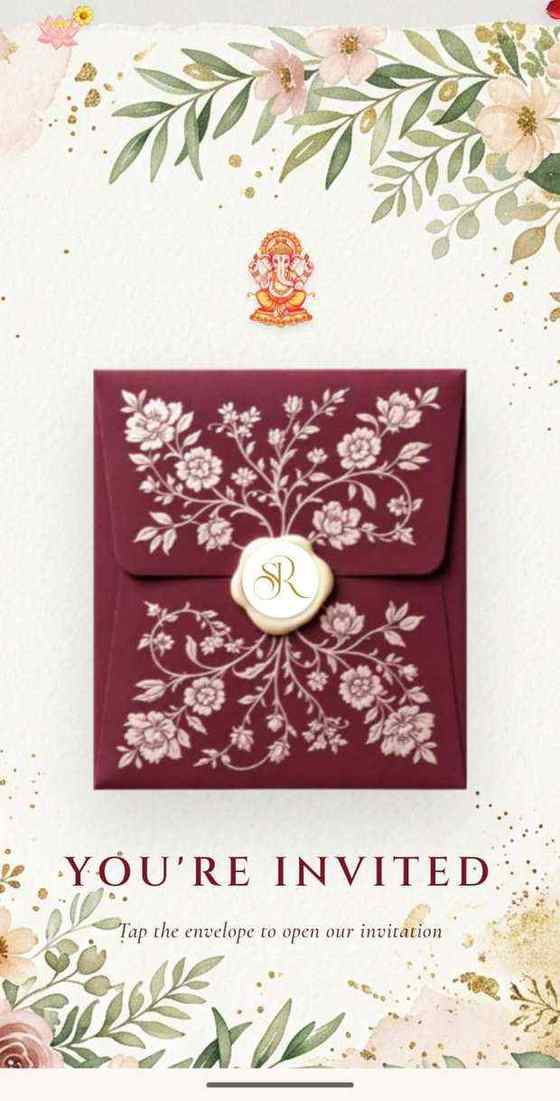
6 designs you can personalise. Open any one to see it full size, with a live demo.

Questions people ask
How do you write a wedding invitation for a love marriage?
The way you write any Indian wedding invitation, with both families inviting: both sets of parents named as hosts, the blessings line, then the couple's names, the date, the functions and the venue. The story is optional and goes after the functions.
Should we mention it is a love marriage on the wedding card?
Not in so many words. 'With the blessings of our elders' is true either way. If both families are proud of it, one line from the parents says it gracefully: 'Our children chose each other, and we gave them our blessings.'
How do we put our love story on the wedding invitation?
In three or four small, true moments: where you met, the first date, the day you told your families, both your home cities. Put it after the functions, keep each moment to a line or two, and add a caption to any picture of a real place.
What if our relatives do not know it is a love marriage?
Send them a version without the story, and without couple photos if the photos give it away, and keep the story on the version that goes to friends. You do not have to delete it for everyone.
Who should invite on a love marriage card, the couple or the parents?
On the family's invitation, the parents of both sides, as on any Indian card. On the friends' version or the save the date, the two of you can invite in your own voice.
How long should the how-we-met story be?
Short enough to read in half a minute on a phone: three or four moments. Elders will skip it and friends will read every word, so keep it short for both.
Can different guests see different versions of our invitation?
Yes. With Invifest each side or group of guests can have its own link: a traditional one for relatives, one with your story and photos for friends. Each guest sees only their own functions.
What if our families come from different communities?
Give each family its own version, with its names first, its language or script and its ceremonies, in one shared design. Check the colours and symbols that belong to only one side before you send.
Is a love cum arranged marriage invitation any different?
No. It is a family wedding invitation like any other. Say it in one line if you want to, such as 'We found each other, and our families said yes', or leave it out.


